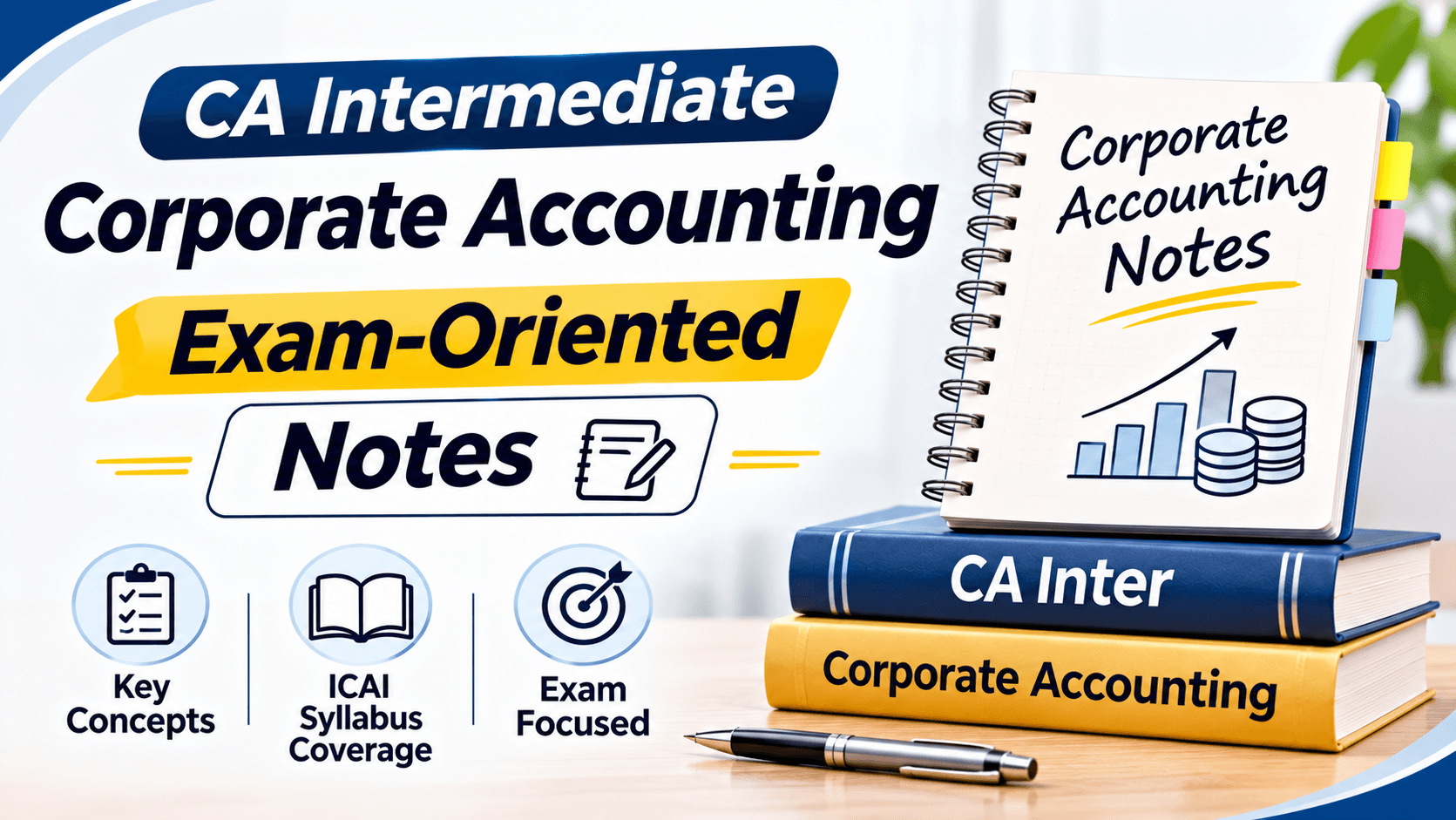
Exam-Oriented CA Intermediate Corporate Accounting Notes
Prepare CA Intermediate Corporate Accounting with exam-oriented notes, structured chapter revision, accounting treatment practice, presentation checks and a clear…
In this article(13 sections)ShowHide
Corporate Accounting preparation requires students to understand accounting treatments, apply the correct steps, and present workings clearly. Notes are most useful when they help you revise the logic behind a treatment and remind you how to approach questions, rather than simply repeating textbook paragraphs.
Use this structure to create exam-oriented notes alongside the current ICAI study material and applicable syllabus for your attempt. Accounting standards, syllabus coverage, and examination requirements should always be checked against the relevant official material.
What makes notes exam-oriented
Good notes answer three questions: what is the accounting issue, which treatment applies, and how should the working be presented? Include the concept, sequence of steps, journal entries or formats where applicable, and common mistakes from practice.
Close your notes after this topic and check what you can recall or apply independently. Record any gap and schedule a follow-up review rather than marking the topic complete based only on reading.
Organise notes around the current syllabus
Make a chapter checklist from the current official syllabus. For each chapter, mark whether you have learned the concept, reviewed the treatment, solved questions, and revisited errors. This keeps the notes aligned with the examination rather than an outdated chapter list.
Close your notes after this topic and check what you can recall or apply independently. Record any gap and schedule a follow-up review rather than marking the topic complete based only on reading.
Write the logic behind each treatment
Avoid memorising a format without understanding why the entries or calculations are required. Add a short explanation of the accounting logic and note conditions that change the treatment. Understanding helps you adapt when a question varies the facts.
Close your notes after this topic and check what you can recall or apply independently. Record any gap and schedule a follow-up review rather than marking the topic complete based only on reading.
Use standard formats and consistent working
Where a topic requires a statement, schedule, journal entry, or calculation, record a clean format that you can reproduce under time pressure. Label figures, show calculations in order, and use consistent terminology so errors are easier to locate.
Close your notes after this topic and check what you can recall or apply independently. Record any gap and schedule a follow-up review rather than marking the topic complete based only on reading.
Compare similar accounting treatments
If similar situations use different treatments, compare them side by side. Note the triggering condition, treatment, working required, and usual trap. Confirm technical points against the study material applicable to your attempt.
Close your notes after this topic and check what you can recall or apply independently. Record any gap and schedule a follow-up review rather than marking the topic complete based only on reading.
Practise questions after each topic
After revising a concept, solve questions without looking at the solution. Start with direct applications and then move to questions that combine concepts. Check the reasoning, entries, and presentation—not just the final number.
Close your notes after this topic and check what you can recall or apply independently. Record any gap and schedule a follow-up review rather than marking the topic complete based only on reading.
Keep an error register
Record whether an error came from a misunderstood concept, incorrect entry, wrong classification, arithmetic mistake, missing adjustment, or poor presentation. Write the correction and reattempt the question after a gap.
Close your notes after this topic and check what you can recall or apply independently. Record any gap and schedule a follow-up review rather than marking the topic complete based only on reading.
Use short chapter summaries
At the end of each chapter, create a concise recap with the main treatment, important steps, formats, and common adjustments. Avoid rewriting the whole chapter. The purpose is to make second revision faster.
Close your notes after this topic and check what you can recall or apply independently. Record any gap and schedule a follow-up review rather than marking the topic complete based only on reading.
Revise with active recall
Close the notes and write the steps for a treatment, reproduce a format, or explain why an entry is required. Compare your attempt with the source and correct omissions. This tests whether you can retrieve the method without visual prompts.
Close your notes after this topic and check what you can recall or apply independently. Record any gap and schedule a follow-up review rather than marking the topic complete based only on reading.
Improve time management
Use short timed sets before attempting full papers. Track where time is lost: understanding the question, selecting the treatment, calculating, or presenting the answer. Practise the weakest stage and review calculations where possible.
Close your notes after this topic and check what you can recall or apply independently. Record any gap and schedule a follow-up review rather than marking the topic complete based only on reading.
Check technical accuracy and updates
Use official study material and applicable updates for your attempt. Notes shared online may be incomplete or based on an earlier syllabus. Label session-specific points and verify technical details before final revision.
Close your notes after this topic and check what you can recall or apply independently. Record any gap and schedule a follow-up review rather than marking the topic complete based only on reading.
Use Studycaller as part of accounting preparation
Use relevant Studycaller resources alongside official material, independent question solving, and an error register. The aim is to improve application and presentation, not merely increase the number of pages revised.
Close your notes after this topic and check what you can recall or apply independently. Record any gap and schedule a follow-up review rather than marking the topic complete based only on reading.
Quick Revision Table
| Notes section | What to record | Revision benefit |
|---|---|---|
| Core concept | Purpose and accounting logic | Builds understanding |
| Treatment steps | Sequence and conditions | Supports application |
| Format/workings | Clean layout and labels | Improves presentation |
| Common errors | Mistake and correction | Targets weak points |
| Practice status | Questions attempted and reviewed | Shows readiness |
CA Inter Accounting standards notes
Free notes from the Studycaller library, picked for this article.
 Handwritten
CA Inter · Advanced Accounting
CA Inter May24 Adv account ✔️Revenue based accounting standards ✔️ Other accounting standards
Sakshi KhandveLikes 7Views 9k Detailed Notes
CA Inter · Advanced Accounting
Advanced Accounting Reviewer Part 1 Accounting Standards With Index CA Inter
Monish KannaLikes 12Views 15.7k Summary
CA Inter · Advanced Accounting
CA - INTERMEDIATE JK SHAH : ADVANCED ACCOUNTING NOTES ACCOUNTING STANDARDS PART : 2
PriyadharshiniLikes 7Views 12.5k Summary
CA Inter · Advanced Accounting
CA - INTERMEDIATE JK SHAH : ADVANCE ACCOUNTING NOTES Accounting Standards Part : 1
PriyadharshiniLikes 7Views 8.6k
Frequently asked questions
What should exam-oriented notes contain?
Include core concepts, accounting logic, treatment steps, useful formats, key conditions, common errors, and practice references. Verify technical details against the current official material for your attempt.
Are short notes enough?
Short notes support revision but do not replace detailed learning and question practice. You need to understand the treatment and practise applying it to different facts.
How should I prepare accounting formats?
Learn what each format is used for, reproduce it from memory, and practise filling it with figures from questions. Label calculations clearly and check the format against applicable study material.
How can I reduce calculation mistakes?
Show working step by step, label figures, check adjustments, and review the source of each error. Reattempt incorrect questions after a gap to confirm the correction.
Should I memorise accounting treatments?
Remembering steps helps, but understanding why a treatment applies is essential. Note conditions that change the method and practise variations to adapt to unfamiliar questions.
When should I start question practice?
Begin after learning the basic concept. Direct questions build confidence, while mixed questions help you select the right treatment without a chapter label.
How do I use an error register?
Record the topic, type of mistake, correct method, and a date to retry. Review recurring errors each week and practise the specific skill that caused them.
How can I revise a long chapter quickly?
Use a short summary of concepts, treatment steps, formats, and adjustments, then solve selected questions. Avoid rereading every page when your main need is to test application.
Do online notes always match the current syllabus?
No. Notes may be based on older material or omit updates. Check the applicable official syllabus and study resources before using external notes.
How can Studycaller support revision?
Use relevant Studycaller resources alongside official material and independent practice. Test yourself, analyse mistakes, and revisit treatments that remain difficult to apply.