What Is the Ideal Mock Test Strategy for CA Exams? A Complete Guide
Learn what the ideal mock test strategy for CA exams is, with effective planning, revision techniques, answer-writing practice, and performance analysis to improve exam scores.
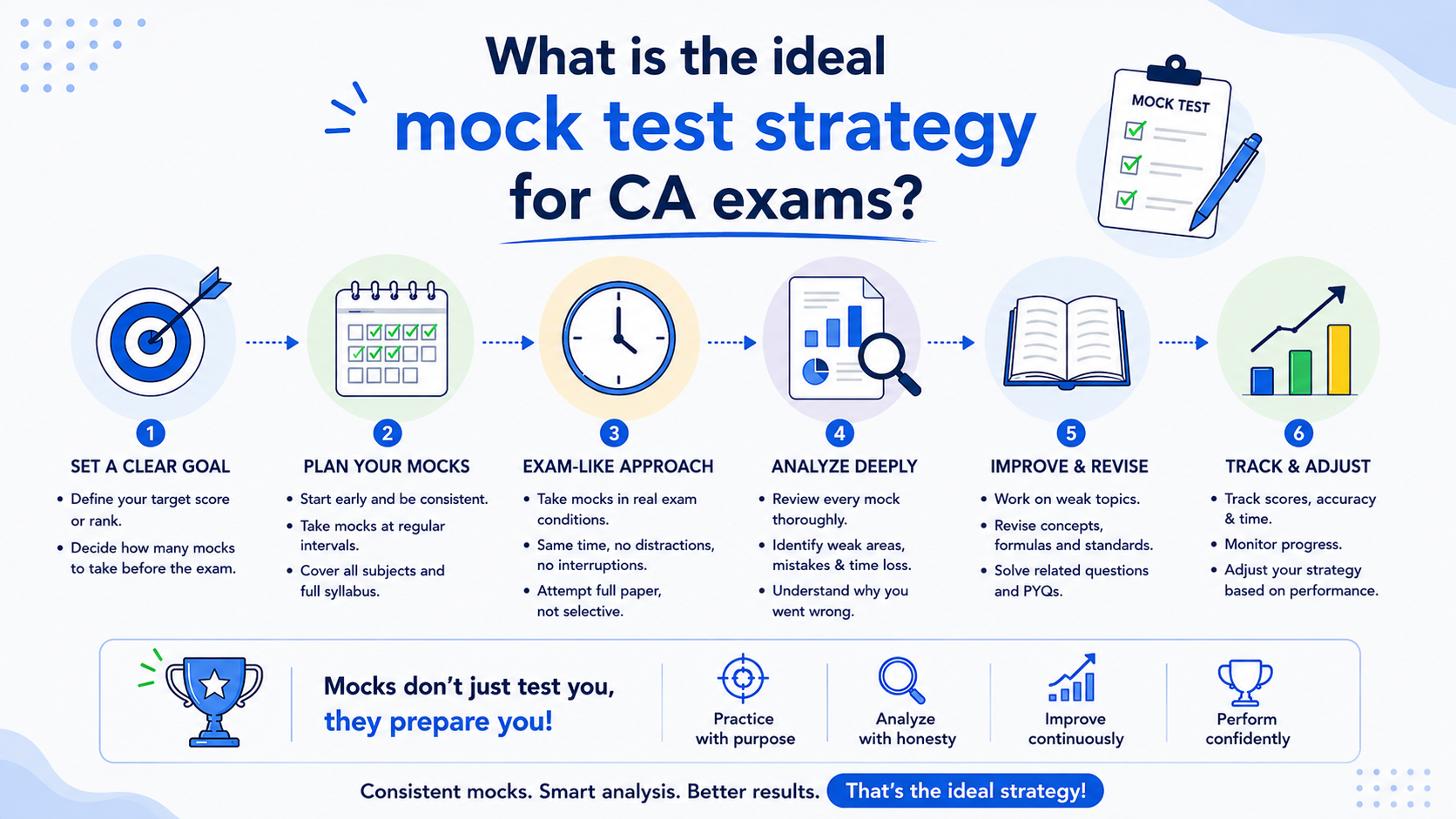
Table of Content
- Start Mock Tests Only After Completing a Major Portion of the Syllabus
- Attempt Mock Tests Under Real Examination Conditions
- What Is the Ideal Mock Test Strategy for CA Exams When Planning the Schedule?
- Focus on Time Management During Every Mock Test
- Analyze Every Mock Test Thoroughly
- Maintain a Mock Test Improvement Notebook
- Use Mock Tests to Improve Answer Presentation
- Revise Before and After Every Mock Test
- Do Not Get Discouraged by Low Mock Test Scores
- Solve ICAI Mock Test Papers and Previous Year Questions
- Monitor Progress Across Multiple Mock Tests
- Balance Mock Tests with Regular Study
- Conclusion
Mock tests have become an essential part of Chartered Accountancy preparation because they bridge the gap between studying concepts and performing well in the actual examination. Many students complete the syllabus and revise multiple times, yet they struggle to score well because they are unfamiliar with writing a complete paper under strict time limits. A mock test provides an opportunity to experience real examination conditions and evaluate preparation before the final exam.
The question "What is the ideal mock test strategy for CA exams?" is important for every CA aspirant who wants to maximize performance. Simply attempting mock papers is not enough. The real benefit comes from planning the tests properly, analyzing mistakes, improving weak areas, and continuously refining the preparation strategy. Students who use mock tests intelligently often enter the examination hall with greater confidence and a much stronger understanding of their strengths and weaknesses.
Start Mock Tests Only After Completing a Major Portion of the Syllabus
One common mistake students make is either starting mock tests too early or postponing them until the last week before the examination.
The ideal approach is to begin full-length mock tests after completing a substantial portion of the syllabus and at least one round of revision. This allows students to evaluate their preparation realistically without feeling overwhelmed. Before attempting the first mock test, ensure that:
- Major chapters are completed.
- Basic concepts are clear.
- Important formulas are revised.
- Short notes are prepared.
- Previous revisions are completed.
This preparation makes mock testing more meaningful.
Attempt Mock Tests Under Real Examination Conditions
Many students pause the timer, refer to books, or discuss answers while writing mock papers. This habit completely defeats the purpose of the exercise. The ideal mock test should replicate the actual CA examination environment. Students should:
- Sit continuously for three hours.
- Keep mobile phones away.
- Avoid referring to notes.
- Follow the official examination timing.
- Attempt every question independently.
Practicing under realistic conditions reduces anxiety and improves confidence for the final examination.
What Is the Ideal Mock Test Strategy for CA Exams When Planning the Schedule?
A structured mock test schedule is far more effective than writing random papers. Students should allocate mock tests according to their preparation stage. A practical approach may include:
- Subject-wise tests after syllabus completion.
- Mixed-topic tests during revision.
- Full-length papers before examinations.
- Weekly mock tests during the final month.
- Multiple revisions between tests.
This gradual progression helps students improve steadily without unnecessary pressure.
Focus on Time Management During Every Mock Test
Many CA students lose marks because they fail to complete the paper within the allotted time. Mock tests provide the perfect opportunity to improve this skill. Students should practice:
- Allocating time according to marks.
- Attempting easy questions first.
- Avoiding lengthy unnecessary explanations.
- Leaving difficult questions temporarily.
- Keeping the last ten minutes for revision.
Effective time management developed during mock tests becomes a major advantage in the final examination.
Analyze Every Mock Test Thoroughly
The biggest learning happens after the mock test, not during it. Unfortunately, many students simply check their marks and move on to the next paper without understanding their mistakes. After every mock test, carefully analyze:
- Incorrect answers
- Weak concepts
- Presentation mistakes
- Time management issues
- Calculation errors
- Questions left unanswered
This analysis helps students improve continuously instead of repeating the same mistakes.
Maintain a Mock Test Improvement Notebook
An improvement notebook can become one of the most valuable study resources during preparation. Students should record:
- Frequently forgotten provisions
- Weak chapters
- Formula mistakes
- Presentation errors
- Common calculation mistakes
- Time management observations
Revising this notebook before every mock test gradually improves performance and confidence.
Use Mock Tests to Improve Answer Presentation
Many students possess strong conceptual knowledge but fail to present answers professionally. Mock tests help students practice:
- Proper headings
- Subheadings
- Underlining keywords
- Working notes
- Logical answer flow
- Concise conclusions
Improving presentation during practice ensures better performance in the final examination. Professional presentation often helps students secure additional marks.
Revise Before and After Every Mock Test
Mock tests should not replace revision; they should complement it. Before attempting a paper, revise important concepts and formulas. After evaluation, revise all incorrect questions again. An effective cycle includes:
- Revision
- Mock test
- Analysis
- Improvement
- Re-revision
This continuous learning process strengthens retention and reduces repeated mistakes.
Do Not Get Discouraged by Low Mock Test Scores
Many students become demotivated after scoring poorly in mock examinations. However, mock tests are designed to identify weaknesses, not judge intelligence. A low score simply indicates areas that require additional practice. Students should treat every mock test as a learning opportunity rather than a final result. Improvement over multiple tests matters far more than performance in a single paper.
Solve ICAI Mock Test Papers and Previous Year Questions
Students should not rely only on private test series. ICAI resources provide the closest experience to the actual examination pattern. Students should regularly practice:
- ICAI Mock Test Papers (MTPs)
- Revision Test Papers (RTPs)
- Previous Year Question Papers
- ICAI Study Material illustrations
These resources help students understand examiner expectations more accurately.
Monitor Progress Across Multiple Mock Tests
Preparation should improve with every mock paper. Students should maintain a performance tracker containing:
- Test scores
- Weak subjects
- Revision status
- Time management performance
- Presentation quality
- Confidence level
Tracking progress helps students measure improvement objectively and modify study strategies whenever necessary. Continuous monitoring keeps preparation focused and organized.
Balance Mock Tests with Regular Study
Some students spend excessive time writing mock papers without strengthening concepts, while others avoid mock tests completely. The ideal balance includes:
- Conceptual study
- Regular revision
- Mock tests
- Performance analysis
- Answer-writing practice
All these elements should work together to create comprehensive preparation. Depending only on one method rarely produces the best results.
Conclusion
The answer to "What is the ideal mock test strategy for CA exams?" lies in combining disciplined practice with continuous improvement. Students should attempt mock tests under real examination conditions, analyze every mistake carefully, strengthen weak areas through revision, and improve answer-writing and time management skills consistently. Mock tests should be viewed as learning opportunities rather than performance evaluations. With proper planning and honest self-assessment, they become one of the most powerful tools for improving CA examination performance and building confidence before the final attempt.

FAQs
What is the ideal mock test strategy for CA exams?
The ideal strategy includes completing the syllabus, revising thoroughly, attempting papers under exam conditions, analyzing mistakes, improving weak areas, and continuously tracking progress throughout preparation.
When should CA students start giving mock tests?
Students should begin full-length mock tests after completing most of the syllabus and at least one round of revision to evaluate preparation effectively.
Should mock tests be attempted under real exam conditions?
Yes. Students should avoid notes, maintain the official time limit, and complete the paper in one sitting to simulate the actual examination environment.
How many mock tests should CA students attempt before exams?
The number varies, but attempting multiple full-length papers along with subject-wise mock tests helps improve confidence, speed, presentation, and examination readiness.
Why is mock test analysis important?
Analyzing mock tests helps identify conceptual weaknesses, presentation issues, calculation mistakes, and time management problems that can be corrected before the final examination.
Can mock tests improve answer-writing skills?
Yes. Regular practice improves answer structure, presentation, writing speed, keyword usage, and logical explanation, leading to better examination performance.
Should students revise after every mock test?
Absolutely. Revising incorrect answers and weak concepts after every mock test helps prevent repeated mistakes and strengthens long-term retention
Is scoring low in mock tests a bad sign?
No. Low scores highlight preparation gaps and provide valuable opportunities for improvement before the actual CA examination.
Should ICAI Mock Test Papers be included in preparation?
Yes. ICAI Mock Test Papers, RTPs, and previous year papers closely reflect the examination pattern and should be an essential part of preparation.
How can students track improvement through mock tests?
Students can maintain a performance tracker recording scores, weak topics, revision progress, presentation quality, and time management to monitor improvement over multiple mock tests.