How to Improve Speed and Accuracy in CA Exams (2026 Complete Guide)
Learn practical strategies to improve speed and accuracy in CA Foundation, Inter, and Final exams with expert tips, smart practice methods, and proven techniques.
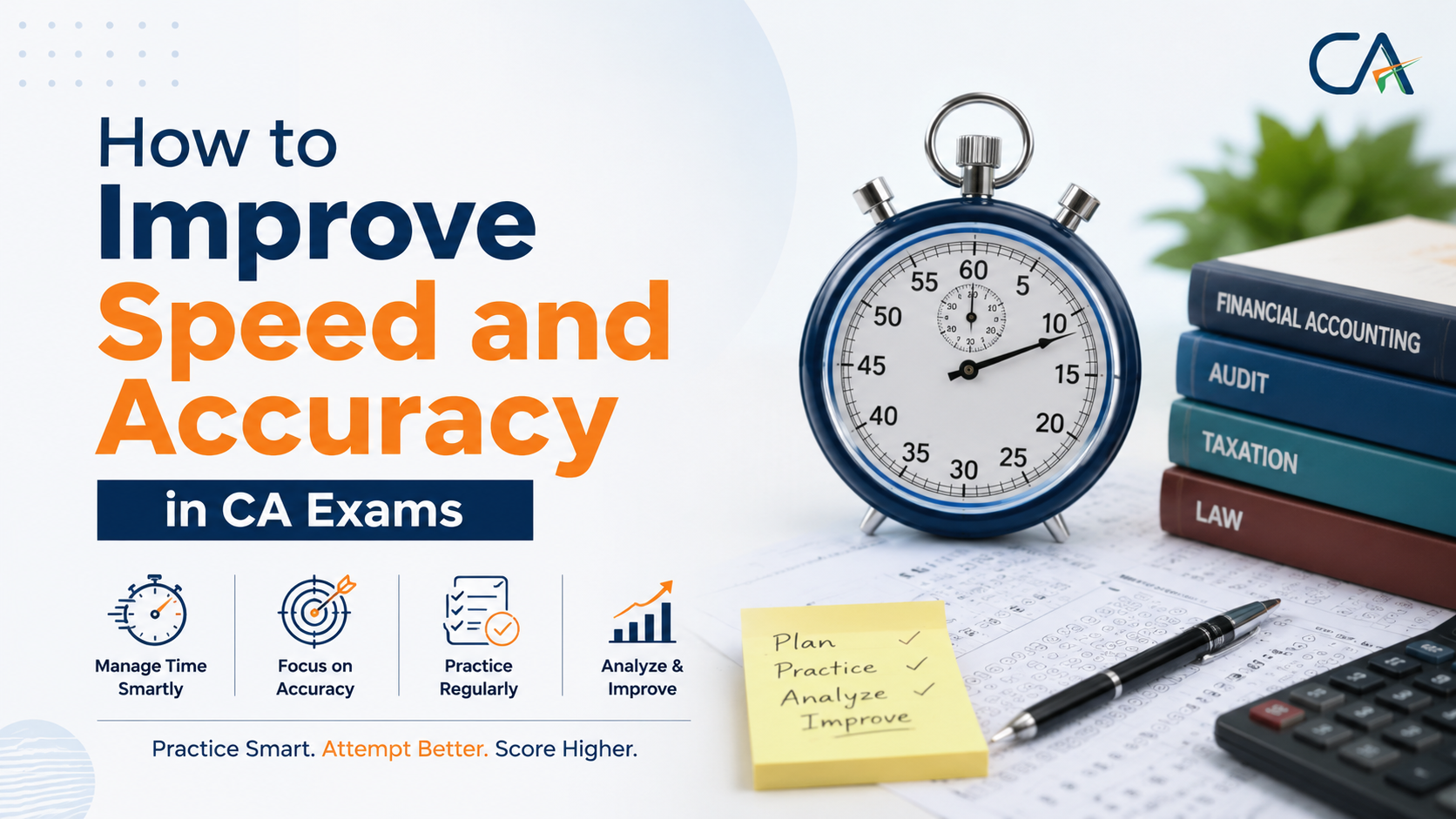
Table of Content
- Why Speed and Accuracy Matter in CA Exams
- Here's why both speed and accuracy are equally important:
- Common Reasons Students Lose Marks
- What Is the Ideal Time Allocation in a 3-Hour CA Exam?
- 10 Proven Ways to Improve Speed and Accuracy in CA Exams
- 1. Practice Full-Length Mock Tests Regularly
- Benefits of Mock Test Practice
- 2. Follow the 1.8-Minute Rule Per Mark
- 3. Strengthen Conceptual Clarity Instead of Memorizing
- 4. Improve Your Writing Speed Without Compromising Presentation
- 5. Solve Previous Year Question Papers Repeatedly
- How Many Previous Papers Should You Solve?
- 6. Master the Art of Question Selection
- Why Does This Strategy Work?
- Recommended Attempt Strategy
- 7. Reduce Calculation Errors
- 8. Build a Daily Writing Practice Routine
- 9. Improve Answer Presentation
- Tips for Better Presentation
- Use Bullet Points
- Underline Keywords
- Draw Proper Working Notes
- 10. Revise Smartly Before the Exam
- Smart Techniques Used by CA Rank Holders
- Weekly Practice Plan to Improve Speed and Accuracy
- Mistakes That Slow Down CA Students
- Best Resources to Improve Speed and Accuracy
- The 30-Day Speed Improvement Challenge
- Final Exam-Day Checklist for Maximum Speed and Accuracy
- Quick Speed & Accuracy Checklist
- Key Takeaways
- Why Choose Studycaller for CA Exam Preparation?
- Conclusion
Preparing for the Chartered Accountancy (CA) examination is not only about understanding concepts—it is equally about applying them efficiently within the limited exam duration. Every year, thousands of CA Foundation, CA Intermediate, and CA Final students walk into the examination hall with excellent preparation but still struggle to complete the paper on time.
The reason isn't always a lack of knowledge.
In most cases, students lose valuable marks because they write too slowly, spend too much time on difficult questions, make calculation mistakes, or fail to manage their time effectively. Even highly prepared candidates sometimes leave 15–20 marks unanswered simply because they couldn't finish the paper.
The good news is that speed and accuracy are skills, not talents. Like accounting, auditing, taxation, or law, these skills can be developed with the right strategy and consistent practice.
Whether you are appearing for CA Foundation, CA Inter, or CA Final, this guide will help you learn practical methods to solve questions faster, reduce errors, and maximize your score in the ICAI examination.
Why Speed and Accuracy Matter in CA Exams
Unlike many competitive examinations, CA papers require students to demonstrate conceptual understanding, presentation skills, calculations, and practical application—all within three hours.
Simply knowing the answer is not enough.
You must also write it clearly, calculate correctly, and finish the entire paper before time runs out.
Here's why both speed and accuracy are equally important:
|
Speed |
Accuracy |
|
Helps complete the entire paper |
Prevents unnecessary mistakes |
|
Allows time for revision |
Improves overall score |
|
Reduces exam pressure |
Builds examiner confidence |
|
Gives time for difficult questions |
Avoids negative impression through careless errors |
Many rank holders consistently mention that their success wasn't because they studied the most hours—it was because they practiced writing under real exam conditions.
Common Reasons Students Lose Marks
Before improving performance, it's important to understand where most students make mistakes.
Spending Too Much Time on One Question
Many students become emotionally attached to a difficult question.
Instead of moving ahead, they continue trying to solve it for 20–25 minutes, affecting the rest of the paper.
Remember:
Every question carries marks, but every minute is equally valuable.
Lack of Writing Practice
Reading notes repeatedly creates confidence but does not build writing speed.
The actual examination requires continuous writing for three hours.
Without practice, your hand speed naturally becomes slower.
Calculation Errors
Simple mistakes like:
- Wrong addition
- Incorrect totals
- Missing decimal points
- Formula mistakes
- Copying wrong figures
can cost valuable marks despite knowing the concept.
Poor Time Management
Some students spend the first 30 minutes overthinking instead of writing confidently.
Others rush through the last hour.
Both situations reduce the overall score.
Lack of Mock Test Practice
Many aspirants complete their syllabus but never attempt full-length mock papers.
As a result, the real examination becomes their first experience of writing under pressure.
What Is the Ideal Time Allocation in a 3-Hour CA Exam?
A proper time management strategy significantly improves your chances of completing the paper.
|
Activity |
Recommended Time |
|
Reading the question paper |
15 Minutes |
|
Attempting easy questions |
75 Minutes |
|
Moderate questions |
60 Minutes |
|
Difficult questions |
20 Minutes |
|
Final Revision |
10 Minutes |
This plan helps maintain a balanced pace throughout the examination.
10 Proven Ways to Improve Speed and Accuracy in CA Exams
1. Practice Full-Length Mock Tests Regularly
Nothing improves exam performance more effectively than solving complete mock tests.
Many students solve chapter-wise questions throughout their preparation but fail to experience the pressure of writing continuously for three hours.
Mock tests simulate the real ICAI examination environment.
They help you:
- Improve writing speed
- Build confidence
- Identify weak areas
- Learn time management
- Improve answer presentation
- Reduce examination anxiety
Benefits of Mock Test Practice
|
Without Mock Tests |
With Mock Tests |
|
Poor time management |
Better paper completion |
|
Low confidence |
Higher confidence |
|
Slow writing speed |
Faster answer writing |
|
More mistakes |
Better accuracy |
|
Exam stress |
Calm performance |
A good target is to complete multiple full-syllabus mock tests before the actual examination. Review every paper carefully and work on the mistakes instead of simply checking your score.
2. Follow the 1.8-Minute Rule Per Mark
One of the smartest strategies used by successful CA students is allocating time according to marks.
For example:
|
Question Marks |
Maximum Time |
|
4 Marks |
7 Minutes |
|
6 Marks |
11 Minutes |
|
8 Marks |
14 Minutes |
|
10 Marks |
18 Minutes |
This simple rule prevents spending excessive time on any one question.
If a question exceeds its allocated time, move ahead and return later if time permits.
Remember, an unanswered 10-mark question hurts more than leaving a single calculation unfinished.
3. Strengthen Conceptual Clarity Instead of Memorizing
Students who rely solely on memorization often spend extra time recalling answers during the examination.
On the other hand, students with strong conceptual understanding naturally write faster because they don't waste time thinking about what comes next.
For subjects like:
- Accounting
- Costing
- Financial Management
- Taxation
- Audit
- Law
focus on understanding the logic behind every concept rather than memorizing lengthy paragraphs.
When concepts are clear, your brain retrieves information much faster under exam pressure.
4. Improve Your Writing Speed Without Compromising Presentation
Writing fast doesn't mean writing carelessly.
ICAI examiners appreciate answers that are neat, structured, and easy to evaluate.
To improve your writing speed:
- Write daily for at least 45–60 minutes.
- Practice previous year questions by hand instead of typing.
- Avoid unnecessary overwriting.
- Maintain a consistent handwriting style.
- Use proper headings and subheadings.
- Leave adequate spacing between answers.
A clean presentation saves the examiner's time and creates a positive impression, which can indirectly enhance your overall scoring potential.
5. Solve Previous Year Question Papers Repeatedly
One of the biggest mistakes CA aspirants make is collecting multiple books but not mastering the Previous Year Question Papers (PYQs).
ICAI has a pattern. While questions change, the concepts, presentation style, and weightage often remain similar.
By solving PYQs, you will:
- Understand the examiner's expectations.
- Learn frequently tested concepts.
- Improve question interpretation.
- Increase solving speed.
- Build confidence for the actual exam.
How Many Previous Papers Should You Solve?
|
CA Level |
Recommended Papers |
|
CA Foundation |
Last 5–7 Attempts |
|
CA Intermediate |
Last 6–8 Attempts |
|
CA Final |
Last 8–10 Attempts |
Pro Tip: Solve previous papers under a timer instead of reading solutions first. This develops real exam temperament.
6. Master the Art of Question Selection
One common trait among CA rank holders is that they do not attempt questions in the exact order they appear.
Instead, they begin with questions they are most confident about.
Why Does This Strategy Work?
Starting with easier questions helps you:
- Build momentum.
- Increase confidence.
- Secure quick marks.
- Reduce exam anxiety.
- Save time for difficult questions later.
Recommended Attempt Strategy
|
Priority |
Type of Question |
|
First |
Very Easy |
|
Second |
Easy |
|
Third |
Moderate |
|
Last |
Difficult or Lengthy |
This approach ensures you collect maximum marks before tackling complex problems.
7. Reduce Calculation Errors
For subjects like:
- Financial Accounting
- Advanced Accounting
- Costing
- Financial Management
- Direct Tax
- GST
calculation mistakes can be expensive.
Most students lose marks not because they don't know the concept, but because of simple computational errors.
Common Mistakes
- Wrong totals
- Missing negative signs
- Incorrect formula application
- Carry-forward mistakes
- Writing incorrect figures
- Decimal placement errors
How to Improve Accuracy
- ✔ Write calculations neatly.
- ✔ Solve one step at a time.
- ✔ Double-check final totals.
- ✔ Highlight important workings.
- ✔ Don't rush the final answer.
Remember:
A neat calculation sheet is often faster to review than a messy one.
8. Build a Daily Writing Practice Routine
Just like athletes train their muscles, CA students must train their writing speed.
Reading alone cannot prepare you for writing continuously for three hours.
Sample Daily Writing Routine
|
Activity |
Time |
|
Theory Writing Practice |
20 Minutes |
|
Practical Questions |
30 Minutes |
|
Case Study Questions |
20 Minutes |
|
Self Review |
15 Minutes |
Even one hour of daily writing can significantly improve your speed within a month.
9. Improve Answer Presentation
Two students may write the same answer.
The student with better presentation usually scores higher.
Examiners evaluate hundreds of answer sheets.
A clean, organized answer naturally creates a better impression.
Tips for Better Presentation
Use Proper Headings
Separate every major point with headings.
Example:
- Meaning
- Features
- Advantages
- Limitations
Use Bullet Points
Instead of writing long paragraphs, break answers into points whenever possible.
Example:
Instead of
"A partnership firm has several characteristics which include..."
Write
- Two or more persons
- Partnership agreement
- Profit-sharing ratio
- Mutual agency
- Lawful business
This improves readability.
Underline Keywords
Underline:
- Accounting Standards
- Sections of Law
- Important Formulae
- Technical Terms
- ICAI Keywords
It helps the examiner identify important points quickly.
Draw Proper Working Notes
Especially for:
- Accounts
- Costing
- FM
- Taxation
Neat working notes improve both accuracy and presentation.
10. Revise Smartly Before the Exam
Revision is where speed actually develops.
Students who revise effectively spend less time recalling concepts during the examination.
Ideal Revision Strategy
|
Days Before Exam |
Focus Area |
|
30 Days |
Complete Revision |
|
15 Days |
Mock Tests |
|
7 Days |
Important Topics |
|
3 Days |
Formulae & Amendments |
|
1 Day |
Quick Notes & Confidence Building |
Avoid learning completely new concepts during the last two days unless absolutely necessary.
Smart Techniques Used by CA Rank Holders
Many top-performing students follow similar habits regardless of their coaching institute.
They:
- Practice under strict time limits.
- Analyze every mock test.
- Maintain concise revision notes.
- Focus on high-weightage topics first.
- Solve ICAI RTPs and MTPs.
- Revise multiple times instead of studying new material continuously.
- Keep a mistake notebook for repeated errors.
- Stay consistent throughout preparation.
Success is rarely about studying 16 hours a day.
It is about studying the right way every single day.
Weekly Practice Plan to Improve Speed and Accuracy
|
Day |
Practice Goal |
|
Monday |
Chapter-wise Questions |
|
Tuesday |
Practical Problems |
|
Wednesday |
Theory Writing Practice |
|
Thursday |
Previous Year Questions |
|
Friday |
Mock Test (Half Paper) |
|
Saturday |
Full-Length Mock Test |
|
Sunday |
Analyze Mistakes & Revision |
Following this schedule consistently for a few weeks can noticeably improve your writing speed and confidence.
Mistakes That Slow Down CA Students
Avoid these common mistakes during preparation and in the exam hall:
|
Mistake |
Impact |
|
Reading without writing |
Slow answer writing |
|
Skipping mock tests |
Poor time management |
|
Memorizing without understanding |
Confusion during exams |
|
Spending too much time on one question |
Incomplete paper |
|
Ignoring presentation |
Lower examiner impression |
|
Poor revision planning |
Weak recall |
|
Not analyzing mistakes |
Repeating the same errors |
|
Overthinking difficult questions |
Loss of valuable time |
Recognizing these habits early can help you avoid losing easy marks.
Best Resources to Improve Speed and Accuracy
While self-study is essential, the right practice material can make your preparation more effective.
A balanced study plan should include:
- ICAI Study Material
- ICAI RTPs (Revision Test Papers)
- ICAI MTPs (Mock Test Papers)
- Previous Year Question Papers
- Chapter-wise Practice Questions
- Full-Length Mock Tests
- Self-made Short Notes
- Formula and Amendment Sheets
Using these resources consistently ensures that you are practicing with content that closely matches the actual exam pattern.
The 30-Day Speed Improvement Challenge
If your exams are approaching, follow this simple challenge for the next 30 days:
|
Daily Task |
Duration |
|
Solve one timed question paper section |
45 Minutes |
|
Practice answer writing |
30 Minutes |
|
Revise formulas or provisions |
20 Minutes |
|
Review mistakes from previous tests |
15 Minutes |
|
Read ICAI RTP/MTP |
20 Minutes |
This routine combines speed, accuracy, revision, and analysis—four pillars of strong exam performance.
Final Exam-Day Checklist for Maximum Speed and Accuracy
Your preparation may take months, but your performance on exam day depends on how effectively you execute your strategy during those three hours. Follow this checklist before entering the examination hall.
Before the Exam
- Revise only your short notes and formula sheets.
- Get at least 7–8 hours of sleep.
- Carry your admit card, calculator, pens, and other essentials.
- Reach the exam center early to avoid unnecessary stress.
- Stay calm and avoid discussing difficult topics with friends at the last minute.
During the Exam
- Read the question paper carefully during the reading time.
- Start with the questions you are most confident about.
- Allocate time according to the marks of each question.
- Write neatly and leave enough space between answers.
- Underline keywords and important provisions wherever applicable.
- Keep an eye on the clock after every 30–40 minutes.
- If you get stuck on a question, move ahead and return later.
Before Submitting the Paper
- Check question numbering.
- Verify calculations and totals.
- Ensure no answer has been left incomplete.
- Review objective questions if applicable.
- Confirm that all pages have been attempted correctly.
A disciplined approach in the examination hall often makes the difference between an average score and an excellent result.
Quick Speed & Accuracy Checklist
Use this checklist throughout your preparation.
|
Task |
Status |
|
Completed ICAI Study Material |
|
|
Solved Previous Year Question Papers |
|
|
Attempted RTPs & MTPs |
|
|
Practiced Full-Length Mock Tests |
|
|
Prepared Short Notes |
|
|
Improved Answer Presentation |
|
|
Revised Formula Sheets |
|
|
Maintained Mistake Notebook |
|
|
Practiced Under Time Limits |
|
|
Completed Final Revision |
The more boxes you can confidently tick, the better prepared you'll be for the examination.
Key Takeaways
Improving speed and accuracy in CA exams is not about writing faster at any cost—it's about writing smarter.
Consistent writing practice, regular mock tests, effective revision, strong conceptual understanding, and disciplined time management work together to improve your overall performance.
Every CA topper once struggled with slow writing, difficult papers, and exam pressure. The difference is that they turned those challenges into habits through continuous practice.
Whether you're preparing for CA Foundation, CA Intermediate, or CA Final, remember that every mock test you write, every mistake you analyze, and every revision session you complete brings you one step closer to success.
Stay consistent, trust your preparation, and focus on steady improvement rather than perfection. Small improvements every day lead to remarkable results on exam day.
Why Choose Studycaller for CA Exam Preparation?
Preparing for the CA examination becomes much easier when you have access to reliable study resources and structured guidance.
With Studycaller, students can access:
- Comprehensive CA study notes
- Practice material aligned with the latest ICAI syllabus
- Expert-curated learning resources
- Exam-oriented preparation support
- Easy access to classes and educational resources
By combining quality study material with regular practice and smart revision, you can significantly improve both your speed and accuracy in the examination.
Conclusion
Success in CA exams is not determined by how many hours you study but by how effectively you utilize those hours. Students who consistently practice writing, solve mock tests, analyze mistakes, and revise strategically are far more likely to complete the paper on time and score higher marks.
Improving speed and accuracy is a gradual process that requires patience, discipline, and continuous improvement. Instead of looking for shortcuts, focus on building strong concepts, practicing under real exam conditions, and learning from every mock test you attempt.
As you continue your CA journey, remember that every answer you write today is preparing you for the answer sheet that will determine your future. Stay committed, trust the process, and keep improving one paper at a time.
Your CA dream is achievable—with the right strategy and consistent effort.

FAQs
How can I improve my writing speed for CA exams?
Practice handwritten answers daily, solve full-length mock tests under timed conditions, and regularly attempt previous year question papers. Consistent writing practice is the most effective way to improve speed.
How many mock tests should I attempt before the CA exam?
Ideally, every student should attempt 8–15 full-length mock tests before the examination. The exact number depends on your preparation level, but consistent mock practice is more important than quantity.
Does answer presentation matter in ICAI exams?
Yes. A well-structured answer with proper headings, bullet points, working notes, and underlined keywords is easier for examiners to evaluate and can improve overall scoring.
What is the biggest reason students fail to complete the CA exam paper?
Poor time management, spending too much time on difficult questions, and insufficient mock test practice are the most common reasons students leave questions unanswered.
Should I solve previous year question papers or only study ICAI material?
Both are important. Start with ICAI Study Material for conceptual understanding and then solve previous year papers, RTPs, and MTPs to understand the actual exam pattern.
How can I improve calculation accuracy in practical subjects?
Write calculations neatly, solve each step carefully, double-check totals, and practice regularly. Reviewing your mistakes after every mock test also helps reduce calculation errors.
How much time should I spend on revision before CA exams?
Reserve the last 20–30 days primarily for revision, mock tests, and practice. Avoid learning entirely new topics during the final few days before the exam.
Is daily answer writing necessary for CA students?
Yes. Even 45–60 minutes of daily writing practice can significantly improve writing speed, confidence, and answer presentation over time.
What is the best time management strategy during a CA exam?
Read the paper carefully, start with easy questions, allocate time according to marks, avoid getting stuck on one question, and keep the last 10–15 minutes for revision.
Can speed and accuracy really be improved before the exam?
Absolutely. With consistent mock tests, structured revision, previous year paper practice, and effective time management, most students see noticeable improvement within a few weeks.