How to Find the Right CA Test Series Based on Your Preparation Level
Learn how to choose the right CA test series based on your preparation level. Find the best test strategy for beginners, mid-preparation students, revision stage, and exam-ready CA aspirants.
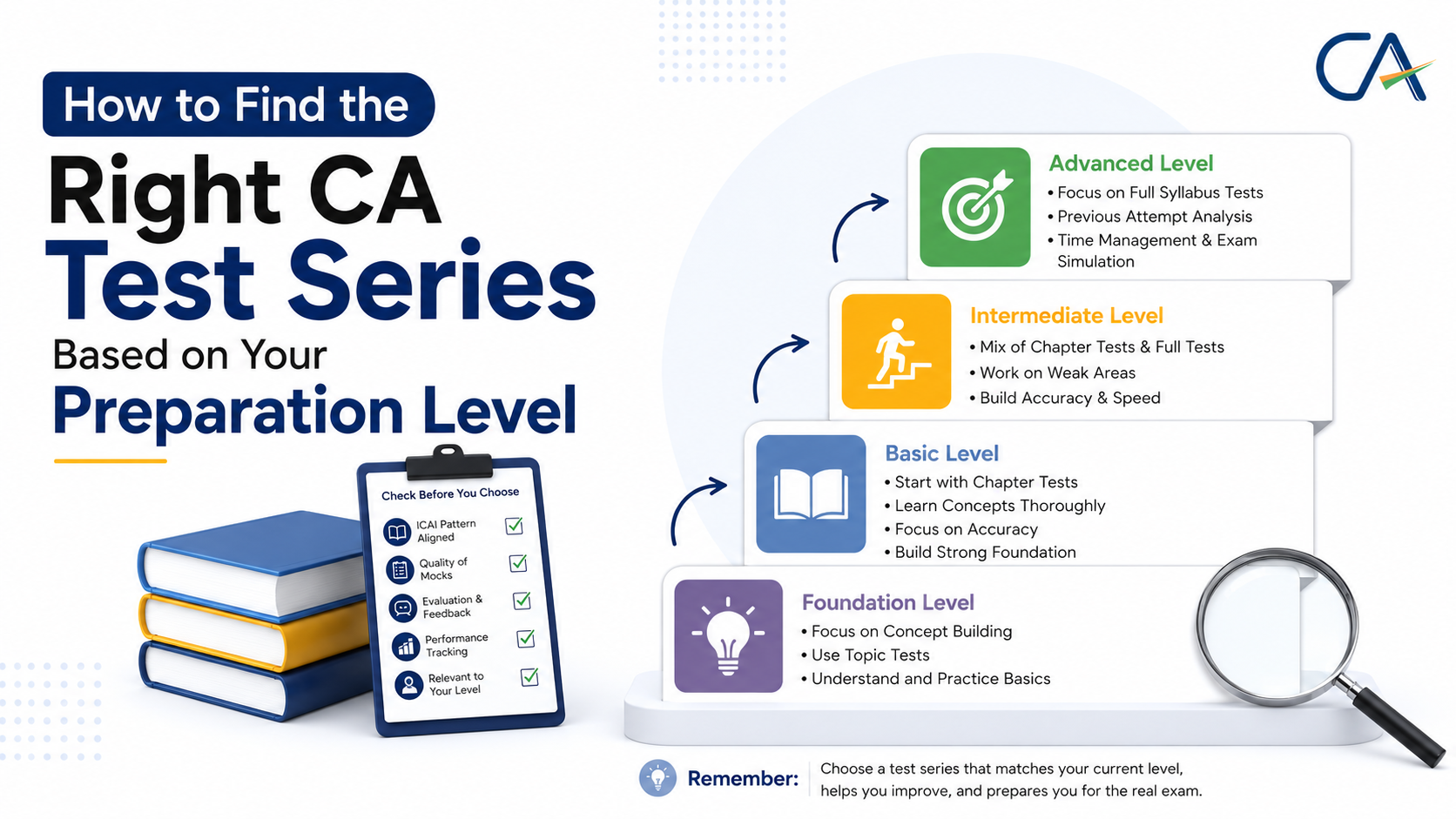
Table of Content
- Why Your Preparation Level Matters When Choosing a CA Test Series
- Honestly Assess Your Current Preparation Level
- Beginner Stage - When You Have Just Started CA Preparation
- Early Preparation Stage - 25% to 40% Syllabus Completed
- Mid-Preparation Stage - Around 40% to 70% Syllabus Completed
- Advanced Preparation Stage - 70% to 90% Syllabus Completed
- Revision Stage - Syllabus Completed Once
- Final Examination Preparation Stage
- How to Know If You Are Ready for Full-Length CA Mock Tests
- Choosing the Right CA Test Series Based on Your Weakness
- How CA Foundation Students Should Choose a Test Series
- How CA Intermediate Students Should Choose a Test Series
- How CA Final Students Should Choose a Test Series
- Studycaller: Choosing Practice According to Your Actual Preparation
- A Simple Decision Framework for Choosing Your CA Test Series
- Should You Change Your Test Series During Preparation?
- How to Avoid Choosing the Wrong CA Test Series
- How to Get Maximum Value From Any CA Test Series
- Final Thoughts: The Right Test Series Depends on Where You Are Today
Choosing a CA test series is not as simple as finding the most popular platform and purchasing the biggest package available.
One of the biggest mistakes CA students make is assuming that the same test series structure will work for everyone.
It will not.
A student who has just completed 20% of the syllabus needs something very different from a student who has completed the entire syllabus and is preparing for the final revision.
Similarly, a student preparing for their first CA attempt may need more structured guidance than someone who has already appeared in the examination and understands the exam environment.
Your preparation level should play a major role in deciding which type of CA test series is right for you.
Unfortunately, many students ignore this.
They purchase a full-length mock test package too early.
Then they become discouraged because they cannot attempt most of the questions.
Others continue solving small chapter-wise tests until the last month and never develop the stamina required for a complete examination paper.
Both situations can affect preparation.
The purpose of a test series is not simply to give you more questions.
It should help you practise the right things at the right stage of your preparation.
Why Your Preparation Level Matters When Choosing a CA Test Series
Imagine two students.
Student A has completed only 30% of the syllabus.
Student B has completed the syllabus twice and is preparing for the examination next month.
If both students purchase the same full-length mock test package, will they benefit equally?
Probably not.
Student A may feel overwhelmed.
Student B may need exactly that level of examination practice.
This is why preparation level matters.
A test series should support your current stage rather than force you into a stage you have not reached yet.
Different Preparation Levels Need Different Practice
|
Preparation Level |
Main Requirement |
|
Beginner |
Concept and chapter testing |
|
Early preparation |
Topic-wise practice |
|
Mid preparation |
Subject-wise testing |
|
Revision stage |
Mixed-topic practice |
|
Final stage |
Full-length mock exams |
Understanding where you currently stand is the first step toward choosing the right test series.
Honestly Assess Your Current Preparation Level
Before searching for the best CA test series, assess yourself honestly.
Do not base your answer on how much time you have spent studying.
Base it on what you can actually do.
Ask yourself:
- How much of the syllabus have I completed?
- How much can I recall without notes?
- Can I solve practical questions independently?
- Have I revised completed topics?
- Can I write answers under time pressure?
- Have I attempted any full-length tests?
Your preparation level is not only about syllabus completion.
A student may say:
“I have completed 80% of the syllabus.”
But if they cannot recall or apply most of it, their actual preparation level may be lower.
A Better Way to Measure Preparation
|
Question |
Strong Preparation Indicator |
|
Syllabus completed? |
Major topics covered |
|
Concepts understood? |
Can explain independently |
|
Questions solved? |
Can apply concepts |
|
Revision done? |
Can recall information |
|
Tests attempted? |
Can perform under pressure |
Be honest with yourself.
Choosing the wrong test series usually starts with incorrectly judging your own preparation.
Beginner Stage - When You Have Just Started CA Preparation
At this stage, students are usually:
- Beginning classes.
- Understanding basic concepts.
- Completing individual chapters.
- Learning new subjects.
- Building their foundation.
This is not the right stage to focus heavily on full-length mock tests.
If you attempt a complete paper with only 15% or 20% syllabus coverage, you may end up leaving most questions unanswered.
That can damage motivation.
Instead, beginners should focus on small testing units.
Best Test Types for Beginners
- Chapter-wise tests.
- Topic-wise quizzes.
- Conceptual questions.
- Small practice assignments.
- Basic application questions.
Beginner Testing Strategy
|
Goal |
Test Type |
|
Understand concepts |
Short quizzes |
|
Test a chapter |
Chapter-wise test |
|
Practise application |
Topic questions |
|
Identify weak basics |
Small assessments |
At this stage, testing should support learning.
It should not become a source of unnecessary pressure.
Early Preparation Stage - 25% to 40% Syllabus Completed
At this stage, you have completed a reasonable portion of your syllabus.
You understand the basic structure of your subjects.
However, major areas may still be pending.
This is the right time to begin more regular testing.
Students should not wait until the entire syllabus is complete before testing themselves.
Early testing helps identify weak concepts before they become bigger problems.
Recommended Test Series Features
Look for:
- Chapter-wise tests.
- Topic-wise assessments.
- Subject portions.
- Gradually increasing difficulty.
- Flexible scheduling.
Suggested Testing Approach
|
Week |
Focus |
|
Week 1 |
Test completed chapter |
|
Week 2 |
Practise weak concepts |
|
Week 3 |
Test another topic |
|
Week 4 |
Review mistakes |
This creates a continuous learning cycle.
Mid-Preparation Stage - Around 40% to 70% Syllabus Completed
This is one of the most important preparation stages.
You have completed significant portions of the syllabus.
Now the challenge changes.
You are no longer struggling only with understanding concepts.
You must start connecting different topics and improving retention.
At this stage, subject-wise tests become more useful.
Best Test Types
- Subject-wise tests.
- Combined chapter tests.
- Moderate-length examinations.
- Mixed-topic questions.
- Timed assessments.
Why This Stage Is Important
Students often become comfortable because they have completed a large portion of lectures.
But lecture completion is not examination readiness.
This stage should be used to transition from learning to performing.
Mid-Preparation Testing Goals
|
Goal |
Practice Method |
|
Improve recall |
Mixed-topic tests |
|
Increase speed |
Timed papers |
|
Identify weak subjects |
Subject-wise tests |
|
Improve application |
Practical questions |
|
Prepare for revision |
Performance tracking |
A good test series at this stage should provide enough structure without forcing students into full examination mode too early.
Advanced Preparation Stage - 70% to 90% Syllabus Completed
At this point, students are approaching examination-oriented preparation.
Most of the syllabus is complete.
Now the focus should shift toward:
- Revision.
- Retention.
- Application.
- Time management.
- Answer writing.
This is the stage where mixed-topic tests become highly valuable.
Recommended Test Series Features
Look for:
- Subject-wise full tests.
- Mixed-topic papers.
- Time-bound assessments.
- Advanced application questions.
- Detailed performance analysis.
What Students Should Focus On
|
Area |
Priority |
|
Syllabus completion |
High |
|
Revision |
Very high |
|
Testing |
Very high |
|
Weak areas |
Immediate attention |
|
Full mocks |
Start gradually |
Students should begin developing examination discipline.
Try to simulate actual test conditions whenever possible.
Revision Stage - Syllabus Completed Once
Completing the syllabus is a major milestone.
But many CA students make a mistake here.
They think:
“My preparation is complete.”
Actually, this is where serious examination preparation begins.
After completing the syllabus, students need to check:
Can I recall what I studied three months ago?
Can I solve questions from different chapters together?
Can I complete a paper on time?
Can I write answers effectively?
The revision stage requires stronger testing.
Best Test Types During Revision
- Full subject tests.
- Mixed-topic examinations.
- Timed papers.
- Revision tests.
- Mock examinations.
Revision Stage Testing Strategy
|
Activity |
Frequency |
|
Topic revision |
Daily |
|
Subject practice |
Weekly |
|
Timed test |
Regularly |
|
Mistake analysis |
After every test |
|
Full mock |
Increasing frequency |
This stage should focus on converting knowledge into performance.
Final Examination Preparation Stage
This is when full-length mock tests become extremely important.
Your preparation should increasingly resemble the actual examination.
Students should practise:
- Sitting continuously.
- Reading complete question papers.
- Managing time.
- Handling difficult questions.
- Maintaining concentration.
- Writing answers at examination speed.
Full-Length Mock Test Benefits
|
Exam Challenge |
How Mock Tests Help |
|
Time pressure |
Develop speed |
|
Difficult questions |
Improve decision-making |
|
Mental fatigue |
Build stamina |
|
Multiple topics |
Improve recall |
|
Anxiety |
Increase familiarity |
A full mock test can reveal problems that chapter-wise practice cannot.
For example, you may know every chapter individually but struggle to maintain focus for an entire paper.
Only full-length practice reveals this.
How to Know If You Are Ready for Full-Length CA Mock Tests
You do not need to wait until your preparation is perfect.
Perfection rarely happens before CA exams.
However, you should have reasonable syllabus coverage before relying heavily on full-length tests.
You may be ready when:
- Most major topics are completed.
- You have revised at least once.
- You can solve questions independently.
- You understand basic answer structure.
- You want to improve time management.
If your syllabus is incomplete, you can still attempt selective tests.
But do not judge your final examination readiness based only on an incomplete full-paper attempt.
Choosing the Right CA Test Series Based on Your Weakness
Your preparation percentage is not the only factor.
Your weaknesses also matter.
Different students need different types of testing.
If Your Concepts Are Weak
Choose a test series with:
- Chapter-wise tests.
- Detailed practice.
- Gradual difficulty.
- Conceptual questions.
Avoid jumping directly into too many full mocks.
If Your Time Management Is Weak
Focus on:
- Timed tests.
- Subject-wise papers.
- Full-length mocks.
- Regular examination simulation.
If Your Answer Writing Is Weak
Look for:
- Descriptive testing.
- Answer evaluation.
- Feedback.
- Model answer comparison.
If Your Revision Is Weak
Choose a structured schedule that forces you to revisit subjects regularly.
Mixed-topic tests can be especially useful.
Weakness-Based Selection Guide
|
Main Weakness |
Best Test Type |
|
Weak concepts |
Chapter-wise |
|
Poor recall |
Mixed-topic |
|
Slow speed |
Timed tests |
|
Weak presentation |
Evaluated tests |
|
Exam anxiety |
Full-length mocks |
Understanding your weaknesses can help you choose much more effectively.
How CA Foundation Students Should Choose a Test Series
CA Foundation students are often experiencing professional examination preparation for the first time.
The test series should therefore help them build examination discipline gradually.
Foundation students should look for:
- Clear test structure.
- Basic to moderate difficulty.
- Topic-wise progression.
- Regular practice.
- Timed mock tests closer to exams.
Students should avoid selecting a test series simply because it is designed for advanced preparation.
The goal should be confidence-building and examination familiarity.
How CA Intermediate Students Should Choose a Test Series
CA Intermediate students deal with greater syllabus depth and multiple subjects.
Their test series selection should depend heavily on syllabus completion.
During early preparation, subject portions and chapter tests may be useful.
During revision, students should move toward:
- Subject-wise tests.
- Mixed-topic papers.
- Full-length mock examinations.
- Performance analysis.
The biggest challenge for Intermediate students is often balancing coverage with retention.
A structured test series can help measure both.
How CA Final Students Should Choose a Test Series
CA Final preparation requires advanced conceptual understanding and mature answer-writing skills.
Students may also be balancing preparation with professional or personal responsibilities.
CA Final students should evaluate:
- Question quality.
- Examination relevance.
- Full-length tests.
- Evaluation.
- Flexible scheduling.
At this stage, students should focus less on simply completing questions and more on improving performance.
Studycaller: Choosing Practice According to Your Actual Preparation
At Studycaller, we believe that students should not select a CA test series based only on popularity.
Your preparation should guide your decision.
A student at the beginning of preparation does not need the same testing structure as a student appearing for the examination next month.
Similarly, a student struggling with concepts needs something different from a student who knows the syllabus but cannot complete papers on time.
The right test series should meet you where you are.
Then help you move forward.
That is the real purpose of structured practice.
At Studycaller, meaningful testing should help students:
- Understand their current level.
- Identify weaknesses.
- Build examination discipline.
- Track improvement.
- Prepare more confidently.
The goal is not to overwhelm students with endless question papers.
The goal is to provide practice that makes sense for their preparation stage.
A Simple Decision Framework for Choosing Your CA Test Series
Use this table to identify what you need.
|
Your Situation |
Recommended Test Series |
|
Just started syllabus |
Chapter-wise tests |
|
25–40% completed |
Topic-wise tests |
|
40–70% completed |
Subject-wise tests |
|
70–90% completed |
Mixed and timed tests |
|
First revision complete |
Full mocks |
|
Exam very close |
Intensive mock practice |
This is not a rigid rule.
Your personal strengths and weaknesses should also be considered.
But it provides a useful starting point.
Should You Change Your Test Series During Preparation?
In some cases, yes.
Your preparation requirements change over time.
A student may start with chapter-wise testing.
Later, they may need subject-wise tests.
Finally, they may require full examination simulations.
This does not necessarily mean purchasing multiple expensive resources.
Look for a structured system that supports different stages.
However, if your current test series no longer meets your requirements, evaluate whether you need additional practice.
Do not remain with a resource simply because you already purchased it.
How to Avoid Choosing the Wrong CA Test Series
Before purchasing, answer these questions honestly.
Preparation Questions
- How much syllabus have I completed?
- How much have I revised?
- What is my biggest weakness?
- How close is the examination?
Test Questions
- What type of tests do I need?
- Do I need evaluation?
- Do I need flexible scheduling?
- Do I need full-length mocks?
Practical Questions
- Can I complete the tests?
- Does the schedule fit my routine?
- Is the price reasonable for the value?
Final Selection Checklist
|
Factor |
Check |
|
Matches preparation level |
Yes/No |
|
Relevant syllabus |
Yes/No |
|
Suitable test types |
Yes/No |
|
Full mocks available when needed |
Yes/No |
|
Evaluation available if required |
Yes/No |
|
Schedule manageable |
Yes/No |
|
Price provides value |
Yes/No |
How to Get Maximum Value From Any CA Test Series
Even the best test series will not help if you use it incorrectly.
Follow this cycle:
1. Study
Learn and understand the concept.
2. Practise
Solve questions without pressure.
3. Test
Attempt questions under structured conditions.
4. Analyse
Identify why mistakes happened.
5. Revise
Fix weak areas.
6. Retest
Check whether improvement occurred.
The CA Preparation Improvement Cycle
|
Stage |
Purpose |
|
Study |
Build knowledge |
|
Practice |
Improve application |
|
Test |
Measure performance |
|
Analyse |
Identify weaknesses |
|
Revise |
Correct weaknesses |
|
Retest |
Measure improvement |
This approach is more effective than continuously studying without checking performance.
Final Thoughts: The Right Test Series Depends on Where You Are Today
The biggest mistake students make while selecting a CA test series is searching for a universally “best” option.
The better question is:
“Which test series is best for my current preparation level?”
That changes everything.
A beginner needs confidence and conceptual practice.
A student in the middle of preparation needs subject-level testing.
A student close to the examination needs full-length mock practice.
Your requirements change as your preparation evolves.
At Studycaller, we believe that meaningful practice should grow with the student.
You should not feel forced to take a full mock when you have barely completed the syllabus.
And you should not continue solving only small chapter tests when the examination is a few weeks away.
Choose according to your current reality.
Be honest about your preparation.
Identify your weaknesses.
Understand what type of practice you need.
Then select a test series that helps you move to the next level.
Because the right CA test series is not simply a collection of questions.
It is a structured practice system.
And when used at the right stage, it can help transform your preparation from passive studying into measurable examination readiness.
Study smart.
Test at the right time.
Learn from your mistakes.
And let your preparation level—not advertisements or peer pressure—guide your decision.

FAQs
How do I choose the right CA test series based on my preparation level?
First assess your syllabus completion, revision status, weak areas, and exam readiness. Then choose chapter-wise, subject-wise, mixed-topic, or full-length tests accordingly.
Which CA test series is best for beginners?
Beginners generally benefit from chapter-wise and topic-wise tests that help them strengthen concepts before moving to larger subject or full-length tests.
Should I take full-length CA mock tests with an incomplete syllabus?
You can take selective tests, but full-length mock tests are generally more useful after completing a major portion of the syllabus.
When should I start taking full-length CA mock tests?
Start gradually when you have covered most major topics and have completed at least one level of revision. You do not need perfect preparation before beginning mock practice.
What type of test is best during CA revision?
During revision, students should focus on subject-wise tests, mixed-topic papers, timed assessments, and gradually increase full-length mock test practice.
How do I know my actual CA preparation level?
Assess syllabus completion, conceptual understanding, ability to solve questions independently, revision status, and performance in timed tests.
Should CA Foundation students use the same test strategy as CA Final students?
No. CA Foundation students usually need more gradual testing and examination familiarity, while CA Final students require advanced application and full-length examination practice.
What test series should I choose if my time management is weak?
Choose a test series that includes timed subject tests and full-length mock examinations so you can regularly practise completing papers within a fixed duration.
Do I need answer evaluation in a CA test series?
Answer evaluation can be particularly helpful if you struggle with descriptive answer writing, presentation, structure, or understanding where marks are lost.
Can I change my CA test strategy during preparation?
Yes. Your testing requirements should evolve as your preparation progresses from chapter-level learning to revision and full examination practice.