How Do I Convert Knowledge into Marks in CA Exams? Smart Strategies
Learn how to convert knowledge into marks in CA exams with effective answer-writing techniques, revision strategies, presentation tips, and exam-day practices.
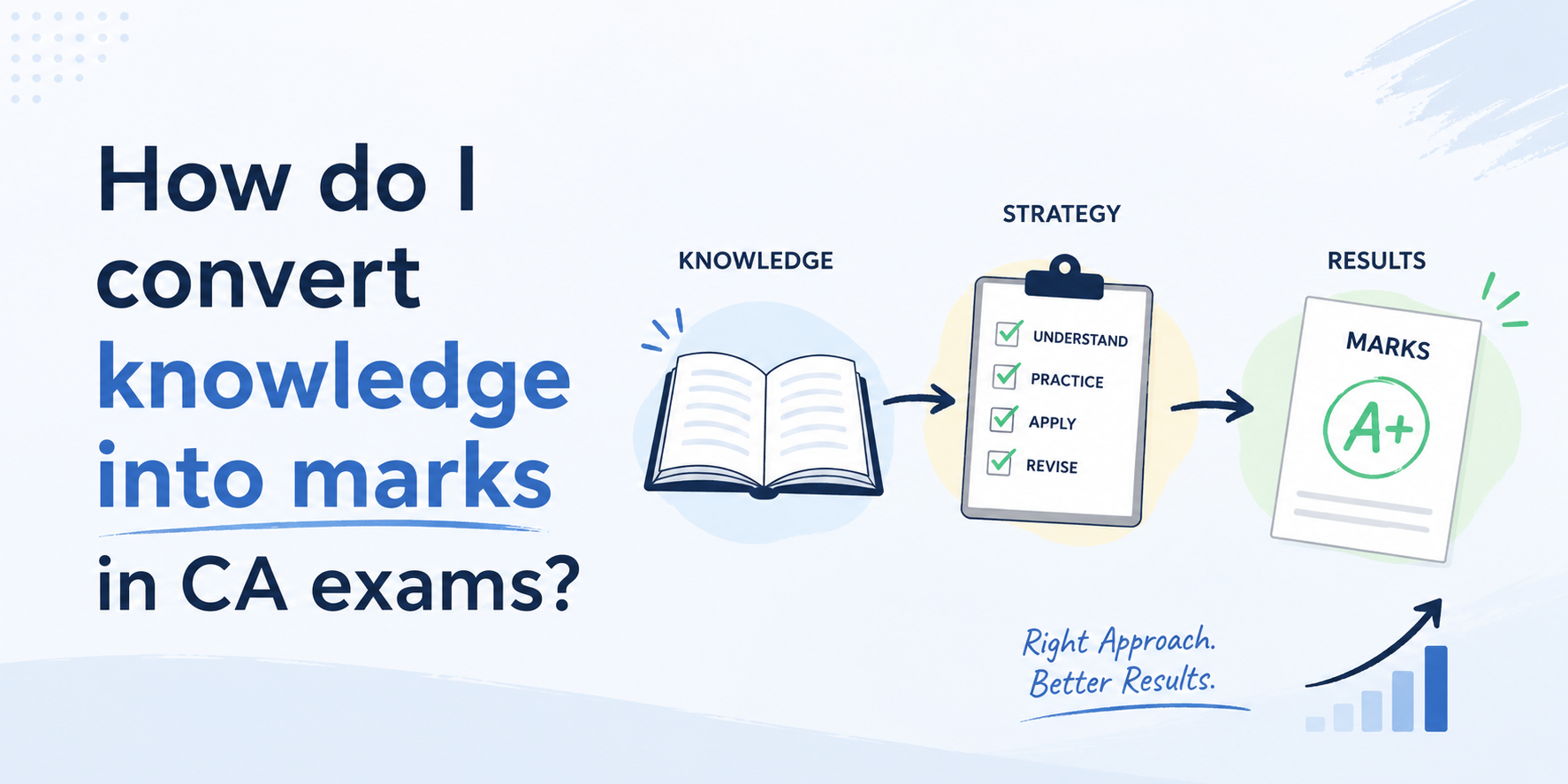
Table of Content
- Knowledge Alone Is Not Enough
- Build Strong Conceptual Clarity Instead of Memorizing
- Practice Answer Writing Regularly
- Presentation Creates a Positive Impression
- Understand What the Question Actually Asks
- Revision Helps Convert Information into Memory
- Time Management Plays a Crucial Role
- Mock Tests Reveal Real Preparation
- Learn to Write What the Examiner Expects
- Avoid Common Mistakes During the Examination
- Confidence Makes a Difference
- Conclusion
Every CA student has met someone who studies fewer hours but scores better marks. At the same time, some students spend months completing the syllabus and revising multiple times, yet fail to achieve the results they deserve. This often leads to one important question—if the knowledge is there, why are the marks missing?
The answer lies in the way knowledge is presented in the examination hall. The CA examination does not reward only hard work; it rewards the ability to communicate concepts clearly, manage time efficiently, and write answers in a professional manner. Understanding how do I convert knowledge into marks in CA exams is essential because knowing the subject and scoring well are two different skills. Students who learn to present their knowledge effectively often gain a significant advantage over others.
Knowledge Alone Is Not Enough
Many students believe that completing the syllabus guarantees success in the examination. Unfortunately, this is not always true. The examiner evaluates only what is written on the answer sheet, not what the student knows mentally.
A student may understand every concept perfectly but still lose marks because of poor presentation, incomplete answers, weak time management, or lack of revision. Therefore, knowledge must be converted into clear, structured, and relevant answers. This is the first step in understanding how do I convert knowledge into marks in CA exams.
Build Strong Conceptual Clarity Instead of Memorizing
Memorization may help in some theory questions, but CA examinations increasingly focus on application-based learning. Students who understand concepts deeply are better equipped to answer practical and analytical questions. Whenever you study a topic, try to understand:
- Why the concept exists
- How it is applied in practice
- What exceptions are applicable
- How it connects with other topics
Conceptual clarity allows students to write confident answers even when questions are framed differently from expectations.
Practice Answer Writing Regularly
One of the biggest reasons students fail to convert knowledge into marks is the lack of answer-writing practice.
Many aspirants spend months reading books but rarely write complete answers before the examination. As a result, they struggle with speed, presentation, and answer structure. Regular answer-writing practice helps students improve:
- Writing speed
- Logical presentation
- Answer structure
- Time management
- Confidence
The more students practice writing, the easier it becomes to present knowledge effectively during the actual examination.
Presentation Creates a Positive Impression
The examiner checks hundreds of answer sheets within a limited time. A neat and well-structured answer naturally becomes easier to evaluate. Students should focus on presenting answers professionally by:
- Using proper headings
- Underlining important keywords
- Maintaining neat handwriting
- Leaving sufficient spacing
- Showing working notes clearly
- Writing conclusions wherever necessary
Good presentation does not replace knowledge, but it certainly helps communicate knowledge more effectively.
Understand What the Question Actually Asks
Many students lose marks because they answer what they know instead of answering what the examiner has asked. Before writing, carefully identify keywords such as:
- Explain
- Discuss
- Evaluate
- Differentiate
- State
- Comment
- Calculate
Understanding the exact requirement helps students write focused answers and avoid unnecessary explanations. Reading the question carefully is a simple habit that can significantly improve scoring potential.
Revision Helps Convert Information into Memory
Many students complete the syllabus but fail to revise it adequately before the examination. Without revision, concepts become difficult to recall under pressure. A structured revision plan should include:
- Short revision notes
- Multiple revisions before exams
- Daily recall practice
- Formula revision
- Important provision revision
Repeated revision strengthens retention and improves answer quality during the examination.
Time Management Plays a Crucial Role
Even brilliant students sometimes leave questions unanswered because they spend too much time on a few difficult questions. Marks can only be scored when answers are actually written. Students should:
- Allocate time according to marks
- Avoid writing unnecessary details
- Attempt easy questions confidently
- Move ahead if stuck
- Reserve time for revision
Good time management ensures that every scoring opportunity is utilized.
Mock Tests Reveal Real Preparation
Mock tests bridge the gap between preparation and performance. Writing full-length papers under exam conditions helps students identify:
- Weak concepts
- Slow writing speed
- Presentation mistakes
- Revision gaps
- Time management issues
Instead of fearing low mock test scores, students should use them as learning opportunities. Regular mock tests significantly improve examination performance.
Learn to Write What the Examiner Expects
Professional examinations reward relevant answers rather than lengthy explanations. Instead of writing everything you know, focus on writing what earns marks. A high-scoring answer generally includes:
- Short introduction
- Relevant provision or concept
- Proper explanation
- Practical application if required
- Clear conclusion
Following this structure improves readability and answer quality. This is another important aspect of how do I convert knowledge into marks in CA exams.
Avoid Common Mistakes During the Examination
Many students lose easy marks because of avoidable mistakes rather than lack of preparation. Some common mistakes include:
- Misreading the question
- Poor handwriting
- Missing working notes
- Ignoring keywords
- Spending excessive time on one answer
- Leaving answers incomplete
Avoiding these mistakes can improve overall scores without increasing study hours.
Confidence Makes a Difference
Confidence during the examination comes from preparation and practice. Students who regularly revise, attempt mock tests, and practice answer writing usually remain calmer during the exam. They are able to think clearly and present answers more effectively. Confidence does not come overnight—it develops through disciplined preparation over time. The better prepared you are, the easier it becomes to convert knowledge into marks.
Conclusion
The answer to "How do I convert knowledge into marks in CA exams?" lies in combining conceptual understanding with effective presentation, revision, answer-writing practice, and time management. Simply knowing the subject is not enough unless that knowledge is communicated clearly on the answer sheet. Students who regularly practice writing, analyze mock tests, revise consistently, and follow a structured exam strategy are more likely to transform their preparation into excellent scores. In the end, success in CA exams depends not only on what you know but also on how effectively you present what you know.

FAQs
How do I convert knowledge into marks in CA exams?
Students can convert knowledge into marks by practicing answer writing, improving presentation, managing time effectively, revising regularly, and understanding what the examiner expects in each question.
Why do students with good knowledge score fewer marks?
Many students lose marks because of poor presentation, weak answer-writing skills, lack of revision, improper time management, and failure to address the actual requirement of the question.
Does answer writing improve CA exam performance?
Yes. Regular answer-writing practice improves speed, presentation, logical thinking, and confidence, helping students express their knowledge more effectively during examinations.
How important is revision for scoring good marks?
Revision strengthens memory retention and improves recall during exams. Multiple revisions help students answer questions accurately and confidently under time pressure.
Should students practice mock tests before CA exams?
Yes. Mock tests improve time management, identify weak areas, strengthen answer-writing skills, and prepare students for the actual examination environment.
Does presentation matter in CA examinations?
Yes. Neat handwriting, headings, working notes, proper spacing, and underlining important keywords improve readability and create a positive impression on the examiner.
How can time management improve exam scores?
Proper time management ensures that students attempt all questions, avoid unnecessary delays, and maximize scoring opportunities within the available examination time.
Why is conceptual understanding better than memorization?
Conceptual understanding helps students solve application-based questions confidently, while memorization alone may fail when questions are presented in a different format.
What common mistakes reduce marks in CA exams?
Poor presentation, incomplete answers, ignoring question requirements, weak revision, calculation mistakes, and ineffective time management are common reasons for losing marks.
What is the best strategy to score higher marks in CA exams?
The best strategy combines conceptual learning, multiple revisions, answer-writing practice, mock tests, effective presentation, and disciplined time management to convert preparation into better examination performance.