Why ICAI Focuses on Practical Knowledge in the CA Course Structure
Learn why ICAI focuses on practical knowledge through articleship, application-based exams, real business exposure, and professional skill development in the CA course.
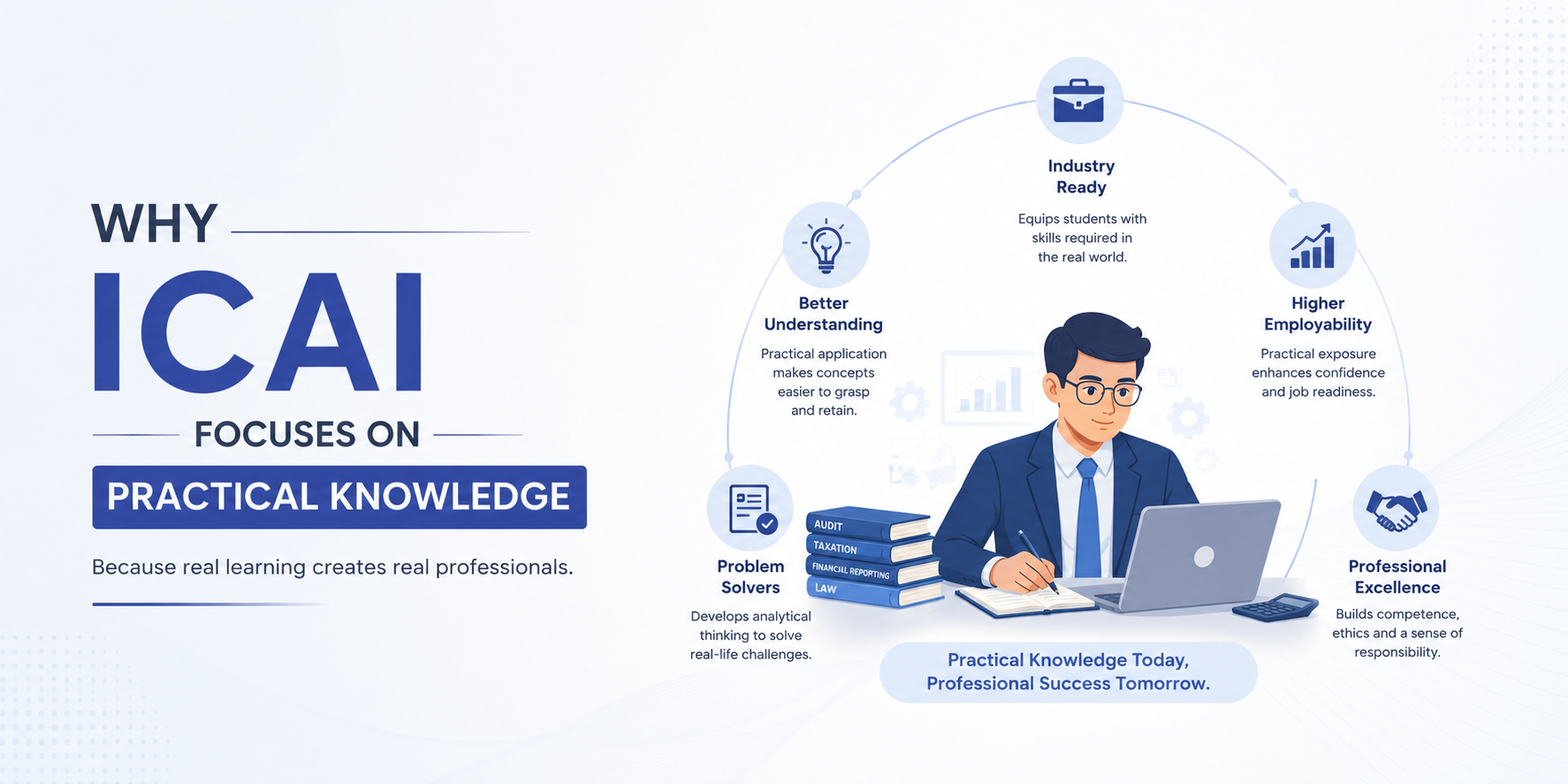
Table of Content
- Real Business Situations Cannot Be Learned Through Theory Alone
- Articleship Is the Biggest Example of Practical Learning
- Application-Based Exams Reflect Practical Thinking
- Practical Knowledge Improves Professional Confidence
- Businesses Expect More Than Academic Knowledge
- Practical Exposure Helps Students Understand Responsibility
- Technology Is Also Changing Practical Learning
- Why Students Sometimes Ignore Practical Learning
- Practical Knowledge Improves Analytical Ability
- ICAI Wants Students to Become Industry-Ready
- Continuous Learning Is Easier With Practical Understanding
- Conclusion
The Chartered Accountancy profession is directly connected with real business operations, financial management, taxation, auditing, and compliance systems. Because of this, theoretical learning alone is not enough for students preparing to become chartered accountants. A finance professional may know concepts from books, but without a practical understanding, handling real-world business situations becomes difficult. This is one of the main reasons why ICAI focuses on practical knowledge while designing the CA course structure.
The Institute of Chartered Accountants of India (ICAI) has always emphasized practical learning alongside technical education. The objective is not simply to create students who can write exams successfully, but professionals who can apply concepts confidently in actual work environments. Through articleship training, application-based examinations, and practical exposure, ICAI prepares students for the realities of the finance industry.
Real Business Situations Cannot Be Learned Through Theory Alone
In textbooks, financial concepts often appear structured and straightforward. However, actual business environments are much more complex. For example, a chartered accountant may need to:
- Handle incomplete financial records
- Interpret taxation complications
- Manage audit observations
- Communicate with clients professionally
- Solve compliance-related issues
These situations require judgment and practical thinking, not only theoretical definitions. This is exactly why ICAI focuses heavily on practical understanding throughout the CA journey.
Articleship Is the Biggest Example of Practical Learning
One of the strongest features of the CA course is mandatory articleship training. Unlike many professional courses where students mainly attend classes, CA students spend years working in practical environments before qualification. During articleship, students experience:
| Area | Practical Exposure |
| Audit Work | Verification and reporting procedures |
| Taxation | Return filing and compliance handling |
| Accounts | Financial statement preparation |
| Office Environment | Professional communication and discipline |
This exposure helps students gradually understand how theoretical concepts are actually implemented in businesses.
Application-Based Exams Reflect Practical Thinking
ICAI examinations are designed in a way that students cannot depend completely on memorization. Many questions involve practical interpretation and case-based application. Students are often required to:
- Analyze situations logically
- Apply accounting concepts
- Interpret provisions practically
- Solve business-oriented problems
This examination style encourages students to think professionally instead of simply reproducing textbook answers. The practical approach is one of the biggest reasons why ICAI focuses on practical knowledge in exams and training together.
Practical Knowledge Improves Professional Confidence
Students with only theoretical understanding often feel nervous while handling actual work responsibilities. On the other hand, practical exposure helps students develop:
- Workplace confidence
- Communication ability
- Professional discipline
- Problem-solving skills
When students regularly work with real financial documents, audit files, compliance systems, and business procedures, they become more comfortable in professional environments. This confidence becomes extremely valuable after qualification.
Businesses Expect More Than Academic Knowledge
Modern businesses no longer expect chartered accountants to only maintain books or file returns. Companies today expect finance professionals to contribute in areas such as:
- Financial planning
- Risk evaluation
- Compliance management
- Business advisory
- Strategic decision-making
These responsibilities require a practical understanding of how businesses actually function. ICAI therefore designs the CA course around industry expectations instead of purely academic learning.
Practical Exposure Helps Students Understand Responsibility
The CA profession carries significant responsibility because financial decisions impact businesses, investors, employees, and regulatory authorities. Practical learning helps students understand:
- Accuracy importance
- Deadline discipline
- Professional accountability
- Ethical conduct in workplaces
Students gradually learn that even small mistakes in finance and compliance work can create major consequences. This professional maturity develops better through practical exposure than classroom theory alone.
Technology Is Also Changing Practical Learning
Modern finance systems increasingly involve digital tools and automated processes. Today’s chartered accountants are expected to understand areas like:
- Cloud accounting systems
- ERP software
- Data analytics tools
- Digital compliance platforms
ICAI’s practical approach is gradually evolving to include technology awareness because the finance industry now depends heavily on digital systems. Practical learning today is no longer limited to manual accounting work.
Why Students Sometimes Ignore Practical Learning
Some students focus completely on clearing exams and underestimate the importance of practical exposure. They may prioritize:
- Theory memorization
- Selective study
- Short-term exam preparation
However, professionals who lack practical understanding often struggle later in interviews, workplace environments, and real business situations. Long-term professional success depends heavily on practical competence.
Practical Knowledge Improves Analytical Ability
One major benefit of practical learning is that it improves professional thinking. Students gradually learn how to:
- Interpret financial data
- Identify compliance risks
- Analyze business situations
- Make logical financial decisions
This analytical ability becomes extremely important in auditing, taxation, consulting, and financial advisory careers. Practical experience strengthens conceptual understanding as well.
ICAI Wants Students to Become Industry-Ready
The CA qualification is not designed only for academic achievement. ICAI aims to prepare professionals who can contribute effectively from the beginning of their careers. This industry-focused approach helps students develop:
- Technical competence
- Practical understanding
- Communication skills
- Workplace adaptability
As industries become more competitive and technology-driven, practical readiness becomes even more important.
Continuous Learning Is Easier With Practical Understanding
Students with practical exposure usually understand new concepts more easily because they can connect theory with real situations. For example:
- Taxation amendments become easier to understand
- Audit concepts feel more realistic
- Financial reporting standards appear more practical
This connection between theory and practice improves long-term professional growth significantly.
Conclusion
Understanding why ICAI focuses on practical knowledge helps students realize that the Chartered Accountancy course is designed to create industry-ready professionals instead of only academically qualified candidates. Through articleship training, application-based examinations, practical exposure, and technology awareness, ICAI ensures students develop real business understanding alongside technical knowledge. Practical learning improves confidence, analytical thinking, workplace discipline, and professional competence, which are essential qualities for long-term success in modern finance careers.

FAQs
Why does ICAI focus on practical knowledge in the CA course?
ICAI focuses on practical knowledge to prepare students for real business situations, professional responsibilities, and industry requirements.
How does articleship improve practical understanding?
Articleship provides exposure to auditing, taxation, compliance work, accounting systems, and professional workplace environments.
Why are CA exams application-based?
Application-based exams test conceptual clarity, analytical thinking, and practical interpretation instead of rote memorization only.
How does practical learning improve professional confidence?
Practical exposure helps students handle real work situations, communicate professionally, and understand workplace responsibilities better.
Why do businesses prefer practically skilled chartered accountants?
Businesses expect professionals who can solve financial problems, manage compliance, and support business decision-making effectively.
How does practical knowledge improve analytical thinking?
Practical exposure helps students analyze financial situations, identify risks, and apply concepts logically in business environments.
Why is technology awareness becoming important in practical learning?
Modern accounting increasingly uses automation, ERP systems, cloud accounting, and digital compliance platforms.
Can theoretical knowledge alone make someone a successful CA?
No, practical understanding is equally important because real business situations require application and professional judgment.
How does practical learning help after qualification?
Practical exposure improves workplace adaptability, communication skills, confidence, and the ability to handle professional responsibilities.
Why does ICAI emphasize industry readiness?
ICAI wants future chartered accountants to become competent professionals capable of contributing effectively in modern finance industries.