The CA Foundation Quantitative Aptitude paper is the one most students treat as a scoring cushion, and also the one where many lose the 50 percent aggregate. With the January 2027 exams starting on 3 January, you have roughly six weeks left. That is enough time to make Paper 3 a safe 60 plus, if you spend it on the right chapters and practise under real exam conditions.
This guide breaks the paper into its three parts, shows where the marks sit, and gives a week-by-week plan for the time that is left. We also cover negative marking, because in this paper a careless guess costs you more than a skipped question.
CA Foundation Quantitative Aptitude paper at a glance
Paper 3 is fully objective. You answer multiple choice questions on an OMR style answer sheet, and the paper lasts two hours. ICAI applies negative marking of 0.25 mark for every wrong answer in the objective papers, which means Paper 3 and Paper 4. Papers 1 and 2 are descriptive and have no negative marking.
To pass CA Foundation you need at least 40 percent in each paper and at least 50 percent in aggregate of all four papers, in one sitting. So a strong Quantitative Aptitude score is not only about clearing Paper 3. It also pulls your aggregate up if Business Laws or Accounting goes badly.
| Part of Paper 3 | Marks | Main chapters |
|---|---|---|
| Business Mathematics | 40 | Ratio and proportion, indices, logarithms, equations, inequalities, mathematics of finance, permutations and combinations, sequences and series, sets and functions, basic calculus |
| Logical Reasoning | 20 | Number series, coding and decoding, odd man out, direction tests, seating arrangements, blood relations |
| Statistics | 40 | Data presentation, sampling, central tendency and dispersion, probability, theoretical distributions, correlation and regression, index numbers |
The table follows the ICAI new scheme syllabus. ICAI allows a small deviation in section-wise weightage, so do not skip a chapter only because it looks light on paper. You can check the chapter-wise split in more detail in our post on CA Foundation chapter-wise weightage.
Where the marks really are in Quantitative Aptitude
Look at the split again. Statistics and Business Mathematics carry 40 marks each, and Logical Reasoning carries 20. Most toppers we talk to treat Logical Reasoning and Statistics as the base of their score, because the questions are direct and the methods do not change much from paper to paper.
Inside Business Mathematics, mathematics of finance (interest, annuity, present value, EMI, CAGR) is the heaviest single block. It is also very formula driven, so a well kept formula page pays off here. Calculus and limits, on the other hand, take a lot of time to learn for a small share of questions. If you are short on time, learn the standard results for differentiation and integration and stop there.
A simple priority order for the last six weeks
- Logical Reasoning: all six chapters. They are quick to learn and give the best marks per hour.
- Statistics: central tendency, dispersion, probability, correlation and regression, index numbers.
- Mathematics of finance and ratio, indices, logarithms.
- Equations, permutations and combinations, sequences and series.
- Sets, functions, limits and calculus, in that order, if time allows.
Business Mathematics: how to study it in less time
Business Mathematics scares many commerce students who dropped maths after Class 10. The good news is that the MCQ format rewards shortcuts. You rarely need the full working. You need the right formula and a calculator you are comfortable with.
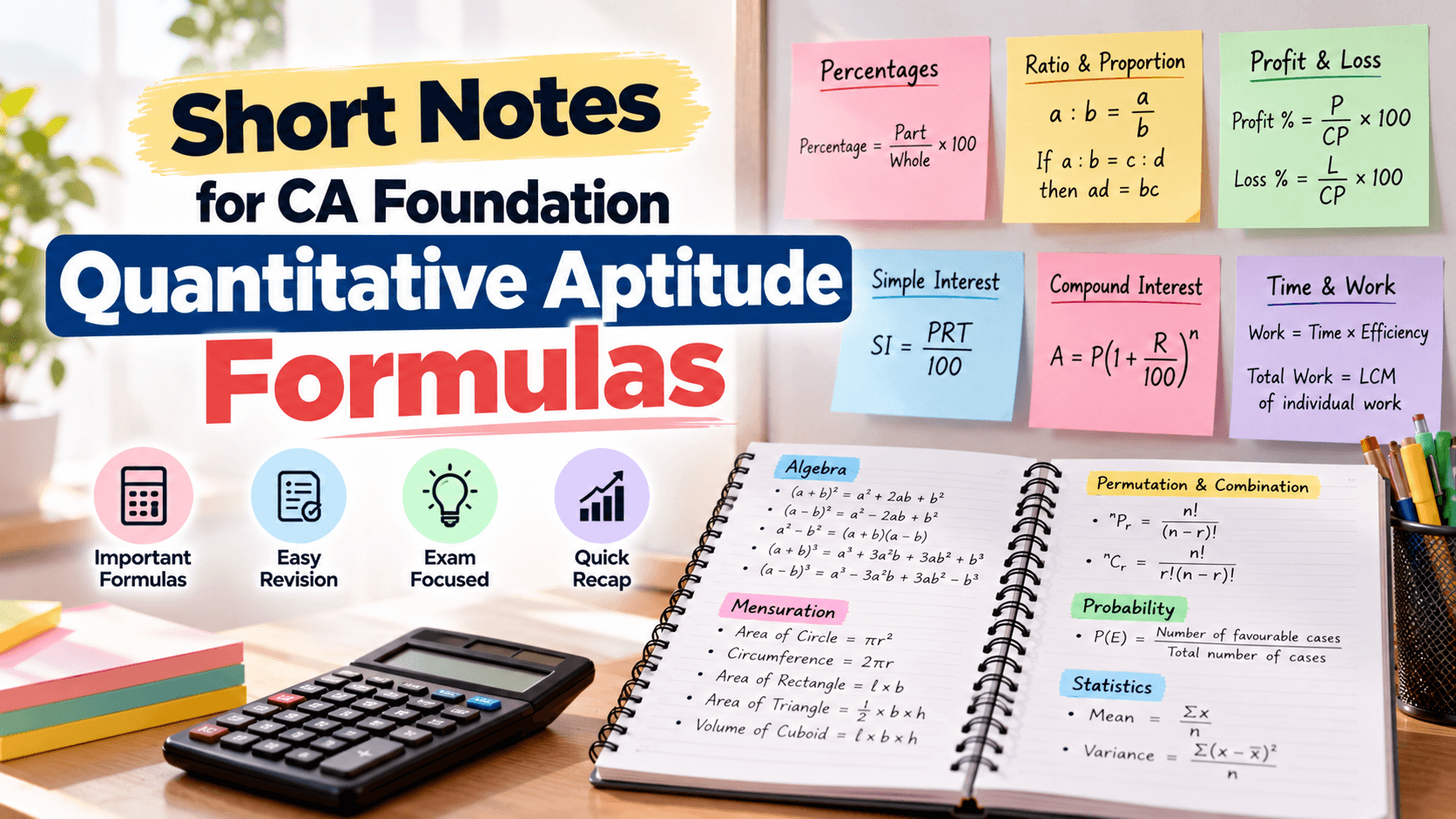
For each chapter, solve the ICAI study material illustrations first, then the exercise questions. Write every formula on one page as you go. Our quantitative aptitude formula notes can save you the effort of building this sheet from scratch.
One habit helps a lot in this part: option checking. In equations, logarithms and sequences, you can often put the options back into the question and see which one works. It is slower than direct solving for a strong student, but for an average student it is safer and cuts wrong answers.
Common mistake in mathematics of finance
Most students lose marks here because they mix up annual and periodic rates. If interest is compounded half-yearly or quarterly, convert both the rate and the number of periods before you touch the calculator. Do ten questions only on this conversion and the problem mostly goes away.
Logical Reasoning: the easiest 20 marks
Logical Reasoning is small, but almost every student can score 15 or more out of 20 with steady practice. The chapters are number series, coding and decoding, odd man out, direction sense, seating arrangements and blood relations.
Do not read theory for these. Solve questions. Aim for 30 to 40 questions a day for one week, timed. In seating arrangements and blood relations, always draw a small diagram on the rough sheet. Students who try to solve these in their head make silly errors under pressure.
Keep a two minute rule for this part. If a puzzle has not opened up in two minutes, mark it and move on. You can return to it at the end, and you will often see the answer at once.
Statistics: score high without fear
Statistics carries 40 marks, and the questions are a mix of concept and calculation. Concept questions come from definitions, properties and relationships, such as the effect of change of origin and scale on mean and standard deviation. These are quick marks if you have revised the theory lines in the study material.
Probability and theoretical distributions (binomial, Poisson, normal) feel hard at first, but the question types repeat. Learn the mean and variance of each distribution and the standard properties of the normal curve. Correlation and regression questions often test the relationship between regression coefficients and the correlation coefficient, so practise those until you can do them quickly.
Index numbers is a short chapter that students leave for the end and then skip. Do not. It is mostly formula based, and one evening is enough to cover it.
Negative marking: when to attempt and when to leave
With 0.25 mark cut for each wrong answer, blind guessing does not pay. But leaving too many questions hurts more. The balance most mentors suggest is simple.
- If you can rule out two of the four options, attempt the question. The odds are in your favour.
- If you cannot rule out any option, leave it.
- Never change an answer at the last minute without a clear reason. First instincts based on working are usually right.
- Fill the OMR sheet as you go, in blocks of ten or so questions, not all at the end.
Practise this rule in your mock tests so it feels normal on exam day. Count how many marks negative marking cost you in each mock, and try to bring that number down week by week.
Six week study plan for CA Foundation Quantitative Aptitude
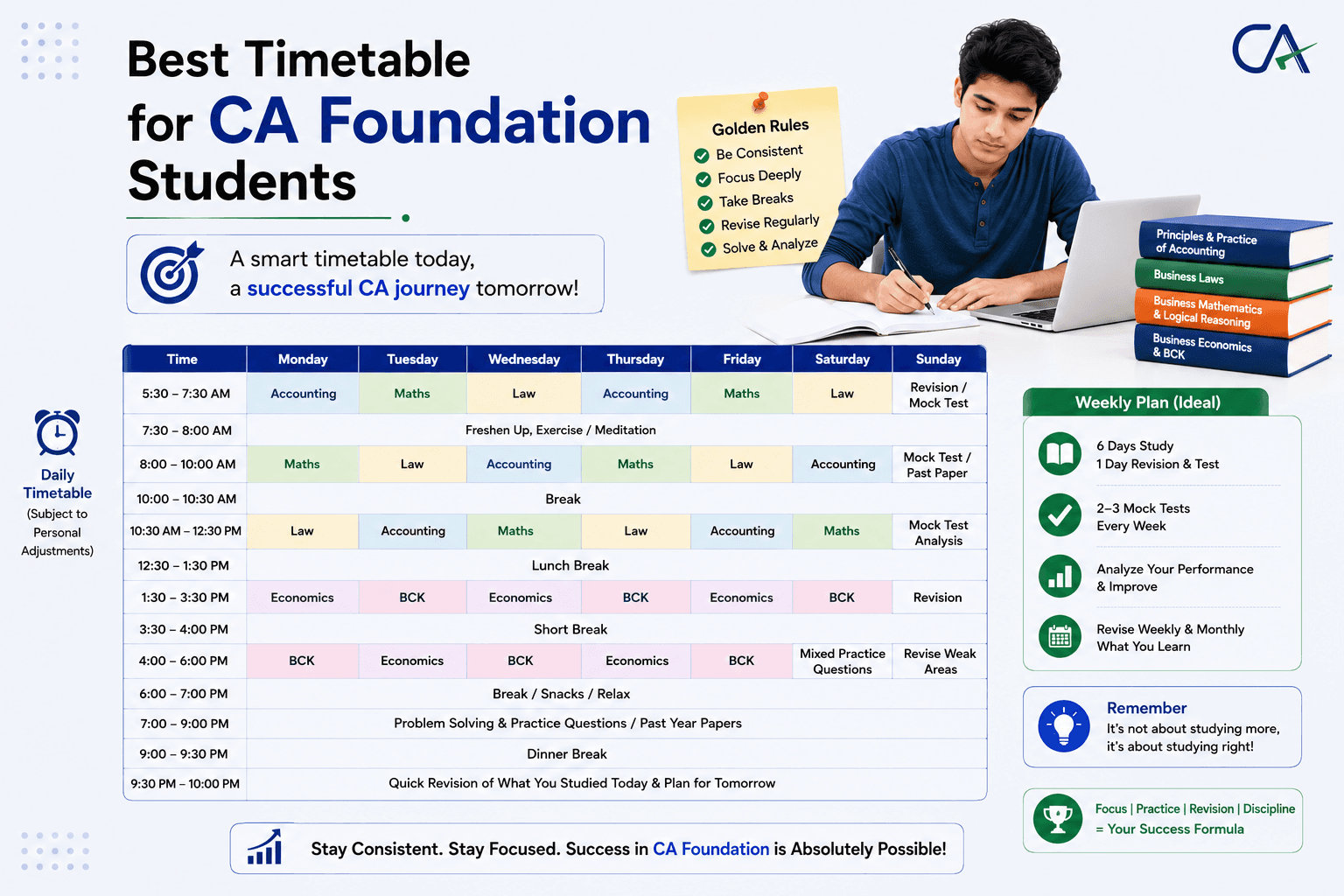
This plan assumes you give Paper 3 about two hours a day, alongside the other papers. Adjust it to your own speed, but keep the order.
| Week | Focus | Target |
|---|---|---|
| Week 1 | Logical Reasoning, all chapters | 200 timed questions, error notebook started |
| Week 2 | Statistics: central tendency, dispersion, correlation, regression, index numbers | Study material exercises done |
| Week 3 | Statistics: probability and distributions, plus sampling theory | Formula and theory sheet ready |
| Week 4 | Business Mathematics: ratio, indices, logs, equations, finance | Finance questions without errors in rate conversion |
| Week 5 | Business Mathematics: P and C, sequences, sets, calculus basics | One full mock, analysed |
| Week 6 | Full syllabus revision and mocks | Two or three timed mocks, negative marks tracked |
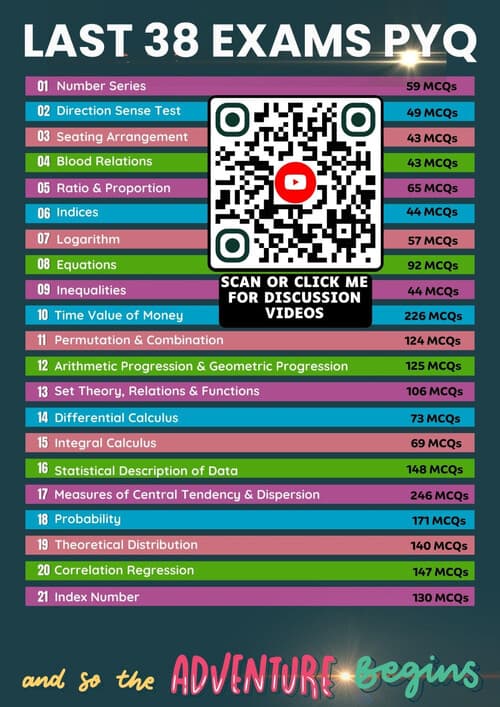
Use the past papers and ICAI mock test papers for weeks 5 and 6. Our list of CA Foundation previous year question papers is a good place to start. For chapter notes you can revise on your phone, open the free CA Foundation notes.
Last three days before the paper
Do not start a new chapter in the final three days. Read your formula sheet twice a day, solve one short timed set from Logical Reasoning to keep your speed, and go through your error notebook. That notebook, where you wrote every question you got wrong and why, is worth more than any new book at this stage.
On the day itself, carry a calculator of the type ICAI permits, keep spare pencils and pens, and read the instructions on the OMR sheet with care. Start with the part you are strongest in. For most students that is Logical Reasoning or Statistics, which builds confidence before the heavier maths questions.
If a concept still does not make sense in these final weeks, ask it on Studycaller doubts and get it cleared before it turns into a lost mark.