CA Foundation Business Laws is a 100 mark descriptive paper, and the marks go to students who write the right provision, apply it to the facts and give a clear conclusion. Knowing the law is only half the work. With the January 2027 Foundation exams starting on 3 January, the next six weeks should go into chapter-wise revision and answer writing, not more reading.
This guide covers the paper pattern, ICAI's chapter weightage, how to write answers that score, and a six week plan for Paper 2.
CA Foundation Business Laws paper pattern
Business Laws is Paper 2 of CA Foundation. It is a descriptive paper of 100 marks and three hours, held from 2 pm to 5 pm, with 15 minutes of advance reading time before it starts. There is no negative marking, since ICAI applies negative marking only to the objective Papers 3 and 4.
You need at least 40 marks in Business Laws and 50 percent aggregate across all four papers in one sitting to pass Foundation. Law is the paper where students with weak writing practice tend to land between 35 and 45. A little answer writing practice can move you well above that zone.
Chapter-wise weightage for Business Laws
ICAI gives a weightage range for each part of the paper under the new scheme. Use it to decide how much time each Act deserves.
| Chapter | Weightage |
|---|---|
| Indian Regulatory Framework | 0% to 5% |
| Indian Contract Act, 1872 | 20% to 30% |
| Sale of Goods Act, 1930 | 15% to 20% |
| Indian Partnership Act, 1932 | 15% to 20% |
| Limited Liability Partnership Act, 2008 | 5% to 10% |
| Companies Act, 2013 | 15% to 20% |
| Negotiable Instruments Act, 1881 | 10% to 15% |
The Indian Contract Act alone can carry up to 30 marks, so it gets the most time. Sale of Goods, Partnership and the Companies Act come next. For the split across all four Foundation papers, see our post on CA Foundation chapter-wise weightage.
Indian Contract Act: your biggest chapter
The Contract Act covers the essentials of a valid contract, offer and acceptance, consideration, capacity, free consent, void agreements, performance, breach and remedies, and the special contracts of indemnity, guarantee, bailment, pledge and agency. That is a lot, but the questions follow clear patterns.
Most practical questions give a short situation and ask whether a valid contract exists or who is liable. Learn the rules with one standard case example each. For instance, when you revise acceptance, know when communication of acceptance is complete for the offeror and for the acceptor. When you revise minors, know that an agreement with a minor is void from the start.
Common mistake in Contract Act answers
Most students lose marks here because they write the whole chapter instead of the one rule the question needs. If the question is about a minor's agreement, do not explain all the essentials of a valid contract. Quote the relevant rule, apply it and conclude. Examiners reward precision, not length.
Special contracts need comparisons
Indemnity and guarantee, bailment and pledge, and the different kinds of agents are where students mix up rules. Make side by side notes: the parties in each contract, the rights of the surety or the pawnee, and when liability ends. For example, know how the discharge of a surety works, and how the rights of a pawnee differ from those of a bailee. Questions in this area often ask you to compare two of these contracts, and a short table inside your answer makes the difference clear to the examiner.
Sale of Goods, Partnership and LLP
Sale of Goods questions come from conditions and warranties, the doctrine of caveat emptor and its exceptions, transfer of ownership, and the rights of an unpaid seller. Make a small table of the implied conditions and the exceptions to caveat emptor. These are asked often and are easy to write once you have them in a fixed order.
The Partnership Act is about the nature of partnership, the rights and duties of partners, the effect of non-registration, and dissolution. The difference between dissolution of partnership and dissolution of the firm is a regular question. Learn it as a comparison.
The LLP Act carries a smaller share. Focus on the features of an LLP, the incorporation process and the difference between an LLP and a partnership firm or a company. A clean comparison table in your answer can earn full marks here.
Companies Act and Negotiable Instruments Act
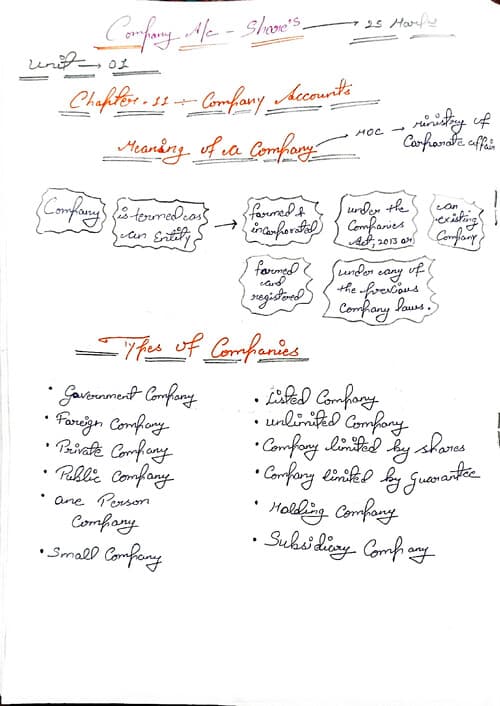
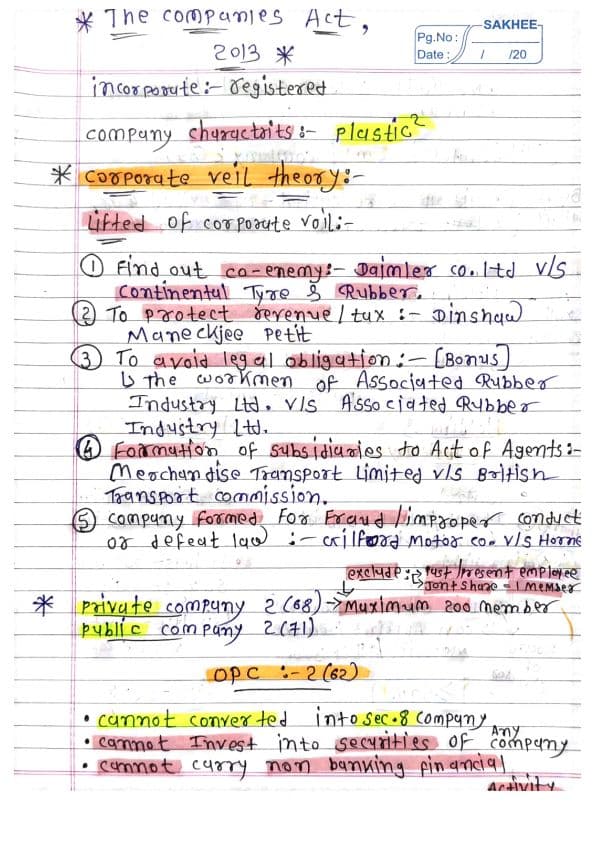
From the Companies Act, the Foundation syllabus covers the features of a company, lifting of the corporate veil, classes of companies, memorandum and articles of association, and the doctrine of indoor management. Questions on the classes of companies (one person, small, private, public, holding and subsidiary) and on indoor management with its exceptions are common.
The Negotiable Instruments Act covers the types of instruments, negotiation, presentment, and dishonour with its consequences. Learn the difference between a bill of exchange, a promissory note and a cheque in a single table, and know the basics of notice of dishonour. These are short, direct questions.
For one-page chapter recaps you can read before writing answers, use our CA Foundation Business Laws chapter summaries along with the free CA Foundation notes.
How to write a Business Laws answer that scores
For practical questions, use a four step format. It is simple, and examiners are used to it.
- Provision: state the rule from the relevant Act in your own words, with the section number only if you are sure of it.
- Facts: restate the key facts of the question in one or two lines.
- Analysis: apply the rule to those facts.
- Conclusion: answer exactly what was asked, in one clear line.
A wrong section number can look worse than no section number, so do not guess. A correct rule in plain words with a clean conclusion usually earns most of the marks. For theory questions, use short paragraphs with headings, and underline key terms with a pencil or pen once, not on every line.
Practise writing, not just reading
Write at least two practical answers from each chapter by hand every day in the first four weeks. Time yourself. Three hours for 100 marks works out to about 1.8 minutes per mark, so an answer worth five marks should take around nine minutes. If you are taking longer, you are writing too much theory.
Six week plan for CA Foundation Business Laws
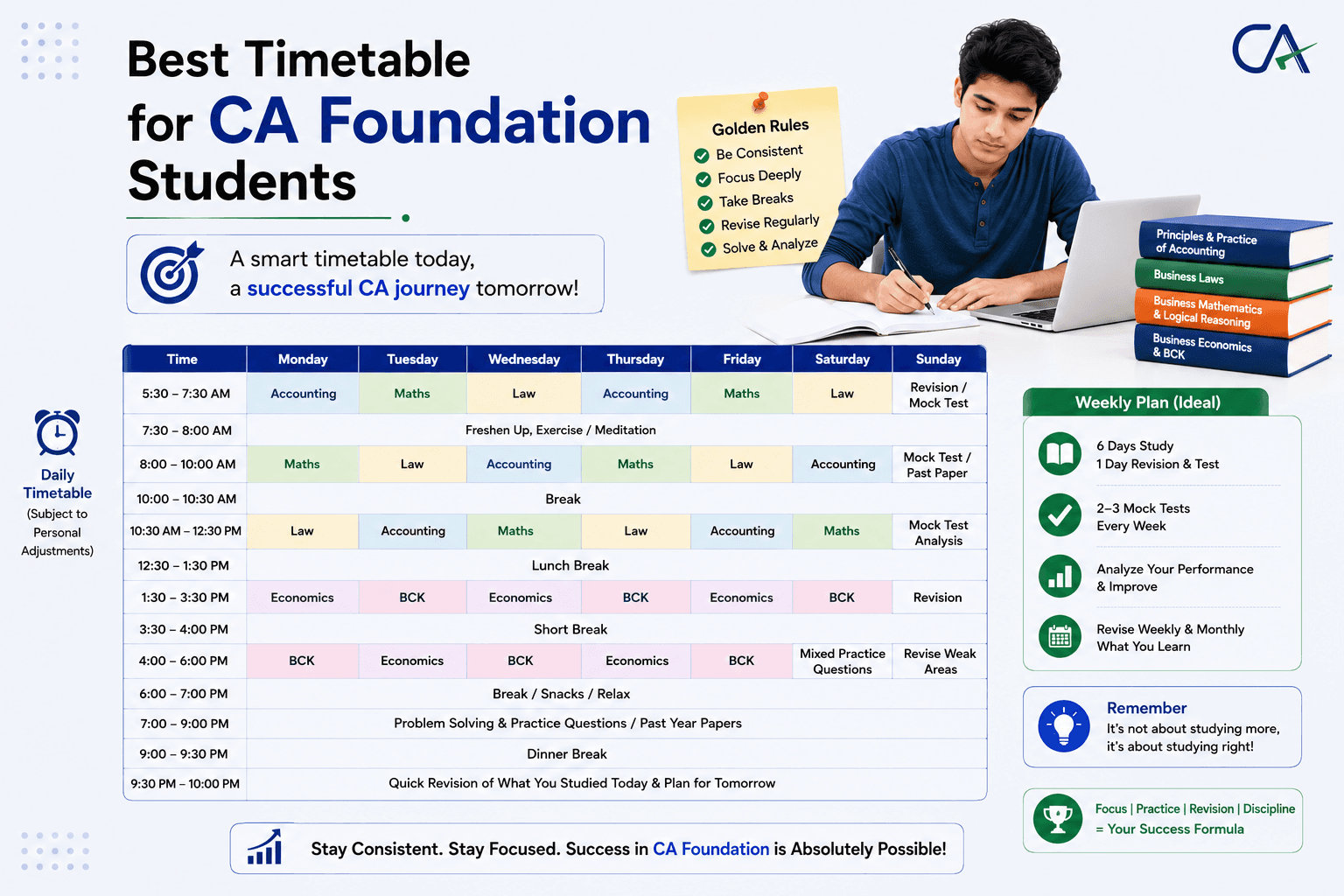
This plan gives Law about 90 minutes a day alongside the other three papers.
| Week | Chapters | Writing target |
|---|---|---|
| Week 1 | Contract Act: general principles | 14 practical answers |
| Week 2 | Contract Act: special contracts, Indian Regulatory Framework | 14 practical answers |
| Week 3 | Sale of Goods Act, Partnership Act | Comparison tables plus 14 answers |
| Week 4 | LLP Act, Companies Act, Negotiable Instruments Act | 14 answers, one sectional test |
| Week 5 | Full syllabus mock papers | Two full papers in three hours each |
| Week 6 | Revision of weak chapters and mistakes | One final full paper |
For mocks, past papers are the best choice because the style of practical questions repeats. You can also go through our list of frequently tested topics in CA Foundation Law to check that none of the regular areas are left out.
On exam day, use the 15 minutes of reading time to choose your questions and plan the order. Start with the question you know best, keep each answer inside its time limit and leave five minutes at the end to check that every answer has a conclusion. If a provision still confuses you before the exam, ask it on Studycaller doubts.