Why Repeated Practice Improves Accounting Accuracy in Exams
Learn why repeated practice improves accounting accuracy through better concepts, fewer mistakes, faster calculations, and improved confidence in accounting exams.
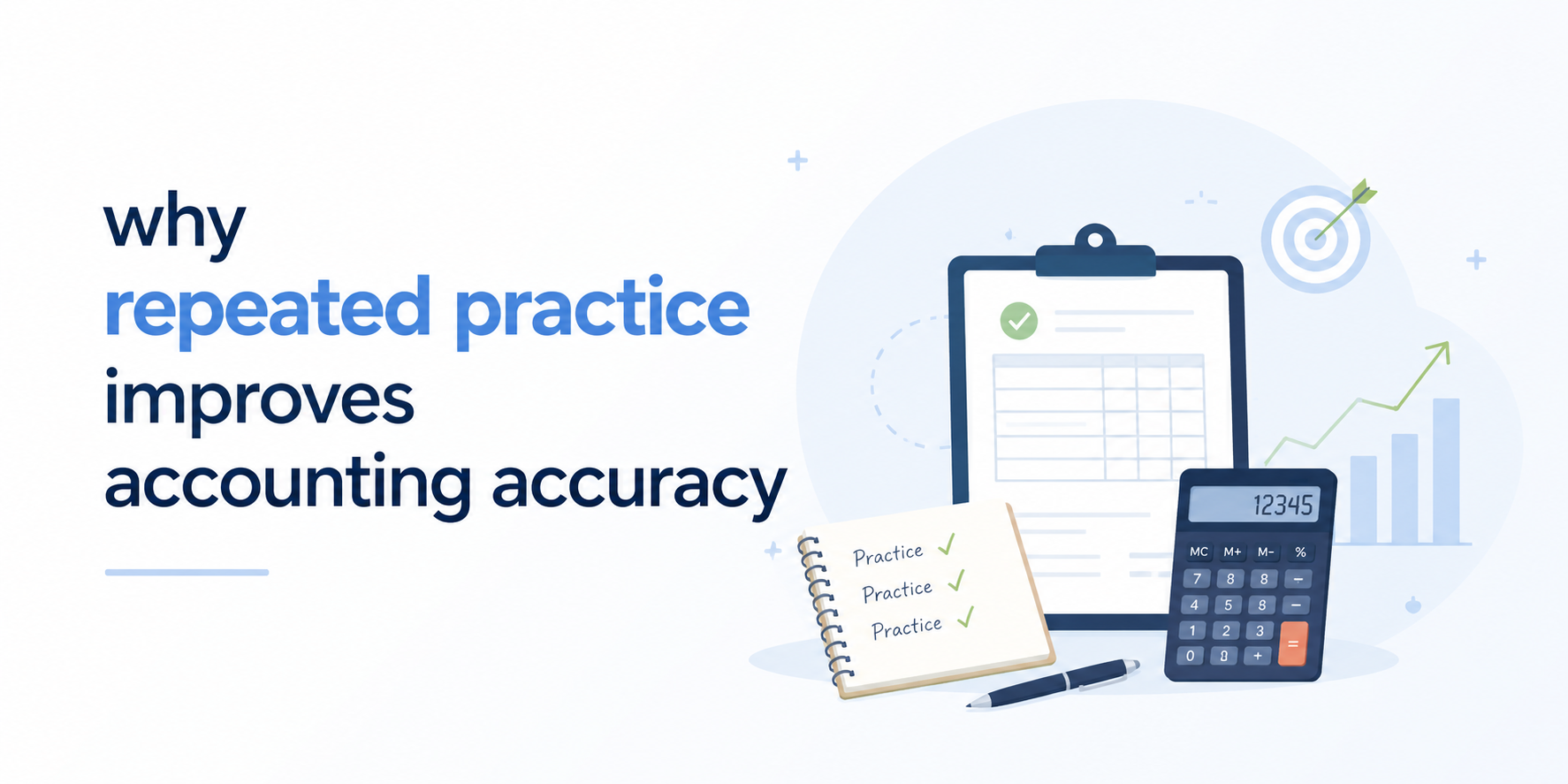
Table of Content
- Accounting Is a Practical Subject
- Practice Reduces Calculation Mistakes
- Repetition Improves Concept Clarity
- Accounting Speed Improves With Practice
- Practice Builds Confidence in Accounting
- Mistake Analysis Helps Students Improve Faster
- Why Revision Matters in Accounting Practice
- Practical Exposure Improves Application Skills
- Why Consistency Matters More Than Occasional Long Practice
- Conclusion
Accounting is one of the most important subjects in commerce and professional courses like CA, CMA, and CS. Many students understand accounting concepts theoretically but still make mistakes while solving practical questions. Common errors like wrong calculations, missing adjustments, incorrect journal entries, or poor presentation often reduce marks during exams.
One of the biggest reasons behind these mistakes is a lack of regular practice. Accounting is not a subject that can be mastered only through reading theory. It requires continuous problem-solving and repeated revision. This is why understanding why repeated practice improves accounting accuracy is extremely important for students preparing for accounting-related exams.
Regular practice not only improves conceptual understanding but also increases speed, confidence, and answer accuracy over time.
Accounting Is a Practical Subject
Unlike purely theoretical subjects, accounting depends heavily on application and calculations. Students must learn how to apply concepts correctly in practical situations. Simply reading accounting formats or solutions is usually not enough because actual accuracy develops only through solving questions repeatedly. Repeated practice helps students become familiar with:
- Journal entries
- Ledger posting
- Adjustments
- Financial statements
- Rectification of errors
- Calculation methods
The more students practice, the more comfortable they become with accounting procedures.
Practice Reduces Calculation Mistakes
Calculation errors are one of the most common problems faced by accounting students. Even when concepts are clear, small mistakes in totals, balances, or adjustments can affect the entire answer. Repeated practice improves accounting accuracy because students gradually become more careful and familiar with calculation patterns. With regular practice:
- Students improve their numerical handling
- Mistakes become easier to identify
- Calculation speed increases naturally
- Confidence during practical questions improves
Over time, students learn how to avoid the same errors repeatedly.
Repetition Improves Concept Clarity
Many students try to memorize accounting formats without understanding the logic behind entries and adjustments. This creates confusion when questions are modified slightly in exams. Repeated question-solving improves conceptual clarity because students start understanding:
- Why Entries Are Passed: Students understand the purpose behind journal entries instead of memorizing them blindly.
- How Adjustments Affect Accounts: Practical application helps students connect concepts logically.
- How Different Topics Are Related: Repeated practice improves overall accounting understanding gradually.
This deeper understanding helps students solve unfamiliar questions more confidently.
Accounting Speed Improves With Practice
Accounting exams are usually time-bound, and many students struggle to complete papers on time. Slow calculations and confusion during adjustments often waste valuable exam minutes. Repeated practice helps students become faster because they:
- Recognize question patterns quickly
- Handle formats more comfortably
- Reduce hesitation during calculations
- Improve working efficiency
Speed improves naturally when students solve questions consistently over time. This balance between speed and accuracy becomes very important during exams.
Practice Builds Confidence in Accounting
Many students fear accounting because they think the subject is difficult or calculation-heavy. However, confidence usually increases once students practice regularly. Repeated practice reduces nervousness because students become familiar with:
- Common question types
- Practical adjustments
- Ledger formats
- Financial statement preparation
Confidence improves when students realize they can solve questions independently without depending heavily on solutions. This confidence also helps students remain calmer during examinations.
Mistake Analysis Helps Students Improve Faster
Repeated practice is effective only when students also analyze their mistakes properly. Simply solving multiple questions without understanding errors may not improve accuracy significantly. Students should identify:
- Which mistakes happen repeatedly
- Which concepts create confusion
- Which calculations are commonly incorrect
This habit improves learning quality and prevents repeated errors in future questions. Students who learn from mistakes usually improve accounting accuracy much faster.
Why Revision Matters in Accounting Practice
Many students practice questions once and then move to new topics without revising previous concepts. This weakens long-term retention. Repeated revision is important because accounting concepts require continuous reinforcement. Revision helps students:
- Recall formats quickly
- Improve memory retention
- Strengthen conceptual clarity
- Maintain calculation accuracy
Even short regular revision sessions improve accounting performance significantly over time.
Practical Exposure Improves Application Skills
Accounting accuracy improves when students expose themselves to different types of practical questions. Solving a variety of problems improves adaptability and application ability. Students should practice:
- Basic questions
- Adjustment-based problems
- Past year questions
- Mock test papers
This variety prepares students for different question styles in actual examinations.
Why Consistency Matters More Than Occasional Long Practice
Some students practice accounting intensively for one or two days and then stop for long periods. This irregular approach often reduces retention and accuracy. Short daily practice sessions are usually more effective than occasional, lengthy practice. Consistent practice helps students:
- Retain Concepts Better: Regular exposure strengthens memory and understanding.
- Reduce Fear of Accounting: Students become more comfortable with the subject gradually.
- Build Long-Term Accuracy: Continuous improvement creates stronger exam performance over time.
Accounting skills develop through repetition and consistency rather than last-minute preparation alone.
Conclusion
Understanding why repeated practice improves accounting accuracy can help students prepare more effectively for accounting exams. Accounting is a practical subject where conceptual clarity, speed, and calculation accuracy improve gradually through continuous problem-solving.
Repeated practice reduces mistakes, strengthens understanding, improves confidence, and helps students handle exam pressure more comfortably. Students who practice consistently and analyze their errors carefully usually perform much better in practical accounting papers. In accounting, regular practice is often the key difference between confusion and confidence.

FAQs
Why repeated practice improves accounting accuracy
Repeated practice improves accounting accuracy by strengthening concepts, reducing mistakes, improving calculation speed, and increasing confidence while solving practical accounting questions.
Why is accounting considered a practical subject?
Accounting is considered practical because students must apply concepts through journal entries, adjustments, calculations, and financial statement preparation instead of only learning theory.
How does practice reduce accounting mistakes?
Practice helps students identify common errors, improve calculation handling, and become more familiar with accounting formats and adjustment procedures during question-solving.
Can repeated practice improve accounting speed?
Yes, repeated practice improves speed because students become familiar with question patterns, calculations, and formats, allowing faster problem-solving during exams.
Why do students make calculation errors in accounting?
Students often make calculation errors because of a lack of practice, poor concentration, confusion in adjustments, or a weak understanding of accounting concepts and procedures.
How does practice improve conceptual clarity in accounting?
Practice improves conceptual clarity by helping students understand why entries are passed, how adjustments work, and how accounting concepts connect practically.
Is revision important in accounting preparation?
Yes, revision is very important because accounting concepts require regular reinforcement to improve retention, speed, and long-term accuracy during examinations.
How can students improve accounting confidence?
Students can improve confidence through regular question-solving, mock test practice, revision, and analyzing mistakes carefully during preparation.
Should students solve different types of accounting questions?
Yes, solving different types of questions improves adaptability, practical understanding, and the ability to handle varied question patterns during actual exams.
Is consistency important in accounting practice?
Yes, consistent practice is extremely important because regular problem-solving improves retention, conceptual understanding, calculation accuracy, and overall exam performance gradually over time.