Difference between cost accounting and management accounting
Learn the major differences between cost accounting and management accounting and their objectives to improve control costs and increase profitability.
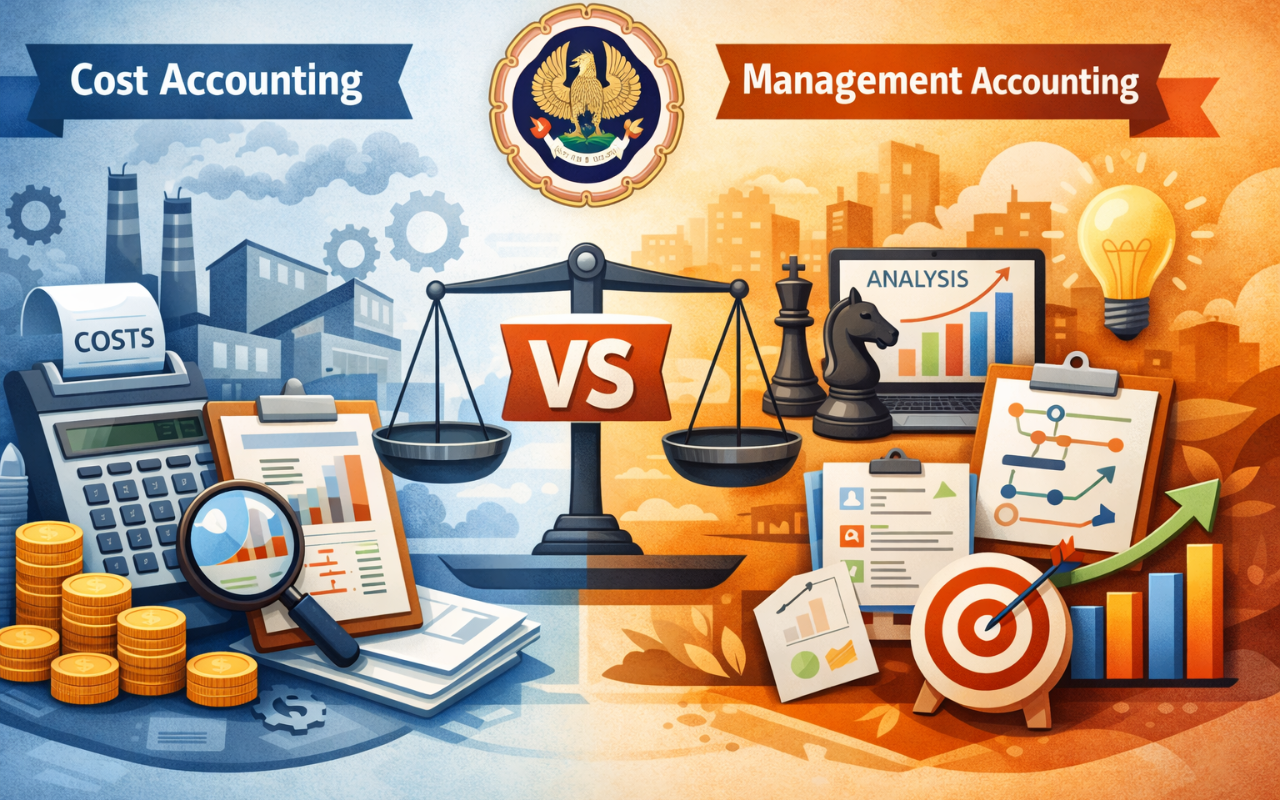
Table of Content
Cost and management accounting play an important role in business operations by focusing on the internal financial processes of an organization. Unlike financial accounting, which provides data to investors and external stakeholders such as regulatory bodies, cost and management accounting plans, monitoring, and decision-making help internal management.
These accounting methods act as essential tools, ensuring smooth information flow for better organizational control and strategic decisions. Understanding cost and management accounting is particularly important for students preparing for the CA exam.
What is cost accounting?
Cost accounting is a special field of accounting that focuses on tracking, analyzing, and managing the costs involved in production and services. It helps in recording and classifying businesses, providing valuable insight for better decision-making, planning, and cost control.
By understanding cost structures and trends, companies can optimize expenses, improve efficiency, and promote profitability. This financial equipment plays an important role in helping the management make an alternative to enhance overall commercial performance.
Objective of Cost Accounting
Cost accounting fulfills many major objectives that help businesses manage and adapt their financial performance. Its main objectives are explained below:
1. Cost Ascertainment: Cost accounting helps determine the exact cost of products, services, or operations within a business. Using methods such as job costs, process costs, and activity-based costs, companies can measure and allocate costs correctly. It helps in understanding competitive pricing and cost structures.
2. Cost control: It helps in the monitoring and management of expenses to ensure that they stay within the budget limits. Techniques such as standard costs, budgets, and variance analysis compare actual costs with planned costs, helping to identify discrepancies and unnecessary expenses. Businesses can take corrective action to improve financial efficiency.
3. Cost reduction: Cost accounting aims to reduce expenses without affecting quality or performance. Continuous improvement, waste reduction, and procedure adaptation can increase profitability by maintaining business product or service standards and reducing overall costs.
4. Profitability analysis: It helps in assessing the profitability of products, services, or departments. Using margin analysis, break-even analysis, and segmental beneficiality assessment can help decide on pricing, product mix, and market strategies to maximize business earnings.
5. Inventory valuation: Financial reporting requires the accurate evaluation of raw materials, functioning, and finished goods. Cost accounting implements methods such as FIFO (first in, first out), LIFO (last in, first out), and methods such as weighted average costs to ensure correct benefits calculations and transparency in financial reports.
Management Accounting
Management accounting, also called managerial accounting, is a branch of accounting that helps businesses make smart decisions. This provides financial and non-financial data to internal teams, such as officials and managers of the department, enabling them to plan strategies and improve performance.
Unlike financial accounting, which is for external stakeholders, management accounting focuses on internal operations. By analyzing cost, budget, and forecasts, it plays an important role in strategic planning, performance tracking, and business development.
Difference Between Cost Accounting and Management Accounting
Cost accounting focuses on cost determination and control, while management accounting emphasizes using financial data for informed decision-making, planning, and performance evaluation to drive business strategy. Both support business operations.
| Difference Between Cost Accounting and Management Accounting | ||
| Aspect | Cost Accounting | Management Accounting |
| Objective | Tracks and controls production and operational costs. | Helps in planning, decision-making, and overall business control. |
| Primary Focus | Measures, allocates, and manages costs. | Provides financial and non-financial insights for better decision-making. |
| Scope | Costing of products and services. | Covers budgeting, performance evaluation, risk management, and financial planning. |
| Users | Internal teams like production managers. | Top management and various internal stakeholders. |
| Time Perspective | Analyzes past and present costs. | Forward-looking with future projections and business strategies. |
| Reports Generated | Cost sheets, budgets, variance reports, and cost-volume analysis. | Budgets, performance reports, financial forecasts, and strategic plans. |
| Nature Of Data | Primarily quantitative financial and cost-related data. | Both quantitative (financial) and qualitative (market trends, operational insights) data. |
| Regulatory Requirement | Not legally required, but essential for cost control. | Not mandatory, but crucial for internal business decisions. |
| Data Precision | Highly detailed and specific. | Less precise but focuses on strategic insights. |
| Decision Support | Helps with pricing, production, and cost-cutting strategies. | Supports resource allocation, growth strategies, and overall business decisions. |
| Common Techniques Used | Job costing, process costing, and activity-based costing. | Budgeting, variance analysis, financial modeling, and performance evaluation. |
| Reporting Frequency | Regular reports (monthly, quarterly) based on costing periods. | Reports can be periodic or ad hoc, depending on management needs. |
| Resulting Actions | Focuses on reducing and controlling costs. | Aims at strategic decision-making, improving business performance, and managing risks. |
Function of Cost Accounting
There are some functions of cost accounting-
-
Cost control: Cost allows accounting organizations to track actual costs against budgetary costs. This enables managers to identify variance and take corrective action for waste minimization and optimal resource use. This process involves checking expenditure at regular intervals; it improves efficiency and increases profitability.
-
Cost allocation: The correct cost allocation for profitability measurement through assignments of costs for some departments, products, or services is fundamental. Costs are different functions of accounting that ensure that direct costs, such as raw materials, and indirect costs, such as overheads, are correctly allocated so that each section can know its financial health.
-
Pricing decision: Cost is a good understanding of structures that determine whether prices are competitive. It is possible to decide from the data generated from cost accounting what will be the best price for products so that they have an opportunity to sell. The optimal pricing decisions will ensure that the prices of the products are sufficient to compensate for the cost, while at the same time remaining attractive to the customer. Therefore, this analysis supports exemption, markup, and publicity pricing decisions.
Functions of Management Accounting
There are some functions of management accounting:
-
Strategic Planning: The management accounting function is useful for strategic planning in terms of providing insights and analysis on financial data and market trends. In this way, management accounting plays an important role in identifying the development opportunities and identifying future-proofing potential challenges, which guide organizations to clarify clear financial objectives and allocate resources properly.
-
Management accounting: It can measure the level of efficiency and effectiveness within an organization by installing major performance indicators. In this regard, managers are able to understand areas that require improvement to make an organization close to strategic objectives and so align it with internal goals.
-
Risk management: Management accounting allows an organization to weigh its potential risks and uncertainties related to the financial plan. If it analyzes potential scenarios and determines their potential implications, it will be well-equipped to respond to market volatility and adjust its strategy.
Summary
Cost accounting and management accounting have developed to become seminal tools in organizations trying to optimize financial performance and operational efficiency. While cost accounting brings granular details that help manage the control of costs, management accounting presents a broader perspective, which involves strategic decisions and long-term plans.
In combination, they create a broader structure that helps organizations navigate complications in today's competitive landscape and makes them agile, informed, and prepared to accept opportunities for business growth. The mastery of these accounting practices is necessary to maintain a business atmosphere.

FAQs
What is the difference between cost accounting and management accounting?
Cost accounting focuses on calculating, controlling, and reducing costs, while management accounting uses financial and non-financial data to help with internal decisions and strategic planning.
What is the difference between CA and FA?
The CA stands for a chartered accountant, a professional designation for accountants in many countries, including India, equivalent to a certified public accountant (CPA) in the US. FA stands for financial accounting, a branch of accounting that focuses on recording, abbreviating, and reporting a business's financial transactions.
What is the role of cost accounting in strategic planning and management control?
The CA stands for a chartered accountant, a professional designation for accountants in many countries, including India, equivalent to a certified public accountant (CPA) in the US. FA stands for financial accounting, a branch of accounting that focuses on recording, summarizing, and reporting a business's financial transactions.
What is the difference between a cost accountant and a CMA?
Cost accounting focuses on identifying, analyzing, and controlling the costs of a business, while a CMA (certified management accountant) is a comprehensive designation that incorporates cost accounting, but it also includes financial planning, budgets, and strategic financial management.
What are the features of cost and management accounting?
Cost and management accounting (CMA) focuses on providing information to make internal decision-making, planning, and controlling the financial elements of the organization.
What is the full form of GAAP?
The complete form of GAAP is generally accepted accounting principles. These are usually accounting rules and standards for financial reporting, especially in the United States. They provide a framework to prepare, present, and report financial statements, which ensures stability, comparison, and reliability.
What is the role of management accounting?
The role of management accounting is to provide informed decisions to managers and to provide internal financial information to help improve performance and achieve professional goals. It focuses on identifying, analyzing, and interpreting the relevant financial data relevant to internal management, which often includes a wide cost breakdown and performance reports.
What is the main role of cost accounting?
The main function of cost accounting is to track, analyze, and report on all costs incurred by a business, providing insight to improve internal decisions and efficiency.
What are the objectives of cost and management accounting?
The primary purposes of cost and management accounting include cost detection, cost control, and assistance in decision-making. Cost accounting focuses on cost and management, while management provides information for accounting, control, and strategic decision-making.
What is CA's salary?
A fresh CA can expect to earn around 6–8 lakhs per year, while an experienced CA with 5–10 years of experience can earn 15–20 lakhs or more annually. The highest salary, potentially reaching 60-80 lakhs per year, is often seen in senior positions within large firms or MNCs and in those who choose to go to private practice.