PDF · Practice Questions
Rectification of Errors CA Foundation Questions and Answers with Practice Notes
- Shared by
- Abhishek
- Course
- CA Foundation
- Subject
- Accounting
- Added
- 28 Mar 2024
Part of: CA FoundationAccountsPractice Questions
Most read note on this topic
3 more notes on this topic ↓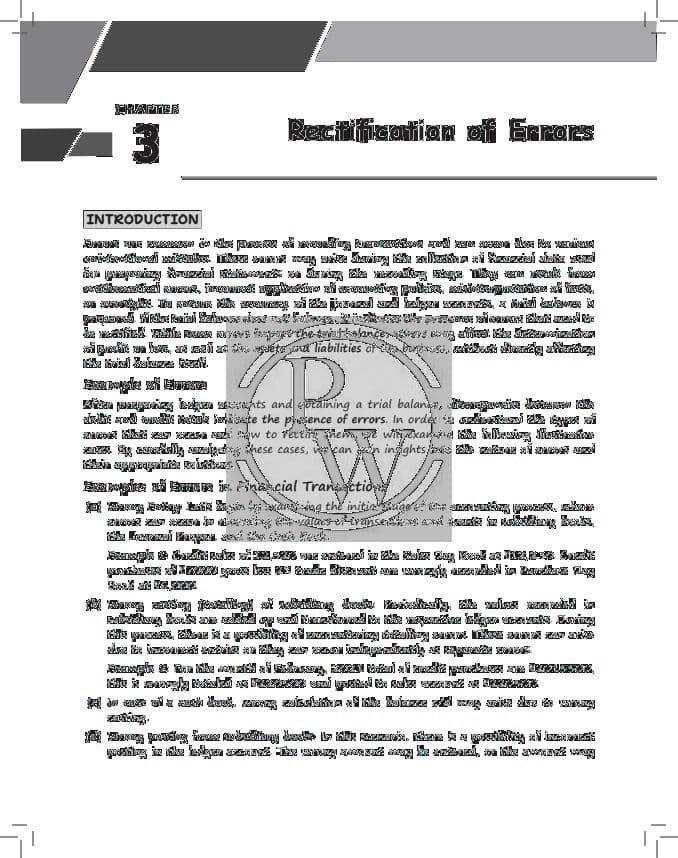
Continue reading in the Studycaller app
The full PDF — free to read, save and share in the app.
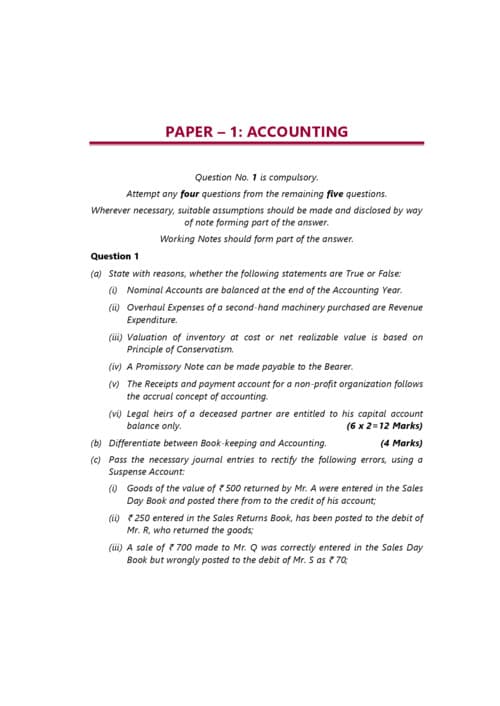
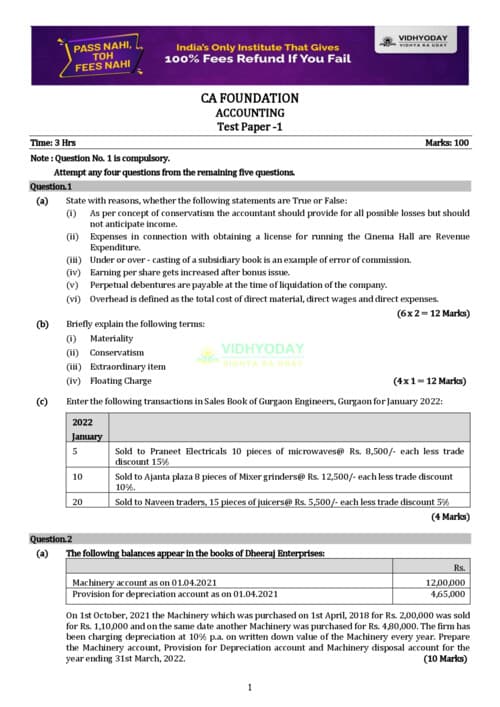
These rectification of errors CA Foundation questions and answers notes combine chapter theory with practice and previous questions in one 57-page PDF for the Accounting paper. The opening pages explain why errors creep into the journal, ledger and subsidiary books, and why a trial balance that does not tally signals mistakes that must be corrected. The note then walks through worked examples of wrong entries in the Sales Day Book and Purchase Day Book, wrong casting of subsidiary books, wrong posting, and wrong casting of ledger balances. It also maps errors to the stage at which they happen and classifies them as errors of principle, omission, commission and compensating errors. It suits CA Foundation students who want clear theory followed by question practice on rectification of errors before the exam.
What these rectification of error notes cover
The chapter opens with an introduction explaining that errors arise from mathematical slips, wrong application of accounting policies, misinterpretation of facts or plain oversight, and that some errors disturb the trial balance while others only affect profit, assets and liabilities. It then uses numbered examples: credit sales of 12,320 entered as 12,230 in the Sales Day Book, credit purchases of 7,000 less 2% trade discount wrongly recorded at 6,000, a month's purchases total miscast and posted to the sales account, and a creditor's account where the credit side is wrongly totalled. Next comes a stage-wise breakdown of errors made while journalising, posting to the ledger, balancing accounts and preparing the trial balance, including partial and complete omission, posting to the wrong account, on the wrong side or of the wrong amount. The types of errors section separates errors of principle from clerical errors, with examples such as debiting a machine purchase to building expenses. As the caption states, the remaining pages carry practice and previous questions for the chapter.
Key points on rectification of errors for the exam
First, know which errors affect the trial balance and which do not. An error of principle, such as treating the purchase of an asset as an expense, places amounts on the correct side but in the wrong account, so the trial balance still agrees. Complete omission of a transaction also leaves the trial balance unaffected, while partial omission, posting on the wrong side, posting the wrong amount and wrong casting usually make it disagree. Second, learn the four broad classes listed in the note: errors of principle, omission, commission and compensating errors, where one mistake offsets another. Third, be clear on the stage at which an error was made, because the correcting entry depends on it: a wrong amount in a day book needs a different fix from a correct day book posted to the wrong ledger account. Finally, pay attention to trade discount in purchase examples, since recording the gross figure or a wrong net figure is a common trap in examination questions on this chapter.
How to revise with these notes and past papers
Start by reading the introduction and the stages of errors list, then write a one-page chart with each error type, an example from the note and whether it affects the trial balance. Rework the numbered examples on your own before checking the explanation, since they mirror the way examiners frame short practical questions. Once the theory is clear, move to the practice and previous questions in the later pages and attempt them under time limits, writing full rectification entries rather than just identifying the error. Compare your answers with the ICAI study material chapter on rectification of errors to make sure your terminology and formats match. After that, solve the relevant questions from recent RTPs and MTPs, and finish with past examination papers to see how marks are split between identification, journal entries and their effect on profit. Mark the questions you got wrong and revisit only those in your final revision week.
Who should use these CA Foundation accounting notes
These notes are written for CA Foundation students preparing the Accounting paper, where rectification of errors is a regular source of practical and objective questions. Students who find it hard to decide whether an error affects the trial balance will benefit from the stage-wise and type-wise classification set out at the start. Those who already know the theory can jump to the practice and previous questions section to test their speed and accuracy. The chapter also helps commerce students in Class 11 and B.Com who study the same topic in financial accounting, as the concepts of errors of principle, omission, commission and compensating errors are common across syllabi. Because the note uses simple language with worked figures, it works for a first reading as well as for last-minute revision before the exam. Use it alongside your main textbook rather than as a replacement, and check the current syllabus for your attempt before relying on any single source.
Key topics in these notes
- Introduction to errors in accounting
- Trial balance and detection of errors
- Wrong entry in subsidiary books
- Wrong casting of subsidiary books
- Wrong posting from subsidiary books
- Wrong casting of ledger balances
- Stages of errors
- Errors of principle
- Errors of omission
- Errors of commission
- Compensating errors
- Practice and previous questions
Explore more Accounting notes
- rectification of errors
- ca foundation
- accounting
- trial balance
- errors of principle
- compensating errors
- practice questions
Related notes
- CA Foundation January 2026 Accounting Suggested Answers.. Follow for more precious content
- Detailed notes chapter 1 Accounting
- Unit 2 Accounting Concepts , Principles and Conventions
- Accounting theory
- Nitin goel sir Account most important notes with questions
- Accounting notes
- CA foundation accounts journal,ledger, trial balance. Handwritten notes
- # ACCOUNTING # • Theory Questions by CA NITIN GOEL SIR
More notes on this topic (3)
Comments from students
Shreyas · 7 Apr 2024
Bro do u have economic notes of demand and supply
What to study next
Frequently asked questions
Where can I find rectification of errors CA Foundation questions with answers PDF?
This 57-page note combines chapter theory with practice and previous questions on rectification of errors for CA Foundation. Open it free in the Studycaller app to read the full PDF.
What are the types of errors in rectification of errors?
The note classifies errors as errors of principle, errors of omission, errors of commission and compensating errors. Omission, commission and compensating errors are grouped as clerical errors.
Which errors do not affect the trial balance?
Errors of principle do not affect the trial balance because amounts are placed on the correct side but in the wrong account, for example debiting a machine purchase to building expenses. Complete omission of a transaction also leaves the trial balance in agreement.
What is an error of commission?
An error of commission occurs when an amount is posted to the wrong account, on the wrong side, with incorrect totals, or when an incorrect balance is struck.
At what stages can accounting errors occur?
The note lists four stages: recording in the journal, posting to the ledger, balancing ledger accounts and preparing the trial balance, with the errors typical to each stage.
What is a compensating error?
A compensating error is one whose effect is offset by another error, so the mistakes cancel each other out in the totals.
Are these notes useful for the CA Foundation Accounting paper?
Yes, they are prepared for CA Foundation Accounting and cover rectification of errors theory along with practice and previous questions for revision.