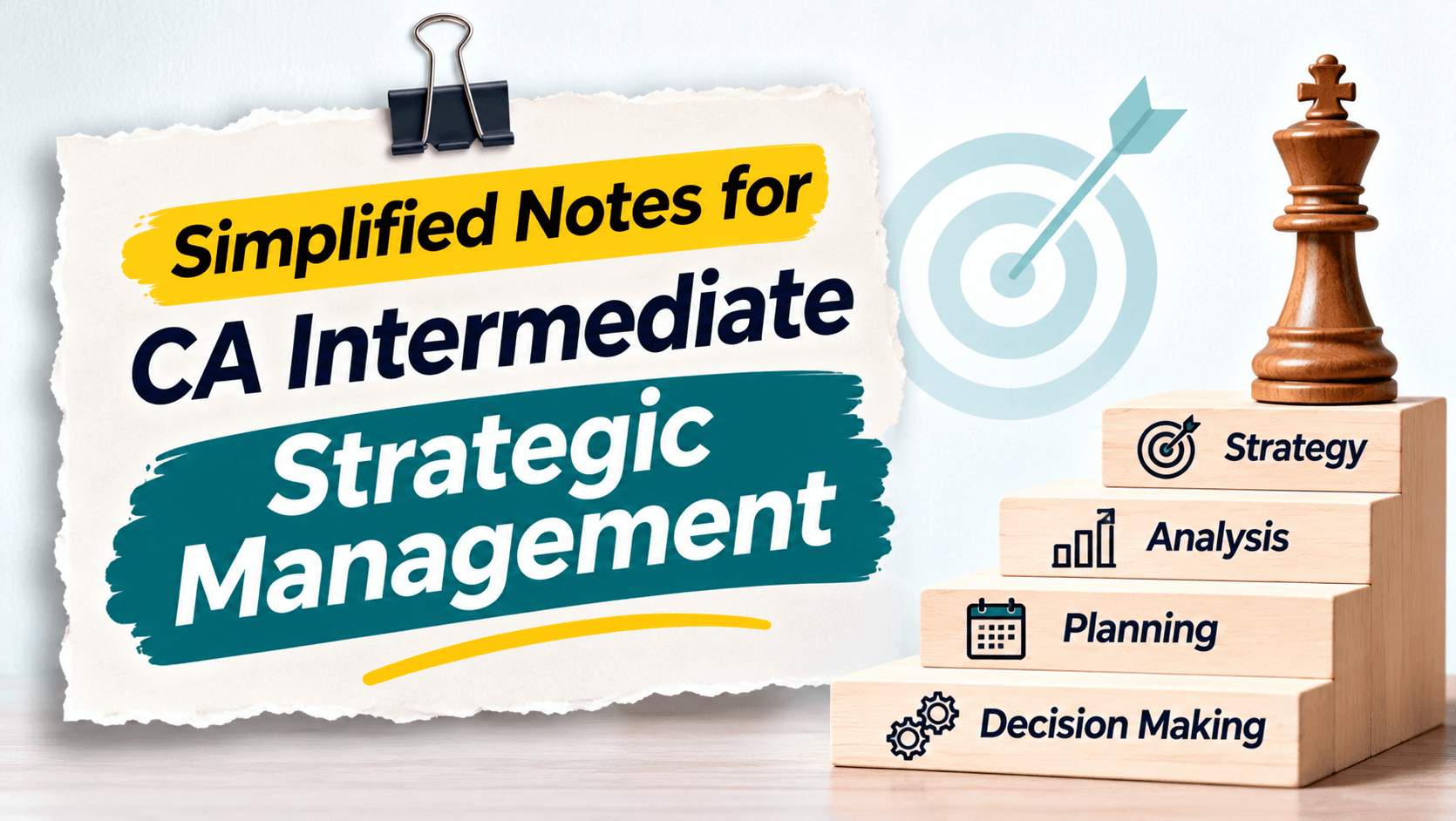
Simplified Notes for CA Intermediate Strategic Management
Explore simplified notes for ca intermediate strategic management with practical study methods, revision tips, topic planning, question practice and exam-focused…
In this article(11 sections)ShowHide
Simplified Notes for CA Intermediate Strategic Management is a practical study resource when it is built around the syllabus applicable to your examination attempt. Students often collect many pages of material but struggle to identify what to revise, how to practise and which errors need attention. A useful set of notes should make preparation clearer rather than simply shorter.
This guide explains how to organise the topic, strengthen understanding, revise systematically and use examination-style practice. The approach is designed for CA aspirants who want reliable notes, clear examples and a manageable preparation routine, with Studycaller included as a supplementary practice resource.
Understand the purpose of Strategic Management
Strategic Management is easier to study when concepts are connected to business decisions. Instead of treating every heading as an isolated definition, ask what problem the concept helps a business solve. This creates a useful foundation for remembering frameworks.
Start with the applicable ICAI study material and map the chapter sequence. Identify the central question in each chapter, such as how organisations assess their environment, select a direction or implement strategy.
Make short notes without losing meaning
A simplified note should retain the definition, key features, steps and limitations of a concept. Write a short explanation in plain language, then add the technical keywords needed for examination answers. Do not replace a complete idea with an unexplained acronym.
Use a consistent format for each topic: meaning, purpose, main elements, practical example and common confusion. This makes later revision faster because every note follows a familiar pattern.
Explain the business environment with examples
External and internal analysis becomes more memorable when linked to a real business situation. Consider how competition, technology, customers, resources and capabilities can influence a strategic decision. Use a simple hypothetical example rather than relying only on abstract terms.
After reading a framework, try applying it to a small retail business, service firm or digital platform. Ask which factors create opportunities, which create threats and which are within the organisation's control.
| Study component | What to record | How to check progress |
|---|---|---|
| Core concept | Meaning, conditions and exceptions | Explain without notes |
| Application | Worked example or short case | Solve a fresh question |
| Revision | Summary and weak points | Recall after a gap |
| Practice | Timed question and errors | Review corrections |
Distinguish strategic choices clearly
Students often confuse concepts that appear similar. Prepare comparison notes for levels of strategy, strategic alternatives and related decision-making approaches covered in the applicable syllabus. Highlight the basis of difference rather than memorising two separate long paragraphs.
A two-column comparison table can be effective. Include the purpose, decision-maker, scope and example where relevant. Check your distinctions against the current study material to preserve technical accuracy.
Turn frameworks into simple diagrams
A process or framework is easier to recall when represented as a short sequence of connected steps. Draw a compact flow showing analysis, choice, implementation and review where that structure matches the prescribed material.
The diagram should support explanation, not replace it. Under each step, add one sentence explaining its role. Practise reproducing the framework from memory and describing how the steps influence one another.
Prepare application-based examples
A business scenario may describe declining sales, new competitors, limited resources or changing customer preferences. Identify the strategic problem before choosing a framework. Explain why the selected concept helps analyse the situation.
Write short examples in your own words and vary the industry. This prevents you from memorising one illustration that may not fit a new question. Keep the example concise and directly related to the concept.
Use active recall for theory retention
Close your notes and explain the meaning, purpose and key elements of a topic aloud or in writing. Then compare your recall with the original material. This reveals missing points more effectively than repeatedly reading highlighted lines.
Use flashcards selectively for definitions, distinctions and framework elements. For longer concepts, practise a short structured answer instead of trying to memorise an entire paragraph word for word.
Sample Four-Week Study and Revision Plan
| Week | Main task | Checkpoint |
|---|---|---|
| 1 | Review syllabus and learn core concepts | Short topic quiz |
| 2 | Complete notes and practise examples | Chapter questions |
| 3 | Revise weak areas and mix topics | Timed practice |
| 4 | Review mistakes and attempt a test | Performance analysis |
Create a weekly revision rotation
Divide topics into manageable blocks and revisit earlier chapters while learning new ones. A weekly plan can include concept study, short recall sessions, scenario practice and a chapter test. The exact allocation should reflect your preparation stage.
Keep a list of concepts you confuse. Revisit these more often than areas you can explain confidently. Revision is most effective when guided by actual recall and practice results.
Practise writing concise strategic answers
Read the command word carefully. A question asking for explanation needs more than a list of headings, while an application question requires a connection to the facts. Start with the concept and develop the relevant points in a logical order.
Use short headings where they improve clarity. Avoid unrelated background and repetitive introductions. Review whether your answer includes the technical terms from the applicable study material without becoming unnecessarily lengthy.
Studycaller and a practical Strategic Management routine
A useful study routine combines simplified notes, official chapter material, scenario-based questions and timed tests. After each test, note whether mistakes came from weak definitions, confusion between frameworks or incomplete application.
Studycaller can complement this routine through practice and performance review. Use the results to improve your notes and choose the next revision topics, while keeping official ICAI material as the source for syllabus and examination updates.
CA Inter notes students love
Free notes from the Studycaller library, picked for this article.
 Detailed Notes
CA Inter · Corporate and Other Laws
Law Rapid Revision Book CA Shubham Singhal Sir
KeyurLikes 115Views 99.4k RTPs
CA Inter · Taxation
BB Direct Tax Compiler Questions and Answers CA CMA Intermediate May June Sep
RahulLikes 78Views 34.4k Questions
CA Inter · FM AND SM
Ca inter fm most important questions just give 1 🏆.Bhot hardwork se Milla hai
AshrafLikes 50Views 20.4k Amendments
CA Inter · Corporate and Other Laws
CA inter law notes By shubham singhal Detailed notes from may 25 onwards Follow for more.
Arya ShelkeLikes 47Views 24.5k
Frequently asked questions
How should I prepare simplified Strategic Management notes?
Strategic Management is easier to study when concepts are connected to business decisions. Start with the applicable ICAI study material and map the chapter sequence. Use the official ICAI material relevant to your attempt and check your understanding with short questions or timed practice.
Can I study Strategic Management without memorising paragraphs?
A simplified note should retain the definition, key features, steps and limitations of a concept. Use a consistent format for each topic: meaning, purpose, main elements, practical example and common confusion. Use the official ICAI material relevant to your attempt and check your understanding with short questions or timed practice.
How do I remember strategy frameworks?
External and internal analysis becomes more memorable when linked to a real business situation. After reading a framework, try applying it to a small retail business, service firm or digital platform. Use the official ICAI material relevant to your attempt and check your understanding with short questions or timed practice.
Are business examples useful?
Students often confuse concepts that appear similar. A two-column comparison table can be effective. Use the official ICAI material relevant to your attempt and check your understanding with short questions or timed practice.
What is the best way to revise definitions?
A process or framework is easier to recall when represented as a short sequence of connected steps. The diagram should support explanation, not replace it. Use the official ICAI material relevant to your attempt and check your understanding with short questions or timed practice.
How should I compare similar concepts?
A business scenario may describe declining sales, new competitors, limited resources or changing customer preferences. Write short examples in your own words and vary the industry. Use the official ICAI material relevant to your attempt and check your understanding with short questions or timed practice.
Should I draw diagrams in my notes?
Close your notes and explain the meaning, purpose and key elements of a topic aloud or in writing. Use flashcards selectively for definitions, distinctions and framework elements. Use the official ICAI material relevant to your attempt and check your understanding with short questions or timed practice.
How can I improve case-based answers?
Divide topics into manageable blocks and revisit earlier chapters while learning new ones. Keep a list of concepts you confuse. Use the official ICAI material relevant to your attempt and check your understanding with short questions or timed practice.
How often should I revise Strategic Management?
Read the command word carefully. Use short headings where they improve clarity. Use the official ICAI material relevant to your attempt and check your understanding with short questions or timed practice.
How can Studycaller help with preparation?
A useful study routine combines simplified notes, official chapter material, scenario-based questions and timed tests. Studycaller can complement this routine through practice and performance review. Use the official ICAI material relevant to your attempt and check your understanding with short questions or timed practice.