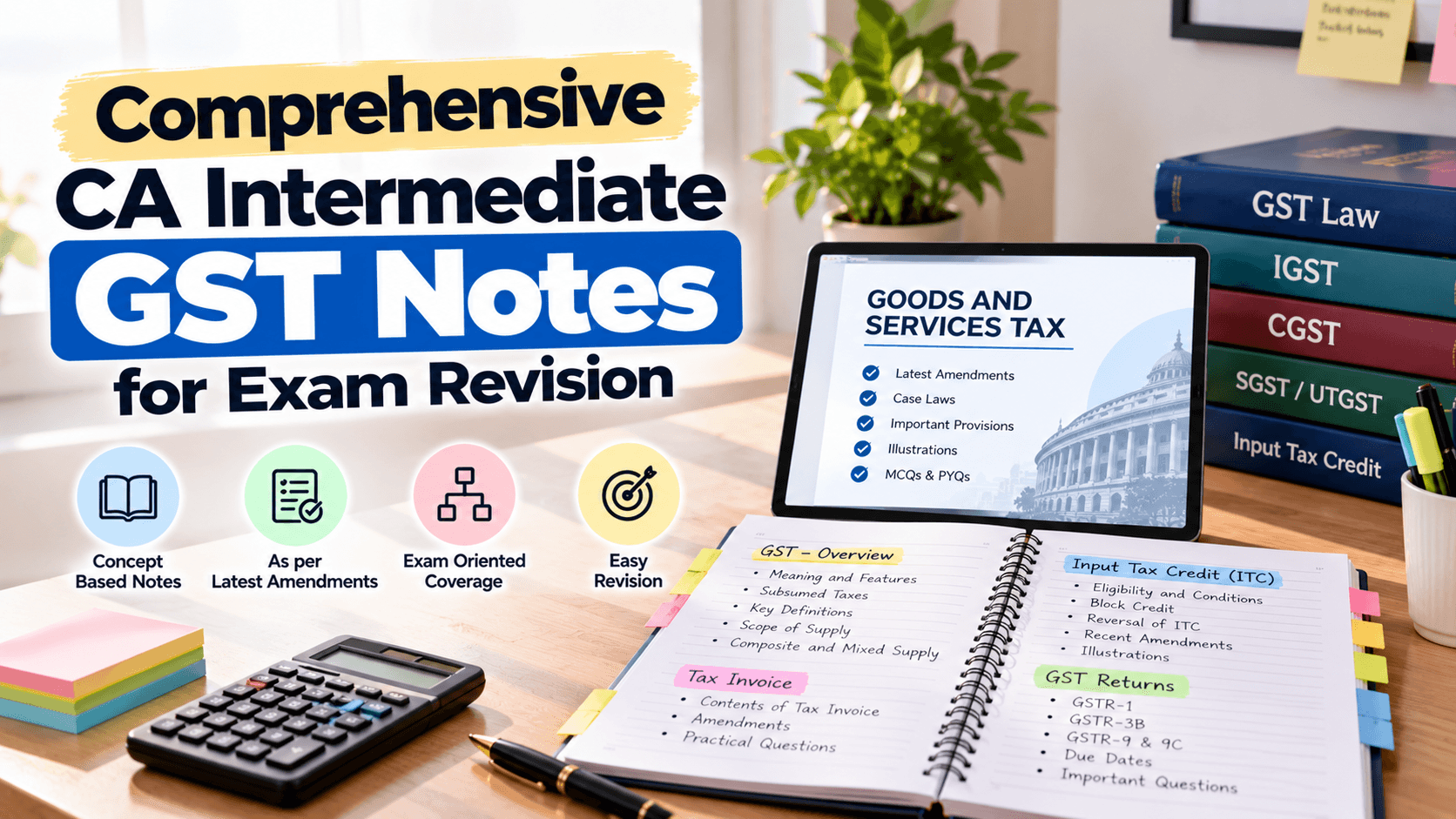
Comprehensive CA Intermediate GST Notes for Exam Revision
Organise CA Intermediate GST revision with chapter summaries, conditions, time limits, practical examples and question practice aligned with applicable ICAI material.
In this article(11 sections)ShowHide
GST revision can become confusing when provisions, conditions, exceptions and calculations are spread across lengthy notes. A chapter-wise structure helps you understand how rules work and makes them easier to revise before the examination. The goal is not simply to make the shortest notes, but to create notes that support accurate answers.
GST law and examination applicability can change. Check the ICAI study material, statutory updates and announcements relevant to your CA Intermediate attempt. Treat any summary as a revision aid rather than a replacement for official material.
Check syllabus and amendments
Confirm the syllabus and GST coverage for your attempt, including the statutory updates and amendment cut-off stated by ICAI. Older notes may explain a concept well but contain outdated limits, time periods or procedures.
Keep an update sheet listing the chapter, change, applicability and source. If a question refers to a particular date or transaction period, read the facts carefully and apply the rule relevant to that context.
Make chapter-wise summaries
Follow the prescribed study material. For each chapter, write the purpose of the provision, key conditions, process or calculation, exceptions and a short illustration. Keep detailed examples separate so the summary remains easy to scan.
Use official terminology accurately. GST concepts can sound similar while operating differently, so do not replace legal terms with vague wording. Simplify only when the meaning and conditions remain intact.
Summarise supply concepts
For supply-related concepts, focus on the conditions and distinctions prescribed in your material. Note the facts that determine whether a transaction falls within a category, along with relevant exceptions. A decision tree can help you apply the concepts to a new situation.
Practise short scenarios rather than memorising examples alone. Change one fact in a solved example and ask whether the result changes. This tests whether you understand which facts matter.
Organise time limits and procedures
Keep a separate table for time limits or procedural steps included in the syllabus. Record the trigger event, required action, time period and any stated exception.
Verify each number and period against the applicable material. Do not mix a general rule with an exception or assume a timeline applies to every category of taxpayer. Put dates in order before deciding which provision applies.
Prepare input tax credit notes
For input tax credit topics in your syllabus, create a checklist of eligibility conditions, restrictions, documentation and relevant time limits. Follow the prescribed material and distinguish a condition that must be met from a restriction that prevents a claim.
Apply the checklist to practice scenarios. State which condition is met, which is not and what consequence follows under the applicable rule. This encourages explanation rather than guessing based on a familiar phrase.
Practise GST calculations
Write calculations in a consistent order and label the figures you use. Show relevant working rather than jumping straight to a final number. Clear working helps you catch mistakes and makes your answer easier to review.
Separate concept errors from arithmetic errors. If the concept is wrong, revisit the provision. If the method is correct but arithmetic is wrong, practise more questions using the same working format.
Compare related concepts
Comparison tables are useful when provisions differ by scope, conditions, treatment or procedure. Use only distinctions supported by official study material and keep the table compact.
Cover one side of the table and recall the missing details. Then solve a question where you must choose between the concepts. This helps you apply the comparison during an examination.
Track errors and revision
Record the topic, mistake, cause and corrective action after each practice session. Common causes include misunderstood conditions, outdated figures, missed facts, incorrect classification and calculation errors.
Mark each chapter as not started, in progress, revised and practised. Do not mark a chapter complete simply because you read it; include recall or a practice set before treating it as ready.
Use Studycaller for practice
Studycaller can be an additional practice resource alongside ICAI material. Choose notes and tests aligned with your syllabus and applicable GST amendments. Verify legal conditions and updated figures through official sources.
Use test results to decide what to revise next. If you forget a condition, create a recall prompt. If timing is the problem, practise a set under a time limit and review how you used the available minutes.
Plan final revision
Prioritise verified summaries, important conditions, procedural timelines, calculations and questions you previously answered incorrectly. Avoid adding large amounts of material without checking its relevance to your attempt.
Use short revision blocks and mixed practice. Close your notes and write key steps or conditions from memory. Recall, practice and correction are more useful than repeated reading without testing yourself.
How Studycaller Can Support Your Revision
Studycaller can be used as an additional revision and practice resource alongside the applicable ICAI study material. Choose content aligned with your examination attempt, and verify syllabus coverage, amendments and examination instructions through official ICAI sources.
CA Inter GST notes
Free notes from the Studycaller library, picked for this article.
 Questions
CA Inter · Taxation
CA inter GST super 30 question by CA Vishal bhattad sir
HarshLikes 43Views 49.6k Amendments
CA Inter · Taxation
CA Inter Indirect Tax Question Bank by CA Amit Mahajan for May June Sept Dec
InterverseLikes 36Views 30.4k Summary
CA Inter · Taxation
GST Summary book by Amit Mahajan sir September/January 2025 Exam
AbhinavLikes 26Views 20.9k Questions
CA Inter · Taxation
Gst QB
VickyLikes 24Views 26k
Frequently asked questions
How should I make CA Intermediate GST notes?
Follow the prescribed chapter sequence and summarise each provision’s scope, conditions, exceptions and examples. Keep timelines and calculation methods in separate tables.
Are old GST notes useful?
They can explain concepts, but compare them with applicable ICAI study material and amendments before relying on them.
How do I revise GST time limits?
Create a table showing the trigger event, required action, time period and exceptions. Verify each figure and apply it to date-based scenarios.
How can I improve GST calculation accuracy?
Use a consistent working format, label adjustments and check relevant conditions before calculating. Review whether mistakes came from concepts or arithmetic.
Should I memorise GST provisions?
Understand the rule and conditions first. Memorise required details and practise applying them to varied scenarios.
What is the role of practice questions?
They test whether you can apply provisions to facts, identify conditions and complete calculations under time pressure.
How often should I revise GST?
Use regular short sessions and increase mixed practice closer to the examination. Revisit topics where your error log shows repeated mistakes.
Can summary notes replace ICAI material?
No. Summary notes support revision; use prescribed ICAI material and applicable updates as the main reference.
Can Studycaller help with GST revision?
Studycaller can provide additional practice when content matches your syllabus. Verify applicability and amendments against official ICAI sources.
What should I do in the last week?
Review verified summaries, conditions, timelines and calculations, then attempt mixed questions. Focus on known errors instead of rewriting all notes.