Revision Booklet for CA Final Advanced Auditing
Explore revision booklet for ca final advanced auditing with practical study methods, revision tips, topic planning, question practice and exam-focused guidance from…
In this article(11 sections)ShowHide
Revision Booklet for CA Final Advanced Auditing is a practical study resource when it is built around the syllabus applicable to your examination attempt. Students often collect many pages of material but struggle to identify what to revise, how to practise and which errors need attention. A useful set of notes should make preparation clearer rather than simply shorter.
This guide explains how to organise the topic, strengthen understanding, revise systematically and use examination-style practice. The approach is designed for CA aspirants who want reliable notes, clear examples and a manageable preparation routine, with Studycaller included as a supplementary practice resource.
Build a revision booklet around the current syllabus
Start with the ICAI study material and the syllabus applicable to your examination attempt. Advanced Auditing and related professional ethics areas require accurate concepts, current standards and a clear understanding of the examiner's requirements. Your booklet should follow the applicable chapter sequence rather than an old coaching index.
Create a chapter tracker with the topic, source reference, revision status and last practice date. Mark chapters that contain extensive procedures or frequently confused terminology. This prevents the booklet from becoming a collection of disconnected highlights.
Create a one-page chapter summary
For each chapter, record the core objective, important definitions, responsibilities, procedures, reporting implications and common exceptions. A one-page summary should help you recall the structure before you return to detailed study material.
Write in your own words wherever possible, but retain the correct technical meaning. Do not shorten a requirement so much that a condition or exception disappears. Add a source page reference for any statement you may need to verify.
Organise Standards on Auditing systematically
Group relevant Standards on Auditing by their purpose and the stage of an audit. A compact table can record the objective, principal responsibility, key documentation points and typical examination applications. This is more useful than memorising a list of standard numbers without context.
Focus on how a standard operates in a scenario. When a question describes an audit situation, you should be able to identify the underlying requirement and explain what the auditor should consider. Verify the exact standard wording in the prescribed material.
| Study component | What to record | How to check progress |
|---|---|---|
| Core concept | Meaning, conditions and exceptions | Explain without notes |
| Application | Worked example or short case | Solve a fresh question |
| Revision | Summary and weak points | Recall after a gap |
| Practice | Timed question and errors | Review corrections |
Revise audit planning and risk assessment
Audit planning, risk assessment and responses to assessed risks are connected concepts. Make a short flow from understanding the entity to identifying risks, designing responses and documenting work. This helps you explain the logic of an audit rather than listing isolated steps.
Practise scenarios involving management estimates, internal controls and unexpected findings. Ask which risk is present, what additional evidence is needed and how the audit approach may change. These questions develop practical application.
Summarise audit evidence and documentation
Prepare concise notes on the nature, relevance and reliability of audit evidence, together with the purpose of documentation. Distinguish between procedures that obtain evidence and the conclusions that can reasonably be drawn from it.
A strong revision note should also explain why evidence may be insufficient and what further action is appropriate. Use short illustrations involving confirmations, analytical procedures or management representations to connect concepts with examination questions.
Prepare reporting and professional ethics notes
Reporting topics benefit from comparison tables showing the circumstances that lead to different reporting considerations. Professional ethics should be revised through duties, restrictions, safeguards and situation-based examples, using the material applicable to the attempt.
Do not memorise a reporting conclusion without the conditions that support it. For ethics cases, identify the relationship, threat or conduct described before selecting the relevant requirement. This keeps answers tied to the facts.
Use case-based questions in every revision cycle
Advanced Auditing questions often reward professional judgement and explanation. After revising a topic, attempt one short application-based question without looking at your notes. Then compare the issue identification, relevant requirement and conclusion with reliable solutions.
Maintain a mistake log. Separate errors caused by weak concepts, confusion between standards, incomplete analysis and poor answer structure. A targeted correction is more effective than rereading the entire chapter.
Sample Four-Week Study and Revision Plan
| Week | Main task | Checkpoint |
|---|---|---|
| 1 | Review syllabus and learn core concepts | Short topic quiz |
| 2 | Complete notes and practise examples | Chapter questions |
| 3 | Revise weak areas and mix topics | Timed practice |
| 4 | Review mistakes and attempt a test | Performance analysis |
Design a three-pass revision routine
In the first pass, rebuild the topic framework and correct incomplete notes. In the second, practise mixed questions and revisit weak areas. In the final pass, use your condensed booklet, error log and short recall tests instead of rewriting everything.
Keep time for full-length paper practice as the examination approaches. Use the booklet to support recall, not as a substitute for the detailed material required to understand the subject.
Avoid common revision booklet mistakes
Copying large textbook paragraphs makes a booklet difficult to use in the final days. Excessive colour coding, outdated references and missing exceptions are other common problems. A concise note must still be technically correct and complete enough for recall.
Check whether every page answers a practical revision question: What must I remember? When does it apply? What can go wrong? How might I explain it in an answer? Remove decorative material that does not help.
How Studycaller fits into an auditing revision plan
Use topic-wise practice to test whether your revision booklet supports recall under examination conditions. Review answers for accuracy, clarity and application. Convert recurring mistakes into short additions to your booklet.
Studycaller can be part of a structured preparation routine through revision guidance and test practice. Always verify auditing standards, syllabus coverage and professional requirements using the official ICAI material relevant to your attempt.
CA Final Audit notes
Free notes from the Studycaller library, picked for this article.
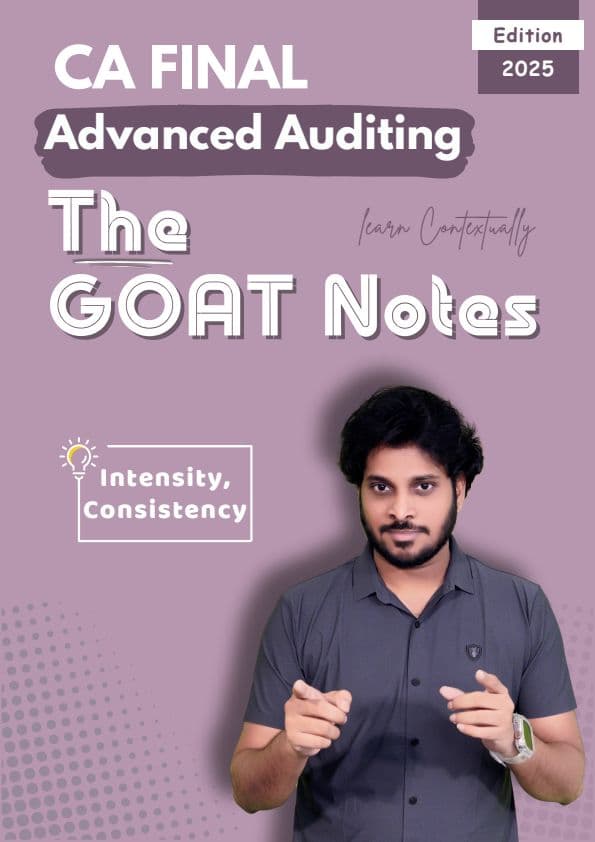 Detailed Notes
CA Final · Advanced Auditing, Assurance and Professional Ethics
CA Final Advanced Auditing GOAT notes by CA RAM HARSHA
BkjLikes 7Views 18.8k Handwritten
CA Final · Advanced Auditing, Assurance and Professional Ethics
Audit Sa Handwritten Charts By Kapil Goyal Sir, Notes By Aakash Gupta
Atish ToradmalLikes 7Views 9.4k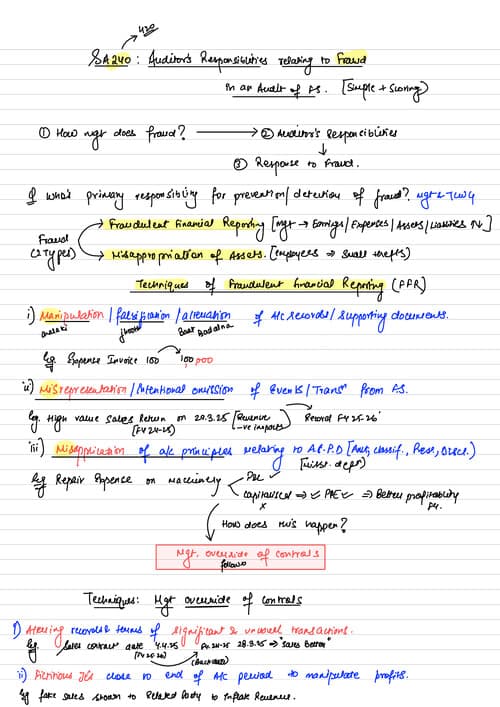 Handwritten
CA Final · Advanced Auditing, Assurance and Professional Ethics
SA 240 subham keshwani
PareekLikes 6Views 20.3k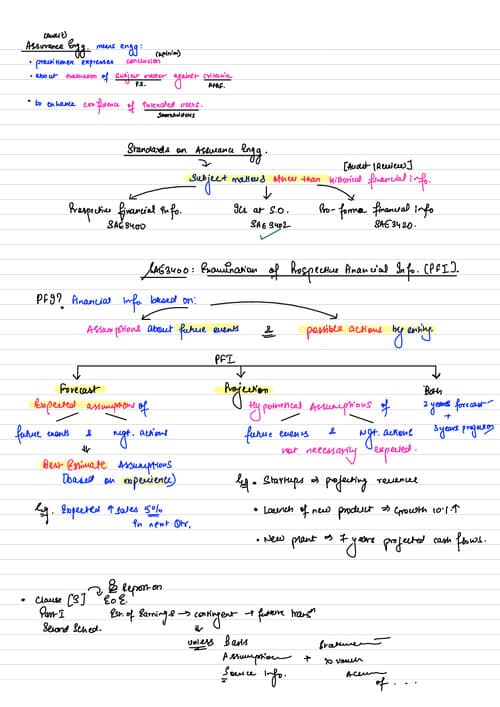 Handwritten
CA Final · Advanced Auditing, Assurance and Professional Ethics
SAE 3400-3402-3420 subham keshwani
PareekLikes 5Views 7.6k
Frequently asked questions
What should a CA Final auditing revision booklet include?
Start with the ICAI study material and the syllabus applicable to your examination attempt. Create a chapter tracker with the topic, source reference, revision status and last practice date. Use the official ICAI material relevant to your attempt and check your understanding with short questions or timed practice.
How do I revise Standards on Auditing efficiently?
For each chapter, record the core objective, important definitions, responsibilities, procedures, reporting implications and common exceptions. Write in your own words wherever possible, but retain the correct technical meaning. Use the official ICAI material relevant to your attempt and check your understanding with short questions or timed practice.
Should I memorise standard numbers?
Group relevant Standards on Auditing by their purpose and the stage of an audit. Focus on how a standard operates in a scenario. Use the official ICAI material relevant to your attempt and check your understanding with short questions or timed practice.
How can I revise professional ethics?
Audit planning, risk assessment and responses to assessed risks are connected concepts. Practise scenarios involving management estimates, internal controls and unexpected findings. Use the official ICAI material relevant to your attempt and check your understanding with short questions or timed practice.
Are case studies important in Advanced Auditing?
Prepare concise notes on the nature, relevance and reliability of audit evidence, together with the purpose of documentation. A strong revision note should also explain why evidence may be insufficient and what further action is appropriate. Use the official ICAI material relevant to your attempt and check your understanding with short questions or timed practice.
How long should a chapter summary be?
Reporting topics benefit from comparison tables showing the circumstances that lead to different reporting considerations. Do not memorise a reporting conclusion without the conditions that support it. Use the official ICAI material relevant to your attempt and check your understanding with short questions or timed practice.
How can I avoid outdated auditing notes?
Advanced Auditing questions often reward professional judgement and explanation. Maintain a mistake log. Use the official ICAI material relevant to your attempt and check your understanding with short questions or timed practice.
When should I attempt full-length tests?
In the first pass, rebuild the topic framework and correct incomplete notes. Keep time for full-length paper practice as the examination approaches. Use the official ICAI material relevant to your attempt and check your understanding with short questions or timed practice.
How do I revise audit reporting topics?
Copying large textbook paragraphs makes a booklet difficult to use in the final days. Check whether every page answers a practical revision question: What must I remember? When does it apply? What can go wrong? How might I explain it in an answer? Remove decorative material that does not help. Use the official ICAI material relevant to your attempt and check your understanding with short questions or timed practice.
How can Studycaller support my revision?
Use topic-wise practice to test whether your revision booklet supports recall under examination conditions. Studycaller can be part of a structured preparation routine through revision guidance and test practice. Use the official ICAI material relevant to your attempt and check your understanding with short questions or timed practice.