Insolvency Professional Career for CAs: Opportunities and Growth
Explore the insolvency professional career for CAs, including roles, responsibilities, career opportunities, required skills, and prospects in the insolvency sector.
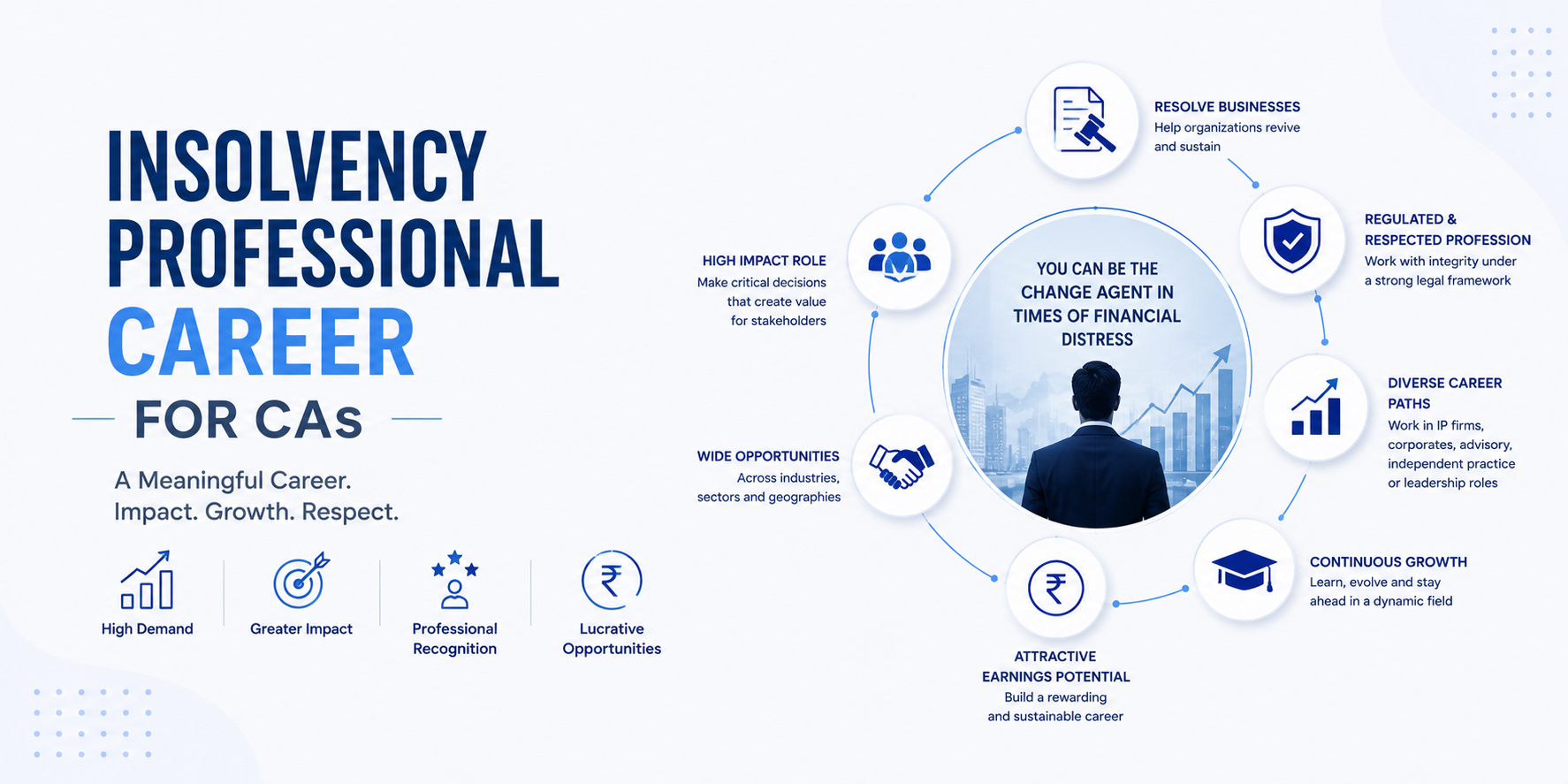
Table of Content
- Understanding the Role of an Insolvency Professional
- Why Chartered Accountants Are Suitable for This Career
- The Career Offers Diverse Exposure
- Growing Demand Is Creating New Opportunities
- Financial Analysis Plays a Key Role
- Negotiation and Communication Skills Matter
- Career Opportunities Beyond Independent Practice
- Challenges in the Insolvency Profession
- The Future of Insolvency Practice for CAs
- Conclusion
The introduction of the Insolvency and Bankruptcy Code (IBC) has significantly transformed India's financial and corporate landscape. As businesses face financial distress, restructuring challenges, and insolvency proceedings, the demand for qualified professionals who can manage these situations has increased considerably.
Among all finance professionals, Chartered Accountants are particularly well-positioned to build successful careers in the insolvency ecosystem. Their expertise in accounting, auditing, financial analysis, taxation, and corporate laws provides a strong foundation for handling complex insolvency matters.
Over the last few years, the insolvency profession has emerged as a specialized and respected career path. For CAs looking beyond traditional practice areas, it offers opportunities to work on challenging assignments while contributing to the revival and restructuring of businesses.
Understanding the Role of an Insolvency Professional
An Insolvency Professional (IP) plays a central role in insolvency and bankruptcy proceedings. Once appointed, the professional takes responsibility for managing various aspects of the insolvency process in accordance with legal requirements.
The role often involves working with creditors, lenders, company management, legal professionals, and regulatory authorities. Unlike traditional accounting assignments, insolvency work requires balancing financial analysis with strategic decision-making. The objective is not always liquidation. In many cases, the focus is on finding viable solutions that can help businesses recover and continue operations. This makes the profession both challenging and highly impactful.
Why Chartered Accountants Are Suitable for This Career
The skills developed during a CA's professional journey align closely with the requirements of insolvency assignments. Chartered Accountants already possess knowledge of:
- Financial statement analysis and business valuation.
- Corporate finance and debt management.
- Regulatory compliance and governance requirements.
These competencies help professionals assess a company's financial condition and identify practical solutions during distress situations. Additionally, CAs are accustomed to handling complex financial information, which is a critical aspect of insolvency proceedings. Their analytical mindset often becomes a significant advantage in this field.
The Career Offers Diverse Exposure
One of the biggest attractions of insolvency practice is the variety of work involved. Unlike routine compliance assignments, insolvency engagements expose professionals to businesses from different industries and situations. Every case presents unique financial, operational, and legal challenges. A professional may work on:
- Corporate restructuring assignments.
- Resolution processes for distressed businesses.
- Liquidation proceedings.
- Debt recovery and stakeholder negotiations.
This diversity keeps the work dynamic and intellectually stimulating. Many professionals find insolvency assignments more engaging because each case requires a customized approach.
Growing Demand Is Creating New Opportunities
The insolvency ecosystem in India continues to evolve. Banks, financial institutions, creditors, investors, and businesses increasingly require professional support in resolving financial distress. This growing demand has expanded opportunities for qualified Insolvency Professionals.
As economic activities become more complex, the need for specialists who understand restructuring and turnaround strategies is expected to increase further. For Chartered Accountants seeking niche practice areas, insolvency offers a field with strong long-term potential. It is no longer viewed as a niche legal process alone but as an important part of the broader financial services ecosystem.
Financial Analysis Plays a Key Role
A major responsibility of insolvency professionals involves evaluating the financial health of distressed organizations. This requires detailed analysis of:
- Assets and liabilities.
- Cash flow patterns.
- Debt obligations and repayment capacity.
The ability to interpret financial information accurately helps stakeholders make informed decisions regarding restructuring or resolution strategies. Because Chartered Accountants are trained extensively in financial analysis, they often adapt well to these responsibilities. Their expertise helps create practical solutions for complex financial challenges.
Negotiation and Communication Skills Matter
Technical knowledge alone is not enough in insolvency practice. Professionals frequently interact with creditors, lenders, investors, legal teams, employees, and company management. Different stakeholders often have conflicting interests and expectations. As a result, effective communication and negotiation skills become extremely important. Successful insolvency professionals are usually those who can:
- Build consensus among stakeholders.
- Explain complex financial matters clearly.
- Manage discussions professionally during challenging situations.
These interpersonal skills often play a major role in achieving successful outcomes.
Career Opportunities Beyond Independent Practice
Many people associate insolvency careers only with independent practice, but the opportunities are much broader. Chartered Accountants with insolvency expertise may work with:
- Insolvency Professional Entities (IPEs).
- Consulting and advisory firms.
- Financial institutions and banks.
- Asset reconstruction companies.
Some professionals combine insolvency services with their existing CA practice, while others choose to specialize entirely in restructuring and resolution work. This flexibility makes the career path attractive for professionals at different stages of their careers.
Challenges in the Insolvency Profession
Like any specialized field, insolvency practice comes with its own challenges. Assignments often involve:
- Complex legal and financial issues.
- Tight timelines and procedural requirements.
- Multiple stakeholders with competing interests.
Professionals must remain updated on regulatory developments and continuously strengthen their technical knowledge. However, many practitioners view these challenges as opportunities to develop expertise and build a strong professional reputation. The complexity of the work is often one of the reasons the profession remains highly respected.
The Future of Insolvency Practice for CAs
The future of insolvency practice appears promising as businesses, lenders, and investors increasingly recognize the importance of structured resolution mechanisms. Factors supporting future growth include:
- Greater awareness of insolvency frameworks.
- Increasing demand for business restructuring expertise.
- Expansion of financial and corporate advisory services.
As the economy continues evolving, professionals with insolvency and turnaround management skills are likely to remain valuable. For Chartered Accountants willing to specialize, this field offers opportunities for both professional growth and meaningful impact.
Conclusion
An insolvency professional career for CAs offers a unique combination of financial expertise, strategic decision-making, and problem-solving responsibilities. The profession provides exposure to complex business situations, diverse industries, and high-impact assignments that go far beyond traditional accounting work. With growing demand for restructuring and resolution services, insolvency practice is emerging as a promising specialization for Chartered Accountants. Those who combine strong technical knowledge with communication, analytical, and negotiation skills can build rewarding careers in this evolving field.

FAQs
What is an insolvency professional career for CAs?
An insolvency professional career involves managing insolvency and bankruptcy proceedings, restructuring distressed businesses, and assisting stakeholders in finding resolution solutions. Chartered Accountants are well-suited for this field because of their strong financial and regulatory expertise.
Why are Chartered Accountants suitable for becoming Insolvency Professionals?
Chartered Accountants possess knowledge of financial analysis, auditing, taxation, corporate laws, and business valuation. These skills help them assess distressed companies, evaluate financial conditions, and support effective restructuring or resolution processes.
What kind of work does an Insolvency Professional perform?
An Insolvency Professional may handle corporate insolvency resolution processes, liquidation proceedings, debt restructuring assignments, stakeholder coordination, and financial assessments. The work often involves balancing legal requirements with practical business solutions.
Is insolvency practice a good career option for CAs?
Yes, insolvency practice offers specialized career opportunities, diverse assignments, and exposure to complex business situations. It can be an attractive option for CAs seeking a niche area beyond traditional audit and taxation services.
What skills are important for success in insolvency practice?
Apart from technical expertise, professionals need analytical thinking, communication abilities, negotiation skills, problem-solving capabilities, and the ability to manage multiple stakeholders during complex restructuring situations.
Can a CA pursue insolvency practice along with regular professional services?
Yes, many Chartered Accountants combine insolvency assignments with existing services such as taxation, audit, consulting, and advisory work. Others choose to specialize completely in insolvency and restructuring services.
What industries provide opportunities for Insolvency Professionals?
Insolvency Professionals may work with companies across manufacturing, infrastructure, real estate, technology, banking, and many other sectors. Financial distress can occur in any industry, creating diverse professional opportunities.
What challenges do Insolvency Professionals commonly face?
Common challenges include dealing with financially distressed businesses, managing conflicting stakeholder interests, handling legal complexities, and meeting strict regulatory timelines during insolvency proceedings.
What career opportunities are available after gaining insolvency expertise?
Professionals can work independently, join Insolvency Professional Entities, consulting firms, banks, asset reconstruction companies, or financial advisory organizations involved in restructuring and resolution services.
What is the future scope of insolvency practice for Chartered Accountants?
The future scope appears strong due to increasing awareness of restructuring mechanisms, growing demand for turnaround expertise, and the continued importance of financial resolution services in the business environment.