How to Handle Tricky Questions in CA Exams Effectively?
Learn how to handle tricky questions in CA exams with practical answering techniques, time management strategies, and smart exam approaches to improve confidence and accuracy.
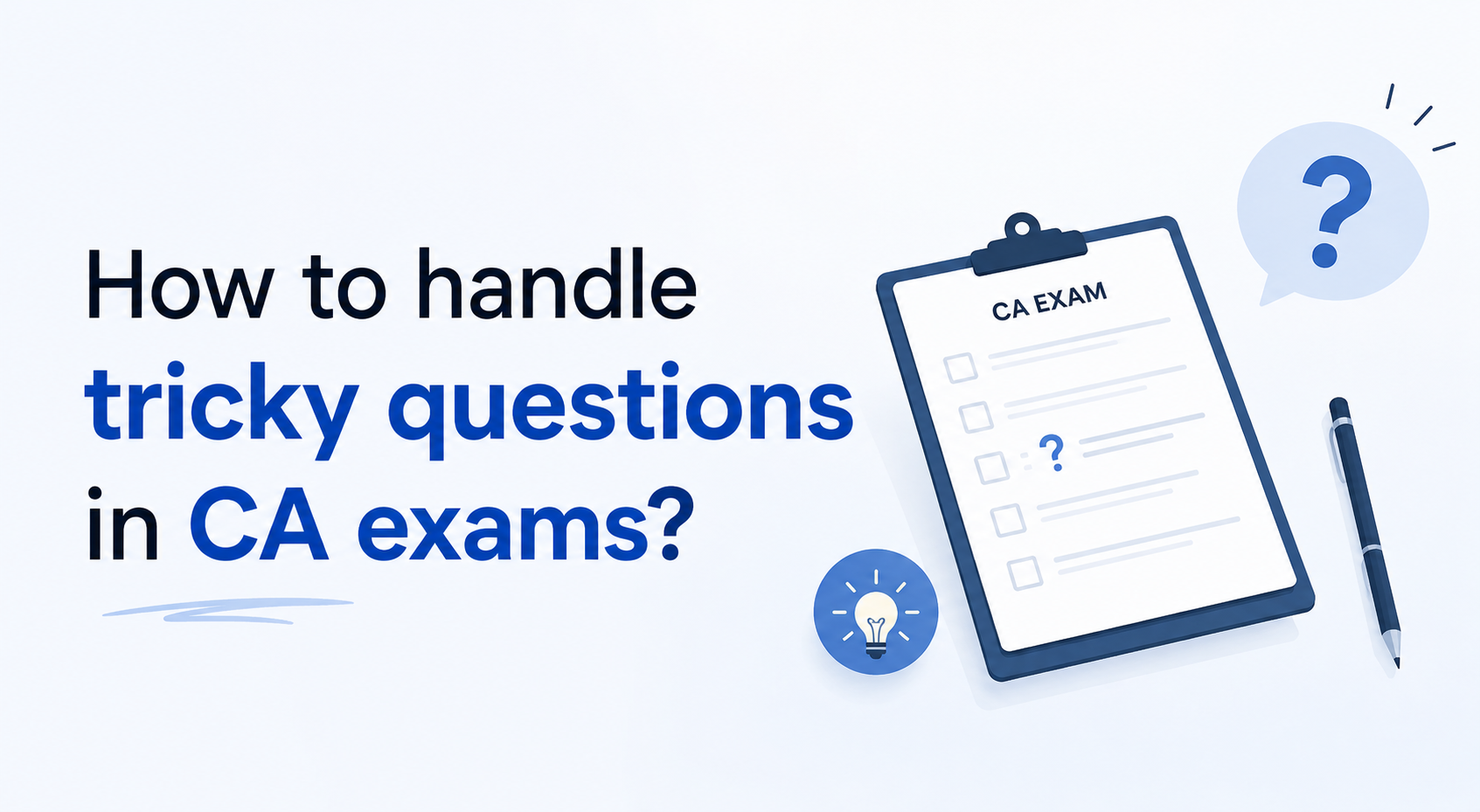
Table of Content
- Do Not Panic Immediately After Seeing a Difficult Question
- Read the Question More Than Once
- Break the Question Into Smaller Parts
- Use Conceptual Understanding Instead of Memorized Lines
- Do Not Waste Excessive Time on One Question
- Write Structured Answers Even When Unsure
- Practice Mock Tests to Improve Question Handling
- Avoid Overthinking During the Exam
- Confidence Plays a Major Role
- Conclusion
Tricky questions are one of the biggest reasons students panic during CA exams. Sometimes the question looks unfamiliar, sometimes the wording feels confusing, and sometimes multiple concepts appear mixed. Even well-prepared students can feel nervous after seeing a difficult or unexpected question in the paper.
The problem is not always the question itself. In many cases, students lose marks because they panic too early and stop thinking calmly. Under pressure, even familiar concepts start feeling difficult.
If you want to understand how to handle tricky questions in CA exams, the most important thing is learning how to stay mentally stable while analyzing the question. Tricky questions are usually designed to test conceptual clarity, application skills, and presence of mind rather than simple memorization. Students who remain calm and think logically often perform much better even in difficult papers.
Do Not Panic Immediately After Seeing a Difficult Question
Many students emotionally react the moment they see a tricky question. They assume the entire paper is difficult and start losing confidence in the remaining questions as well. This reaction affects concentration throughout the exam. A difficult question does not mean:
- The Entire Paper Is Impossible
- Your Preparation Is Weak
- You cannot Score Well
In most cases, the question only appears difficult because of unfamiliar wording or presentation style. Staying calm during the first few seconds is extremely important because panic reduces your ability to analyze logically.
Read the Question More Than Once
One common reason students struggle with tricky questions is that they read them too quickly. Under exam pressure, students often misunderstand what is actually being asked. Reading the question carefully helps identify:
- The Actual Requirement
- Important Keywords
- Hidden Clues In The Language
Sometimes a question looks confusing initially but becomes much clearer after reading it slowly a second time. Students should especially pay attention to:
- Exceptions
- Conditions
- Calculation Requirements
- Practical Scenarios
Careful reading alone can solve many unnecessary mistakes.
Break the Question Into Smaller Parts
Complex questions often look overwhelming because students try to process the entire problem at once. A better approach is to divide the question into smaller manageable parts. This helps organize thinking and reduces confusion. For example, identify:
- What Information Is Given
- What Needs To Be Calculated Or Explained
- Which Concept Applies To Each Part
Breaking the question into steps improves clarity and helps students approach the answer systematically. This technique is especially useful in practical subjects.
Use Conceptual Understanding Instead of Memorized Lines
Tricky questions are often designed in a way that memorized answers may not work directly. Students who depend completely on rote learning usually struggle more in such situations. Strong conceptual understanding helps students:
- Interpret Questions Better
- Apply Logic Correctly
- Adapt To Different Question Formats
Even if the question pattern feels new, conceptual clarity allows students to write relevant answers using reasoning and understanding. This is why concept-based preparation becomes extremely important in CA exams.
Do Not Waste Excessive Time on One Question
Students sometimes spend too much time trying to perfect one tricky question. This affects time management for the rest of the paper. A difficult question should be handled intelligently. If a question feels too time-consuming:
- Attempt The Easier Part First
- Write Whatever Relevant Points You Know
- Move Forward And Return Later If Needed
Protecting overall paper performance is more important than getting stuck on a single question. Good time management helps maintain confidence throughout the exam.
Write Structured Answers Even When Unsure
Some students panic so much during difficult questions that they leave answers incomplete or poorly organized. Even when fully unsure, students should still try to:
- Present Answers Properly
- Mention Relevant Concepts
- Show Logical Working Notes
- Write Stepwise Explanation
A structured attempt often helps secure partial marks. Examiners usually reward logical effort and relevant application, even if the answer is not perfectly complete.
Practice Mock Tests to Improve Question Handling
Mock tests help students become mentally comfortable with unexpected questions. Students who regularly solve practice papers usually develop:
- Better Analytical Thinking
- Faster Decision-Making
- Stronger Exam Confidence
Repeated exposure to different question patterns reduces fear during actual exams. This is why mock tests are not only useful for revision but also for improving adaptability during pressure situations.
Avoid Overthinking During the Exam
Students often make tricky questions harder by overthinking them. Instead of focusing on the actual requirement, they start assuming hidden complications. This increases confusion unnecessarily. In many cases, the simplest logical interpretation of the question is the correct one. Overanalysis under pressure usually:
- Wastes Time
- Increases Anxiety
- Reduces Writing Clarity
A calm and practical mindset helps students think more clearly.
Confidence Plays a Major Role
Confidence does not mean knowing every answer perfectly. It means trusting your preparation enough to think calmly under pressure. Students who enter exams with excessive fear often struggle more with tricky questions because anxiety blocks clear thinking.
Regular revision, conceptual clarity, and writing practice gradually improve confidence and reduce panic during unexpected situations. Strong confidence improves both accuracy and decision-making during exams.
Conclusion
Handling tricky questions in CA exams is less about memorizing special tricks and more about maintaining calm thinking under pressure. Students who read questions carefully, apply concepts logically, and manage time wisely usually perform much better even in difficult papers.
Tricky questions are designed to test understanding, not just memory. This is why conceptual clarity, structured writing, and mental stability become extremely important during exams. In many cases, staying calm and thinking step by step can solve questions that initially appear very difficult.

FAQs
How to handle tricky questions in CA exams effectively?
To handle tricky questions in CA exams effectively, stay calm, read the question carefully, apply concepts logically, and avoid rushing or panicking during the exam.
Why do tricky questions create pressure in CA exams?
Tricky questions create pressure because unfamiliar wording or mixed concepts make students feel confused and uncertain under exam conditions.
Should students skip difficult questions in CA exams?
Students should not panic and completely skip difficult questions immediately. They should attempt relevant parts first and return later if needed.
Does conceptual clarity help in solving tricky CA questions?
Yes, conceptual clarity helps students apply logic and interpret unfamiliar question patterns more effectively during exams.
How does careful reading help with difficult questions?
Careful reading helps students understand the exact requirement, identify important clues, and avoid misinterpreting the question.
Can mock tests improve handling of tricky questions?
Yes, mock tests improve adaptability, analytical thinking, and confidence while exposing students to different question styles before actual exams.
Why is time management important during tricky questions?
Good time management prevents students from spending excessive time on one difficult question and protects overall paper performance.
Should students write answers even when unsure?
Yes, students should write relevant concepts and structured explanations because partial marks are often awarded for logical attempts.
Does panic affect performance in difficult CA questions?
Yes, panic reduces concentration and logical thinking, making even familiar concepts feel difficult during exams.
What is the biggest mistake students make with tricky questions?
The biggest mistake is panicking early and overthinking the question instead of analyzing it calmly and systematically.