How Professional Thinking Develops During the CA Journey
Learn how professional thinking develops during the CA journey through practical exposure, discipline, analytical skills, decision-making, and business understanding.
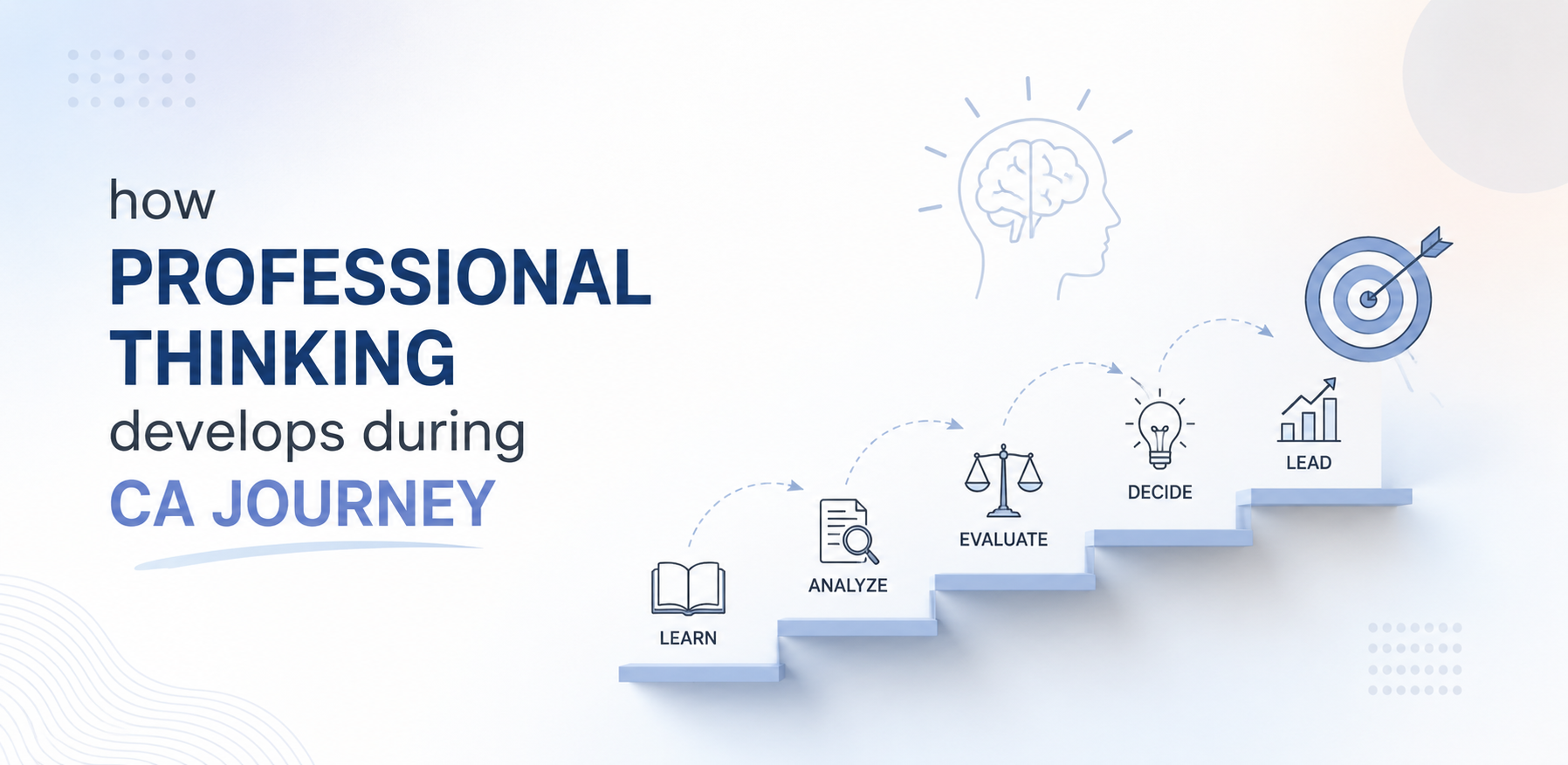
Table of Content
- The CA Journey Changes Thinking Patterns
- Articleship Plays a Major Role in Professional Development
- Responsibility Improves Professional Maturity
- Analytical Thinking Becomes Stronger
- Time Management Develops Professional Discipline
- Students Learn to Handle Pressure More Calmly
- Communication Skills Improve During the Journey
- Exposure to the Business Environment Changes Perspective
- Decision-Making Ability Improves Gradually
- Professional Ethics Become More Important
- Adaptability Develops During CA Preparation
- Failure Teaches Important Professional Lessons
- Technology Awareness Improves Professional Approach
- Why Professional Thinking Matters in Long-Term Careers
- Conclusion
The Chartered Accountancy journey is not only about clearing examinations and studying financial subjects. Over time, the course gradually changes the way students think, analyze situations, and handle responsibilities. Many students enter the CA course with an academic mindset, but during preparation and practical training, they slowly develop a more professional approach toward learning, communication, discipline, and decision-making.
Professional thinking does not develop suddenly after qualification. It grows continuously throughout the CA journey through articleship exposure, practical learning, problem-solving, time management, and interaction with real business environments. This transformation becomes one of the most valuable aspects of the chartered accountancy profession because it prepares students for high-responsibility careers beyond textbooks and examinations.
The CA Journey Changes Thinking Patterns
At the beginning of preparation, many students focus mainly on marks and syllabus completion. However, as the course progresses, students start understanding concepts more practically instead of memorizing information only for examinations. The CA journey gradually teaches students to:
- Analyze situations logically
- Understand practical business impact
- Think beyond theory
- Focus on problem-solving
This shift from academic thinking to professional thinking becomes extremely important for future workplace responsibilities.
Articleship Plays a Major Role in Professional Development
Articleship is one of the biggest reasons professional thinking develops strongly during the CA journey. Through practical training, students interact with:
- Clients
- Audit teams
- Business owners
- Financial records
- Compliance systems
This exposure helps students understand how businesses actually function in real-world environments. Articleship also teaches students how professional responsibilities are managed under deadlines, pressure, and practical business situations.
Responsibility Improves Professional Maturity
During the CA journey, students gradually handle more responsibilities related to studies, office work, assignments, and time management. This teaches them:
- Accountability
- Discipline
- Work management
- Professional behavior
Handling responsibilities regularly improves maturity and decision-making ability over time. Students begin understanding that professional life requires consistency and reliability instead of temporary motivation alone.
Analytical Thinking Becomes Stronger
The CA course regularly exposes students to practical and application-based questions. Because of this, students gradually develop stronger analytical thinking skills. Professional thinking improves when students learn how to:
- Interpret financial information
- Identify business risks
- Analyze practical situations
- Solve financial problems logically
This analytical mindset becomes extremely valuable in auditing, taxation, consulting, and financial planning roles later.
Time Management Develops Professional Discipline
Managing the CA course requires balancing:
- Coaching classes
- Self-study
- Articleship work
- Revision schedules
- Personal responsibilities
Over time, students learn how to prioritize tasks and manage deadlines more effectively. This improves professional discipline and prepares students for workplace environments where time management is extremely important.
Students Learn to Handle Pressure More Calmly
The CA journey can become mentally challenging because students often face:
- Exam pressure
- Tight schedules
- Workload stress
- Multiple attempts
- Self-doubt
However, these experiences also help students develop emotional stability gradually. Professional thinking develops when students stop reacting emotionally to every difficulty and start focusing more on practical solutions and improvement.
Communication Skills Improve During the Journey
Professional thinking also reflects in communication style and presentation. Through articleship, presentations, office interactions, and answer-writing practice, students gradually improve:
- Professional language
- Communication clarity
- Explanation ability
- Workplace confidence
Students learn how to present ideas more professionally and explain concepts in a structured manner. These communication improvements become highly valuable during future careers.
Exposure to the Business Environment Changes Perspective
CA students regularly study subjects related to:
- Business operations
- Taxation systems
- Financial management
- Corporate laws
- Auditing procedures
Along with practical exposure, this knowledge helps students understand how industries and businesses function practically. Professional thinking develops when students start viewing situations from business and financial perspectives instead of only from an academic viewpoint.
Decision-Making Ability Improves Gradually
The CA journey teaches students how to evaluate situations carefully before making decisions. Students slowly develop the habit of:
- Thinking logically
- Analyzing consequences
- Managing risks
- Understanding financial impact
This practical decision-making ability becomes an important professional quality in finance careers.
Professional Ethics Become More Important
Throughout the CA course, students learn about the importance of:
- Integrity
- Confidentiality
- Professional conduct
- Ethical financial practices
Professional thinking develops strongly when students understand that trust and credibility are extremely important in finance-related careers. Ethical understanding helps students become more responsible professionals in future workplaces.
Adaptability Develops During CA Preparation
Business environments and finance industries continuously change because of new regulations, technology systems, and economic conditions. CA students gradually learn how to adapt to:
- Syllabus updates
- Changing laws
- New technology tools
- Different work situations
Adaptability becomes an important part of professional thinking because successful professionals continuously learn and improve themselves.
Failure Teaches Important Professional Lessons
Many students face setbacks or failures during the CA journey. Although difficult emotionally, these experiences often help students develop a stronger professional mindset.
Failures teach students:
- Patience
- Emotional control
- Persistence
- Self-analysis
Professional thinking develops when students stop viewing failure as permanent weakness and start using it for improvement.
Technology Awareness Improves Professional Approach
Modern CA students increasingly work with:
- Accounting software
- Digital finance tools
- Compliance systems
- Online reporting platforms
Technology exposure helps students become more efficient and professionally adaptable in modern business environments. Professionals today are expected to combine technical knowledge with technology awareness effectively.
Why Professional Thinking Matters in Long-Term Careers
Professional thinking helps chartered accountants perform better in:
- Client handling
- Team management
- Financial analysis
- Strategic discussions
- Workplace responsibilities
Technical knowledge is important, but a professional mindset helps individuals apply that knowledge effectively in real-world situations. This is why professional development becomes one of the biggest long-term benefits of the CA journey.
Conclusion
Professional thinking develops gradually during the CA journey through practical exposure, responsibility management, analytical learning, emotional growth, and workplace interactions. The course helps students move beyond academic learning and develop discipline, business understanding, communication skills, and professional maturity. Students who embrace both technical and practical learning during the CA journey often become more confident and adaptable professionals in future finance careers.

FAQs
How does professional thinking develop during a CA journey?
Professional thinking develops through articleship, practical exposure, responsibility management, analytical learning, communication improvement, and real business interactions during the CA journey.
Why is articleship important for professional development?
Articleship provides practical exposure in auditing, taxation, compliance, client communication, and workplace responsibilities that help students understand real professional environments.
How does the CA course improve analytical thinking?
The course improves analytical thinking through application-based learning, financial interpretation, problem-solving, and practical evaluation of business and financial situations.
Why is professional discipline important during CA preparation?
Professional discipline helps students manage time, responsibilities, deadlines, studies, and work pressure effectively during both preparation and future careers.
How does the CA journey improve communication skills?
Students gradually improve communication through office interactions, presentations, answer writing, client discussions, and professional exposure during articleship training.
Why does emotional stability matter in professional thinking?
Emotional stability helps students handle pressure, failures, workload, and difficult situations more calmly while maintaining focus on practical improvement and long-term growth.
How does business exposure change CA students’ mindset?
Business exposure helps students understand practical financial systems, company operations, compliance requirements, and strategic decision-making beyond textbook concepts.
What role do ethics play in professional thinking?
Ethics help students understand integrity, confidentiality, responsible conduct, and professional trust, which are extremely important in finance-related careers.
How does adaptability help CA students professionally?
Adaptability helps students handle changing laws, technology systems, business environments, and professional responsibilities more effectively throughout their careers.
Why is professional thinking important for chartered accountants?
Professional thinking helps chartered accountants manage responsibilities, communicate effectively, analyze situations logically, and perform better in practical workplace environments.