How Can I Make My CA Study Plan More Realistic?
Learn how to create a realistic CA study plan that you can actually follow. Get practical tips for daily targets, revision, mock tests, backlogs and CA exam preparation.
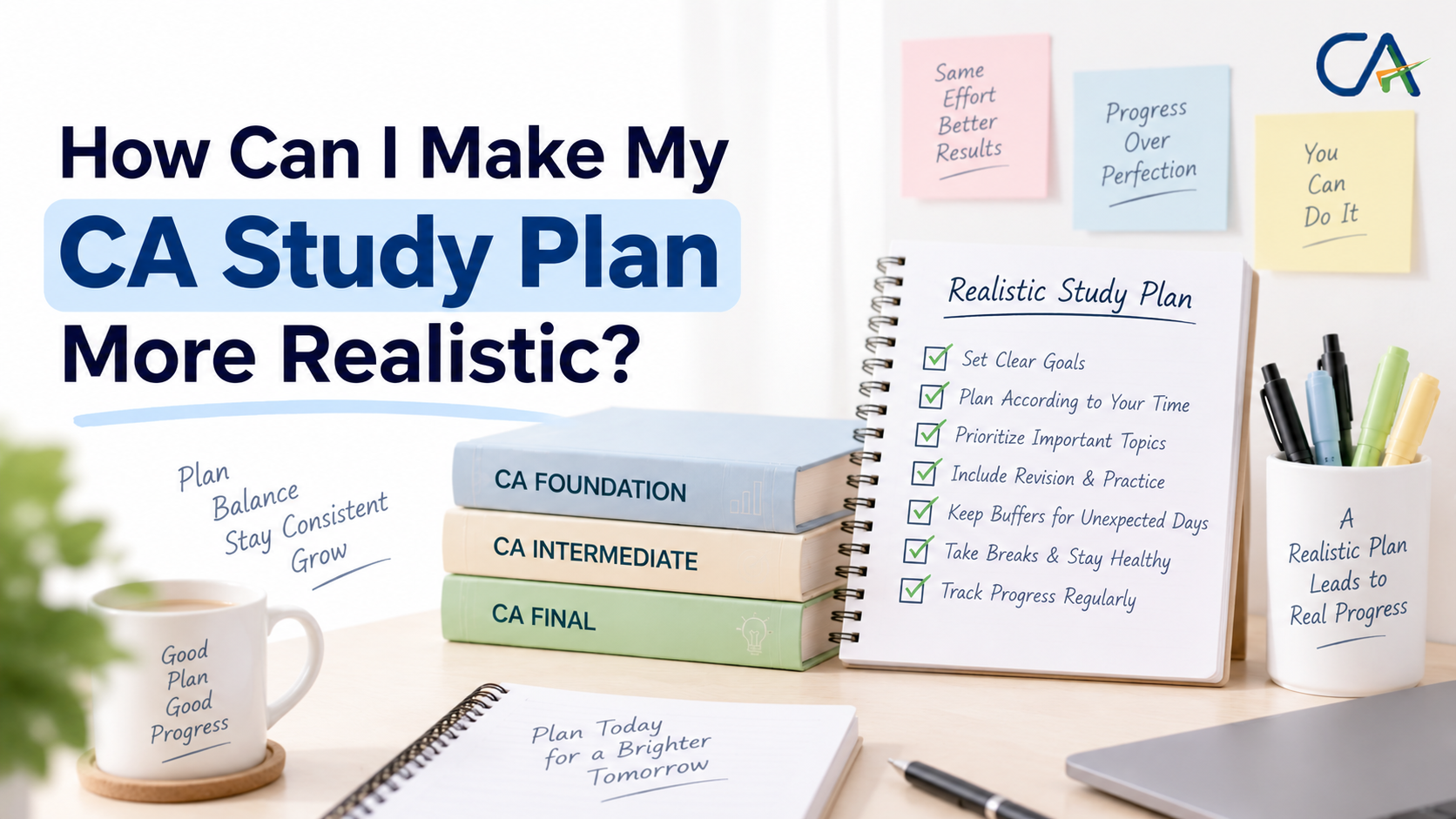
Table of Content
- What Does a Realistic CA Study Plan Actually Mean?
- Why Most CA Study Plans Fail
- 1. You Plan for Your Best Day
- 2. You Plan Too Many Hours
- 3. You Don't Add Buffer Time
- 4. You Treat Every Subject Equally
- 5. You Forget Revision While Planning New Topics
- The Realistic CA Study Plan Formula
- Step 1: Calculate Your Actual Available Study Time
- Step 2: Find Your Real Study Capacity
- Step 3: Plan Weekly Before Planning Daily
- Weekly Planning vs Daily Planning
- Step 4: Divide Your Syllabus Into Small Targets
- Step 5: Use the 70–80% Rule
- Step 6: Create Three Types of Study Blocks
- A Realistic Full-Time CA Study Timetable
- What If You Are Doing Articleship or a Job?
- Step 7: Give Your Weak Subjects More Time
- Step 8: Keep One Backlog Slot Every Week
- What Should You Do When You Fall Behind?
- The “Minimum Day” Strategy
- Step 9: Add Revision to Every Week
- Step 10: Don't Wait Until the Last Month for Tests
- How to Fit a CA Exam Test Series Into Your Study Plan
- Step 11: Build Your Plan Around Output, Not Hours
- Step 12: Track Your Weekly Performance
- How Your CA Study Plan Should Change With Time
- If You Have 4–6 Months
- If You Have 2–3 Months
- If You Have 30–45 Days
- If You Have 15 Days
- CA Foundation, Intermediate and Final Need Different Plans
- The 80% Completion Rule
- Don't Change Your Timetable Every Two Days
- Your Realistic Daily CA Study Plan
- The 3-Task Rule for Every Day
- Your Plan Should Include Sleep and Breaks
- The Realistic CA Study Plan Checklist
- Final Thoughts: Make Your CA Plan Real, Not Perfect
Every CA student has probably made this timetable at least once:
5:00 AM – Wake up
5:30–8:00 AM – Accounts
8:30–11:00 AM – Law
11:30–2:00 PM – Tax
3:00–5:00 PM – Costing
6:00–8:00 PM – Revision
9:00–11:00 PM – Mock Test
It looks amazing on paper.
For the first two days, you may even follow it.
Then one chapter takes longer than expected.
You wake up late one morning.
A lecture runs for another hour.
You get stuck on a practical question.
Something comes up at home.
Suddenly, you have a three-hour backlog.
And by the end of the week, the beautiful timetable you created on Sunday is sitting somewhere in your notebook, completely forgotten.
If this sounds familiar, there is probably nothing wrong with your motivation.
Your plan was simply not realistic enough.
A realistic CA study plan is not the timetable that looks the most productive.
It is the timetable you can actually follow repeatedly, including on average days when you are tired, distracted or slightly behind schedule.
The goal is not to create a perfect day.
The goal is to create a system that survives imperfect days.
What Does a Realistic CA Study Plan Actually Mean?
A realistic CA study plan should answer five questions:
- How much time do I genuinely have?
- What exactly do I need to complete?
- How much can I realistically finish in one day?
- When will I revise what I studied?
- When will I test whether I actually remember it?
Most students answer only the first question.
They say:
“I have 10 hours, so I will study for 10 hours.”
But available time and productive study time are not always the same thing.
If you have 10 hours available but spend two hours on meals, one hour on your phone, one hour taking breaks, and another hour dealing with unexpected tasks, your actual focused study capacity is much lower.
That is not failure.
That's reality.
And your timetable should be built around reality.
Why Most CA Study Plans Fail
Before creating a better plan, understand why the old one failed.
1. You Plan for Your Best Day
Students often create a timetable based on their most motivated version of themselves.
They assume:
- They will wake up early every day.
- They will never get distracted.
- Every chapter will take the planned amount of time.
- They will never feel tired.
- Every question will be solved quickly.
- Nothing unexpected will happen.
That is not a study plan.
That is a fantasy version of a day.
A realistic plan should leave room for real life.
2. You Plan Too Many Hours
There is a common belief that if 8 hours are good, 12 hours must be better.
Not necessarily.
A recent CA study-planning discussion also highlights the difference between available hours and genuinely focused study time; the useful range varies depending on whether a student is full-time, working or balancing other commitments.
Eight focused hours can be more valuable than twelve distracted hours.
The question should therefore not be:
“How many hours can I sit at my desk?”
Ask:
“How many hours can I realistically concentrate and produce useful work?”
That is your real study capacity.
3. You Don't Add Buffer Time
This is one of the biggest planning mistakes.
Suppose you have six study blocks.
You allocate every minute.
There is no extra time.
Then one chapter takes 30 minutes longer.
Your entire timetable moves 30 minutes behind.
The next task gets delayed.
Then the next one.
By evening, you are two hours behind.
Instead, keep 10–20% of your available study time as buffer.
For example:
If you realistically have 8 focused hours, plan around 6.5–7 hours of actual tasks.
The remaining time can absorb:
- Delayed tasks
- Difficult questions
- Revision overruns
- Doubt clearing
- Unexpected interruptions
That one change can make a timetable dramatically easier to follow.
4. You Treat Every Subject Equally
Suppose you have four subjects.
You decide:
“I will give exactly two hours to each subject every day.”
It sounds fair.
But CA preparation doesn't work on equality.
Some chapters are:
- Longer
- More difficult
- More practice-intensive
- More important for your preparation
- Weaker for you personally
A practical CA study plan should therefore allocate time based on:
Difficulty + Syllabus Size + Your Weakness + Exam Priority
Not simply the number of subjects.
5. You Forget Revision While Planning New Topics
This is probably the most dangerous mistake.
Students create a plan like:
Monday: New chapters
Tuesday: New chapters
Wednesday: New chapters
Thursday: New chapters
And suddenly two weeks have passed.
They have “completed” a lot.
But how much can they remember?
A good CA plan must contain revision from the beginning, not as something you will “do later.”
ICAI's study guidance recommends setting clear achievable goals, allocating time by subject/topic, including breaks and reviewing the plan regularly rather than following a rigid schedule forever.
The Realistic CA Study Plan Formula
A useful framework is:
Available Time × Realistic Capacity × Priority = Daily Study Plan
Then add:
Revision + Practice + Testing + Buffer
So your complete planning model becomes:
Learn + Revise + Practise + Test + Analyse + Buffer
If one of these is completely missing, your plan is incomplete.
Step 1: Calculate Your Actual Available Study Time
Before making a timetable, track your life for three days.
Write down:
|
Activity |
Approx. Daily Time |
|
Sleep |
7–8 hours |
|
Meals |
1.5–2 hours |
|
Personal work |
1 hour |
|
College/Articleship/Job |
Variable |
|
Travel |
Variable |
|
Family/Other commitments |
Variable |
|
Actual study |
Remaining time |
Don't lie to yourself.
If you work 9–6, don't create a timetable assuming you have 10 free study hours every weekday.
If you are a full-time student, your available time may be significantly higher.
Your timetable should reflect your life, not somebody else's Instagram routine.
Step 2: Find Your Real Study Capacity
Now conduct a simple experiment.
For one week, record your focused study time.
Don't count:
- Sitting with books open
- Watching lectures at 1.5x while using your phone
- Highlighting notes for hours
- Staring at questions
- Taking unnecessary breaks
Count only genuine productive work.
At the end of the week, calculate your average.
For example:
|
Day |
Focused Study |
|
Monday |
7 hours |
|
Tuesday |
6.5 hours |
|
Wednesday |
7.5 hours |
|
Thursday |
6 hours |
|
Friday |
7 hours |
|
Saturday |
8 hours |
|
Sunday |
5.5 hours |
Average ≈ 6.8 focused hours/day
Now you have something useful.
Instead of creating a 12-hour timetable, build around approximately 6–7 productive hours.
Step 3: Plan Weekly Before Planning Daily
This is one of the biggest upgrades you can make.
Don't immediately start assigning:
9:00–10:00 Accounts
First decide what needs to happen during the week.
For example:
Weekly Target
- Complete 3 Tax chapters
- Revise 2 Law chapters
- Solve 40 Accounts questions
- Complete one Costing test
- Revise previous week's topics
- Attempt one full-length mock
Then divide these targets across the days.
This gives you flexibility.
If Tuesday goes badly, you can shift a task to Wednesday without feeling that the entire plan has collapsed.
Weekly Planning vs Daily Planning
|
Planning Type |
Best Use |
|
Monthly Plan |
Overall direction |
|
Weekly Plan |
Main targets |
|
Daily Plan |
Execution |
|
Hourly Timetable |
Time blocking |
|
Daily Checklist |
Tracking completion |
Your monthly plan tells you where you are going.
Your weekly plan tells you what must happen.
Your daily plan tells you what you are doing today.
Don't make your hourly timetable responsible for your entire preparation strategy.
Step 4: Divide Your Syllabus Into Small Targets
“Complete Tax” is not a target.
“Complete Income from Salary and solve selected ICAI questions” is a target.
“Revise Law” is not a target.
“Revise Chapter 3 and write five answers without notes” is a target.
The smaller the target, the easier it becomes to measure progress.
Use this structure:
Subject → Chapter → Topic → Task
For example:
Tax → Heads of Income → Salary → Revise provisions + solve questions
Now you know exactly what “done” means.
Step 5: Use the 70–80% Rule
This is one of the simplest ways to make a CA timetable realistic.
Don't plan 100% of your available time.
Plan approximately 70–80%.
Keep the remaining 20–30% flexible.
For example:
If you have 10 usable hours:
Plan 7–8 hours.
The remaining time can absorb:
- Breaks
- Delays
- Difficult questions
- Revision
- Backlogs
- Unexpected work
This doesn't mean you should waste the remaining time.
It means you are giving your plan enough breathing space to survive reality.
Step 6: Create Three Types of Study Blocks
Not every study session should have the same purpose.
Use three major blocks.
Block 1: Deep Learning
Use your highest-energy hours for:
- New concepts
- Difficult chapters
- Practical subjects
- Complex questions
Block 2: Practice
Use another block for:
- ICAI questions
- Past papers
- Practical problems
- Case studies
- Answer writing
Block 3: Revision
Use lower-energy periods for:
- Formulas
- Provisions
- Short notes
- Recall
- Mistake revision
This makes your day more efficient.
A Realistic Full-Time CA Study Timetable
Here's an example—not a timetable you have to copy exactly.
|
Time |
Activity |
|
7:00–7:30 |
Morning routine |
|
7:30–9:30 |
Difficult subject / concepts |
|
9:30–10:00 |
Breakfast |
|
10:00–12:00 |
Subject 2 + questions |
|
12:00–12:30 |
Break |
|
12:30–2:00 |
Theory/revision |
|
2:00–3:00 |
Lunch + rest |
|
3:00–4:30 |
Question practice |
|
4:30–5:00 |
Break |
|
5:00–6:30 |
Subject 3 |
|
6:30–7:30 |
Rest/exercise/dinner |
|
7:30–9:00 |
Revision/test |
|
9:00–9:20 |
Mistake analysis + tomorrow's plan |
Notice something important:
The timetable doesn't fill every minute.
That is intentional.
A realistic timetable needs space.
What If You Are Doing Articleship or a Job?
Your plan should be completely different.
Trying to copy a full-time student's timetable is one of the fastest ways to feel like you are failing.
If you have only 3–4 focused hours on weekdays, use them intelligently.
Example
|
Time |
Activity |
|
6:00–7:30 AM |
Difficult concept/practical |
|
Work/College Hours |
Normal commitments |
|
7:30–8:00 PM |
Break/Dinner |
|
8:00–9:30 PM |
Practice |
|
9:30–10:00 PM |
Revision |
Then use weekends for:
- Longer study blocks
- Full-length tests
- Backlog recovery
- Detailed revision
The key is consistency.
A realistic 4-hour plan followed for months is much stronger than an unrealistic 10-hour plan followed for four days.
Step 7: Give Your Weak Subjects More Time
Your timetable should not be emotionally equal.
If Accounts is strong and Tax is weak, don't automatically give both two hours.
You could use:
Accounts — 1.5 hours
Tax — 2.5 hours
Law — 1.5 hours
Revision — 1 hour
This doesn't mean you ignore strong subjects.
It means you use your available time intelligently.
Create three categories:
A — Strong
Needs maintenance.
B — Average
Needs regular practice.
C — Weak
Needs additional attention.
Then allocate your time accordingly.
Step 8: Keep One Backlog Slot Every Week
This is a simple strategy that most students don't use.
Choose one weekly block as your Backlog Recovery Session.
For example:
Sunday 4 PM – 7 PM
Use it only if required.
If you have no backlog, use the time for:
- Revision
- Mock analysis
- Weak topics
- Additional practice
This prevents one missed day from destroying your entire timetable.
What Should You Do When You Fall Behind?
You will fall behind.
It happens.
The mistake is not falling behind.
The mistake is trying to recover everything at once.
Suppose you miss two days.
You now have 12 hours of pending work.
Don't put:
Monday backlog + Tuesday backlog + Wednesday's normal work
into Wednesday.
You will probably fail to complete all three.
Instead, classify the backlog.
|
Backlog Type |
Action |
|
Critical topic |
Complete first |
|
Important revision |
Schedule this week |
|
Low-priority task |
Move later |
|
Repeated topic |
Combine with revision |
|
Optional practice |
Skip if necessary |
A delayed plan is better than a completely abandoned plan.
The “Minimum Day” Strategy
This is particularly useful during long CA preparation.
Not every day will be a 100% day.
You may be sick.
You may have family work.
You may simply feel mentally exhausted.
Create a Minimum Day Plan.
For example:
Minimum Day =
- 2 hours core study
- 30 minutes revision
- 30 minutes question practice
- 15 minutes planning
That's it.
If you have energy, continue.
If not, at least you haven't completely broken your routine.
This is how consistency is built.
Step 9: Add Revision to Every Week
A realistic plan should never be:
100% new syllabus
Instead, use a combination.
A useful starting point during syllabus completion could be:
|
Activity |
Approx. Weekly Focus |
|
New Learning |
50–60% |
|
Question Practice |
20–25% |
|
Revision |
15–20% |
|
Testing |
5–10% |
As the exam gets closer, the balance changes.
During final revision, testing and revision should occupy a much larger share of your time.
Step 10: Don't Wait Until the Last Month for Tests
A CA mock test is not only for measuring your final score.
It is also a learning tool.
Start with:
Chapter Tests
Then:
Sectional Tests
Then:
Subject Tests
Then:
Full-Length Mocks
This progression makes testing less intimidating.
A structured CA Exam Test Series can fit into this process by giving you planned practice and helping you identify weaknesses before the final examination.
The important thing is not to simply attempt tests.
Analyse them.
How to Fit a CA Exam Test Series Into Your Study Plan
Use the test series according to your stage.
|
Preparation Stage |
Test Type |
|
Syllabus Completion |
Chapter Tests |
|
First Revision |
Topic/Sectional Tests |
|
Second Revision |
Subject Tests |
|
Final Revision |
Full-Length Tests |
|
Last 2–3 Weeks |
ICAI MTPs + Full Tests + Past Papers |
After each test, keep time for analysis.
A three-hour mock isn't really a three-hour activity.
You also need time to determine:
- Why you lost marks
- Which topics were weak
- Where time was wasted
- Whether presentation needs improvement
- Which mistakes are repeating
That's where a CA Exam Test Series becomes much more valuable than simply downloading random papers.
Step 11: Build Your Plan Around Output, Not Hours
This is probably the most important idea in the entire article.
Instead of writing:
“Study for 3 hours.”
Write:
“Complete Chapter 5 + solve 15 ICAI questions.”
Instead of:
“Revise Law for 2 hours.”
Write:
“Revise Chapter 4 + recall provisions without notes + write 3 answers.”
Instead of:
“Practice Accounts.”
Write:
“Solve 5 exam-level questions from the selected topic under time limit.”
Hours tell you how long you sat.
Outputs tell you what you actually accomplished.
Step 12: Track Your Weekly Performance
At the end of every week, measure four things.
1. Completion
How much of your planned work did you actually complete?
2. Retention
How much can you recall without looking?
3. Practice
How many meaningful questions did you solve?
4. Testing
What did your mock/sectional performance show?
Use a simple tracker:
|
Metric |
Target |
Actual |
|
Focused Study |
45 hrs |
40 hrs |
|
New Topics |
12 |
11 |
|
Revision Sessions |
7 |
7 |
|
Questions |
100 |
92 |
|
Tests |
2 |
2 |
|
Backlog |
0 |
1 topic |
This is much more useful than saying:
“I studied a lot this week.”
How Your CA Study Plan Should Change With Time
A realistic plan is not static.
It should evolve.
If You Have 4–6 Months
Focus on:
Concepts + First Revision + Regular Practice
Don't panic about daily full-length tests.
If You Have 2–3 Months
Move toward:
Revision + Practice + Sectional/Subject Tests
Start increasing exam-style practice.
If You Have 30–45 Days
Your plan should become:
Revision + Full-Length Tests + Weak Areas
At this stage, avoid spending huge amounts of time creating new notes.
If You Have 15 Days
Focus on:
- High-priority topics
- Revision
- ICAI material
- RTPs
- MTPs
- Past papers
- Mistake notebook
- Full-paper practice
The objective is no longer to make your syllabus “look complete.”
It is to make your preparation exam-ready.
CA Foundation, Intermediate and Final Need Different Plans
A realistic plan also depends on your CA level.
|
Level |
Main Planning Focus |
|
CA Foundation |
Concepts + accuracy + speed |
|
CA Intermediate |
Balanced theory/practical preparation |
|
CA Final |
Application + revision + exam simulation |
A Foundation student may need more foundational learning.
An Intermediate student needs a stronger balance between subjects.
A Final student should increasingly focus on professional answer writing, application and full-paper practice.
Therefore, copying somebody else's timetable is rarely the best solution.
The 80% Completion Rule
Here's another useful mindset.
If your weekly plan has 20 tasks and you complete 16 properly, that's 80% completion.
That's not a failed week.
That's a successful week that needs adjustment.
Your goal should not be:
100% every single day.
Your goal should be:
High consistency over many weeks.
A CA preparation plan is a marathon.
You don't need seven perfect days.
You need enough productive days repeated over months.
Don't Change Your Timetable Every Two Days
This is another common problem.
Monday:
“I will study 12 hours.”
Wednesday:
“This timetable isn't working.”
Thursday:
“I'll wake up at 4 AM.”
Saturday:
“I'll study only at night.”
Sunday:
“New timetable from tomorrow.”
This creates a dangerous cycle:
Plan → Fail → Change → Plan → Fail → Change
Instead, test your timetable for at least one or two weeks unless there is a genuine problem.
Then review it.
Ask:
- Which blocks worked?
- Which were unrealistic?
- Which subject needs more time?
- Where did delays happen?
- What should be removed?
- What should be moved?
Then make a controlled adjustment.
Your Realistic Daily CA Study Plan
Here is a simple template you can adapt.
Morning
Block 1: Difficult/new topic
Block 2: Continue topic + questions
Afternoon
Block 3: Second subject
Block 4: Practice
Evening
Block 5: Revision
Block 6: Test/MCQs/answer writing
Night
15–20 minutes:
- What did I complete?
- What remains?
- What did I learn?
- What mistake did I make?
- What is tomorrow's priority?
This structure is flexible enough to work across different CA levels.
The 3-Task Rule for Every Day
If your timetable is constantly failing, simplify it.
Choose just three major tasks every morning.
For example:
Today's Top 3
- 1. Complete Tax Chapter 4
- 2. Solve 20 Accounts questions
- 3. Revise Law Chapter 2
Everything else is secondary.
If these three are completed, the day was productive.
This is much better than having 14 tasks on your checklist and feeling unsuccessful because you completed only eight.
Your Plan Should Include Sleep and Breaks
This may sound obvious, but students often remove sleep and breaks first when they fall behind.
That usually makes the problem worse.
ICAI preparation guidance explicitly encourages breaks and avoiding burnout as part of effective planning.
A tired brain does not learn efficiently.
Your timetable should protect:
- Adequate sleep
- Meals
- Short breaks
- Some movement
- Mental recovery
You are preparing for an exam that demands concentration.
Rest is not the opposite of preparation.
Rest supports preparation.
The Realistic CA Study Plan Checklist
Before finalising your timetable, ask:
☐ Did I calculate my actual available hours?
☐ Did I account for college/articleship/job?
☐ Did I leave buffer time?
☐ Did I include revision?
☐ Did I include question practice?
☐ Did I include tests?
☐ Did I give extra time to weak subjects?
☐ Did I break chapters into measurable targets?
☐ Did I keep a weekly backlog slot?
☐ Did I make the plan flexible?
☐ Did I include proper sleep?
☐ Can I realistically follow this for four weeks?
If the answer to the last question is no, your timetable needs to be simplified.
Final Thoughts: Make Your CA Plan Real, Not Perfect
A realistic CA study plan is not supposed to impress anyone.
Nobody gives you extra marks because your timetable had 14 study hours written on it.
The only thing that matters is what happens when you sit down and study.
If your plan says 10 hours and you consistently complete 6 focused hours, don't feel guilty.
Change the plan.
If you keep missing the same study block, move it.
If one subject is taking longer, give it more time.
If you fall behind, adjust the week instead of throwing away the entire preparation.
If your mock scores reveal a weakness, change your practice strategy.
And if your schedule works for three weeks and then stops working, change it again.
Your study plan is a tool. It is not a contract.
One of the strongest ideas from current CA planning advice is that a timetable should be adjusted to the student's actual circumstances rather than copied blindly; recent CA-focused resources similarly emphasise realistic hours, revision, practice, buffer time and flexibility.
So don't ask:
“What is the perfect CA timetable?”
Ask:
“What timetable can I realistically follow on an ordinary Tuesday when I am not especially motivated?”
That is the timetable you need.
Build your plan around capacity, not fantasy.
Build your targets around output, not hours.
Build your revision into the plan from Day 1.
And use your CA Exam Test Series not just to collect scores, but to identify weaknesses and improve your actual exam performance.
You don't need to win every single day.
You need to keep moving.
Because CA preparation is not about creating one perfect timetable.
It is about creating a realistic system that you can follow long enough to reach the exam hall prepared.

FAQs
How can I make my CA study plan more realistic?
Start by calculating your actual available study time, identifying your productive capacity, breaking large chapters into smaller tasks and leaving buffer time. Include revision, question practice and mock tests instead of planning only new topics.
How many hours should I study for CA every day?
There is no fixed number of hours prescribed by ICAI. Your ideal study time depends on whether you are a full-time student, working, doing articleship or managing college alongside CA preparation. Focused study is more important than simply counting hours.
Why does my CA timetable work for only a few days?
Usually because the timetable is too ambitious, has no buffer, includes too many tasks or does not account for your real-life commitments. Reduce the daily workload and create a weekly plan with flexibility.
Should I study all CA subjects every day?
Not necessarily. A better approach is to rotate subjects while ensuring that important subjects receive regular attention. Your plan should also consider subject difficulty, syllabus size and your individual strengths and weaknesses.
How should I plan CA revision along with new chapters?
Do not postpone revision until the syllabus is finished. Reserve some time every day or week for recalling previously studied topics. As the exam approaches, gradually increase the percentage of time spent on revision.
When should I start using a CA Exam Test Series?
You can begin with chapter or sectional tests during preparation and move toward subject-wise and full-length tests during revision. A structured CA Exam Test Series can help you practise under time limits and identify weaknesses before the final examination.
What should I do if I have a large CA study backlog?
Don't try to complete the entire backlog in one or two days. Divide it into high-, medium- and low-priority tasks. Complete critical topics first and use a weekly buffer or backlog session to gradually recover.
Is studying 12 hours a day necessary to clear CA exams?
No fixed number of hours guarantees success. The quality of study, consistency, revision, question practice and exam preparation matter far more than simply sitting for a certain number of hours.
Should I change my CA timetable if I cannot follow it?
Yes. If you repeatedly fail to follow the same timetable, the plan may be unrealistic. Analyse which blocks are causing problems and modify them rather than repeatedly blaming yourself for not following an unsuitable schedule.
What is the biggest mistake students make while creating a CA study plan?
The biggest mistake is planning an ideal version of themselves instead of their real life. A timetable with excessive hours, no revision, no buffer and no flexibility may look impressive but is difficult to sustain. A simple plan that you can follow consistently is usually much more useful.