Future Challenges for CA Professionals in the Business World
Learn about future challenges for CA professionals, including technology changes, automation, global competition, compliance pressure, and evolving business expectations.
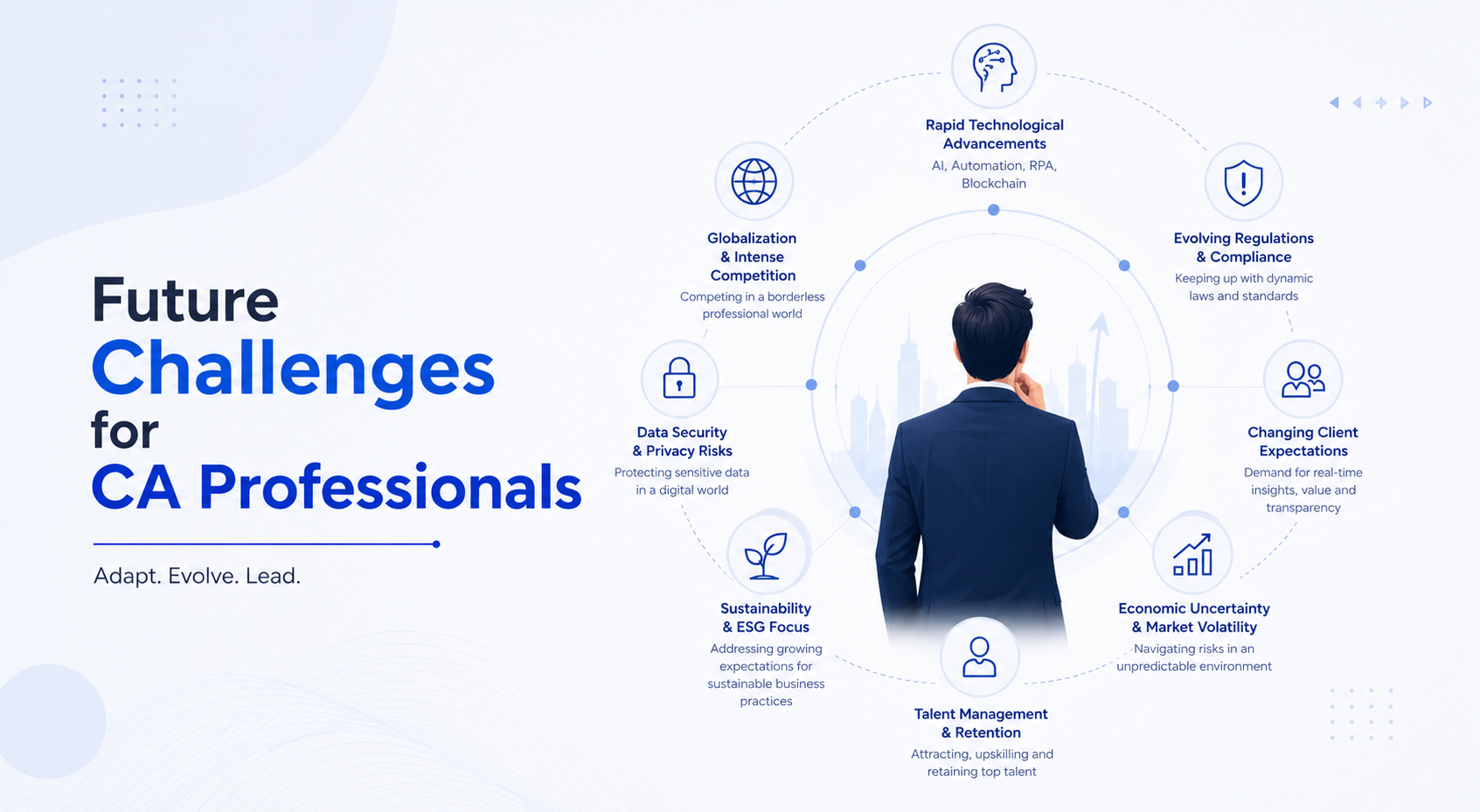
Table of Content
- Technology and Automation Are Changing Traditional Work
- Competition in the Finance Industry Is Increasing
- Continuous Learning Will Become Necessary
- Businesses Now Expect Broader Skills
- Work Pressure and Stress May Increase
- Communication Skills Will Become More Important
- Cybersecurity and Data Protection Risks Are Growing
- Globalization Has Increased Complexity
- Ethical Challenges May Also Increase
- Clients Want Faster and Better Services
- Future Opportunities Will Depend on Adaptability
- Why Human Expertise Will Still Matter
- Conclusion
The Chartered Accountancy profession has always been considered one of the most respected and responsible careers in the finance industry. However, the professional environment is changing rapidly because of technological growth, globalization, digital finance systems, and evolving business expectations. Modern chartered accountants are now expected to perform much more than traditional accounting and taxation work. This transformation is creating new opportunities, but it is also bringing several future challenges for CA professionals.
In the coming years, chartered accountants will need to continuously adapt themselves to changing business environments. Technical knowledge alone may no longer be enough for long-term success. Professionals will increasingly require technology awareness, analytical thinking, communication skills, and strategic understanding to remain competitive. Understanding future challenges for CA professionals helps students and finance experts prepare themselves for the changing demands of the profession.
Technology and Automation Are Changing Traditional Work
One of the biggest future challenges in the CA profession is rapid technological transformation. Today, automation tools can already handle tasks such as:
- Basic bookkeeping
- Invoice processing
- Tax calculations
- Data entry
- Financial reconciliations
This means traditional repetitive work is gradually reducing.
-
Need for Technology Skills
Modern chartered accountants must now understand:
- Cloud accounting systems
- ERP software
- Financial analytics tools
- Digital reporting systems
Professionals who fail to adapt to technology may struggle in future finance environments.
-
Shift Toward Advisory Roles
As automation handles routine tasks, businesses increasingly expect professionals to provide:
- Strategic guidance
- Financial interpretation
- Risk analysis
- Business planning support
The profession is therefore shifting toward more analytical and advisory responsibilities.
Competition in the Finance Industry Is Increasing
The finance industry has become highly competitive because businesses now hire professionals from multiple backgrounds. Chartered accountants often compete with:
- Financial analysts
- MBA finance professionals
- Global consultants
- Technology-driven finance experts
This increasing competition requires chartered accountants to continuously improve their practical and professional skills. Only a technical qualification may not always guarantee long-term career growth in future industries.
Continuous Learning Will Become Necessary
Finance laws, taxation systems, compliance regulations, and technology platforms change regularly. Because of this, chartered accountants will need to keep learning throughout their careers.
- Taxation Updates: Frequent amendments in the GST and income tax systems require constant professional awareness.
- Technology Changes: New software and automation tools continue to change accounting and reporting systems.
- Global Reporting Standards: International finance practices are evolving continuously because of globalization.
Professionals who stop learning may eventually struggle to remain relevant in modern industries.
Businesses Now Expect Broader Skills
Earlier, many businesses mainly depended on CAs for taxation and compliance work. Today, organizations expect support in areas such as:
- Financial planning
- Business strategy
- Profitability analysis
- Risk management
- Decision-making support
This means chartered accountants must develop broader business understanding instead of focusing only on technical accounting knowledge.
Work Pressure and Stress May Increase
The CA profession already involves significant responsibility, but future work environments may become even more demanding. Professionals may face pressure because of:
- Faster reporting deadlines
- Continuous compliance updates
- Increasing client expectations
- Technology adaptation requirements
Maintaining work-life balance could become a major challenge for many professionals in competitive finance industries.
Communication Skills Will Become More Important
Modern chartered accountants regularly interact with:
- Clients
- Investors
- Management teams
- Regulatory authorities
- Because of this, communication ability is becoming increasingly valuable.
- Professional Presentation: Finance professionals must explain complex financial information clearly.
- Client Handling: Strong communication improves trust and professional relationships.
- Leadership Roles: Many chartered accountants move into managerial and strategic positions where people management becomes important.
- Professionals with weak communication skills may face limitations despite strong technical expertise.
Cybersecurity and Data Protection Risks Are Growing
As financial systems become more digital, businesses face rising cybersecurity threats. Future CA professionals may increasingly deal with challenges related to:
- Financial data security
- Digital fraud risks
- Confidentiality protection
- Cyber compliance systems
Awareness regarding digital risk management will become highly important in future finance environments.
Globalization Has Increased Complexity
Global business operations have increased financial and regulatory complexity significantly. Modern chartered accountants now increasingly work with:
- International taxation
- Cross-border transactions
- Global compliance systems
- Foreign reporting standards
Professionals who understand international finance systems may gain better opportunities, while others may struggle to adapt.
Ethical Challenges May Also Increase
Financial pressure and business competition can sometimes create ethical dilemmas in professional environments. Chartered accountants may face pressure regarding:
- Financial reporting practices
- Compliance handling
- Business transparency
- Audit responsibilities
Maintaining integrity and professional ethics will remain one of the most important future responsibilities in the CA profession.
Clients Want Faster and Better Services
Technology has increased expectations regarding speed and efficiency. Clients now expect:
- Faster financial reporting
- Quick compliance support
- Real-time financial insights
- Better strategic guidance
Professionals must therefore balance quality with efficiency in increasingly competitive environments.
Future Opportunities Will Depend on Adaptability
One major reality of the modern finance industry is that adaptability has become essential. Chartered accountants who can quickly adjust to:
- Technology changes
- Business trends
- Industry expectations
- New financial systems
will likely perform better in future markets. Adaptability may become one of the most valuable professional qualities in the coming years.
Why Human Expertise Will Still Matter
Even though automation and AI are increasing, businesses still require professionals for:
- Financial judgment
- Strategic planning
- Ethical decision-making
- Complex business interpretation
Technology can support processes, but human understanding and practical thinking remain extremely important in the finance industry. This means the profession will evolve rather than disappear.
Conclusion
Understanding future challenges for CA professionals is important because the finance industry is evolving rapidly due to technology, globalization, automation, and changing business expectations. Future chartered accountants will need more than technical accounting knowledge to remain successful. Continuous learning, technology awareness, communication skills, adaptability, and strategic thinking will become increasingly important in the coming years. Professionals who embrace change and upgrade themselves regularly are likely to achieve stronger long-term growth in the modern finance world.

FAQs
What are the future challenges for CA professionals?
Future challenges include technology adaptation, automation, global competition, compliance complexity, and increasing client expectations.
How is technology affecting the CA profession?
Technology is automating repetitive accounting work and increasing demand for analytics, advisory, and digital finance skills.
Why is continuous learning important for chartered accountants?
Tax laws, financial systems, compliance rules, and technology platforms change regularly in modern finance industries.
How is globalization creating challenges for CAs?
Globalization increases complexity related to international taxation, reporting standards, and cross-border compliance requirements.
Why are communication skills becoming important for CAs?
Modern chartered accountants regularly interact with clients, management teams, investors, and business leaders.
Can automation replace chartered accountants completely?
No, businesses still require human judgment, strategic thinking, and ethical financial decision-making.
How is competition increasing in finance careers?
Finance professionals now compete with consultants, analysts, technology-driven experts, and global firms.
Why is cybersecurity important for future CA professionals?
Digital financial systems increase risks related to data security, fraud prevention, and confidentiality management.
What skills will future chartered accountants need?
Technology awareness, analytical thinking, communication skills, adaptability, and business understanding will become highly important.
How can CA professionals prepare for future challenges?
Professionals should continuously upgrade their technical knowledge, learn digital tools, improve their communication, and stay adaptable to industry changes.