Can I Crack CA Intermediate in First Attempt? Full Guide 2026
Can I crack CA Intermediate in first attempt? Know the real pass percentage, group-wise strategy, common mistakes, and tips to clear both groups together.
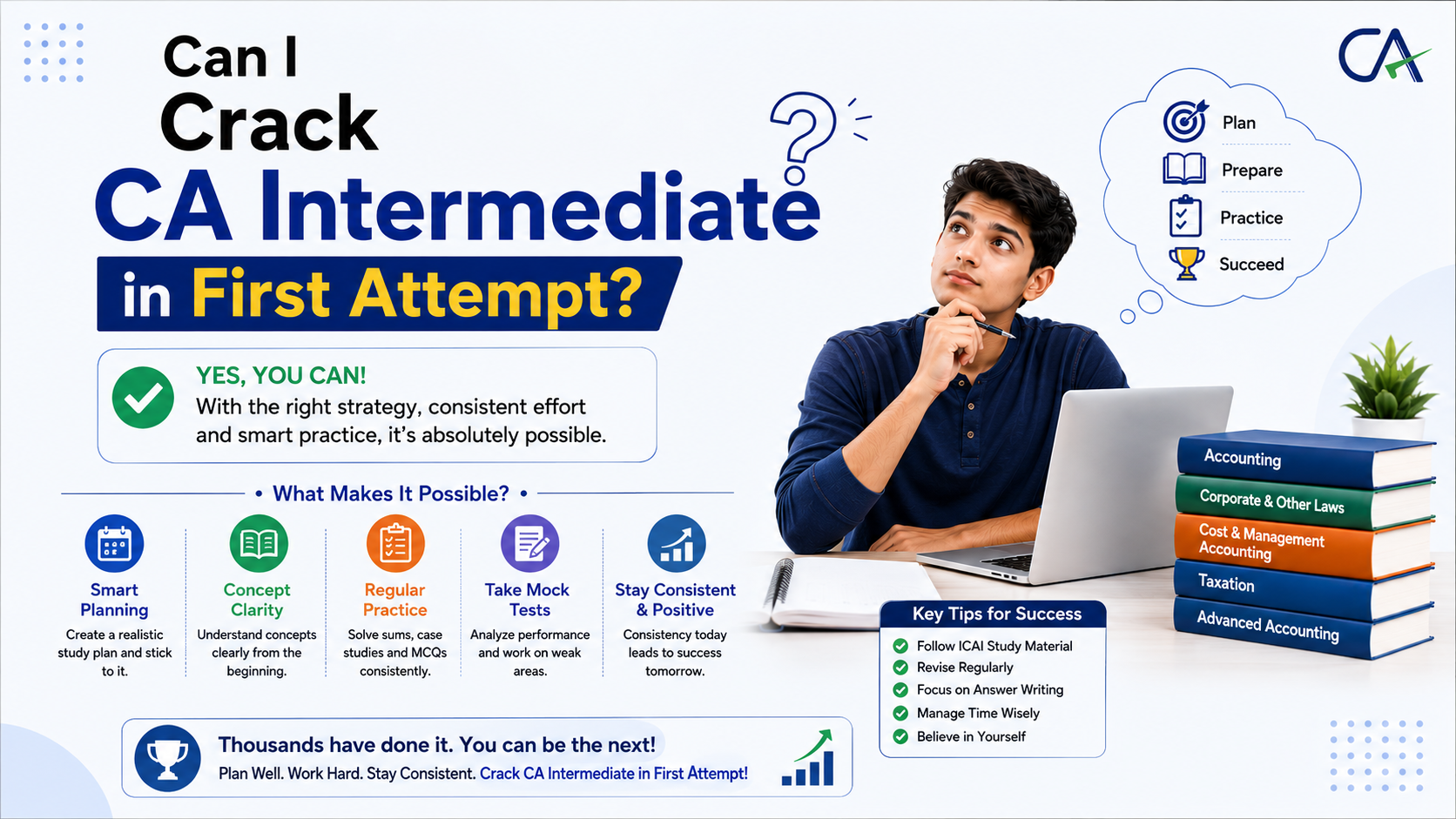
Table of Content
- Can I Crack CA Intermediate in First Attempt?
- CA Intermediate Registration and Eligibility Basics
- Can I Crack CA Intermediate in First Attempt?
- What Does the CA Intermediate Pass Percentage Really Show?
- Understanding the CA Intermediate Exam Pattern
- Why Do Many Students Fail to Clear Both Groups Together?
- Group-Wise Strategy to Improve Your Chances
- Is It Better to Attempt Both Groups Together or Separately?
- Why CA Exams
- Conclusion
Can I Crack CA Intermediate in First Attempt?
After clearing CA Foundation, almost every student asks the same question: can I crack CA Intermediate in first attempt? It's a fair question, because CA Intermediate is widely regarded as the toughest transition point in the entire CA journey. Unlike Foundation, this level has six papers, a much heavier syllabus, and pass percentages that are noticeably lower. That said, clearing both groups together in your first attempt is absolutely possible with the right CA Intermediate preparation strategy. In this blog, we look at the real numbers, why this level trips up so many students, how the exam pattern actually works, and exactly how to plan your preparation to give yourself a genuine shot at clearing it in one go.
CA Intermediate Registration and Eligibility Basics
Before diving into strategy, it's worth being clear on how you actually reach this stage. Students who clear CA Foundation become eligible to register for CA Intermediate, while commerce graduates or postgraduates meeting ICAI's minimum marks criteria can enter directly through the Direct Entry route, bypassing Foundation altogether. Once registered, ICAI requires candidates to complete a mandatory study period before appearing for the exam, similar in spirit to the four-month rule at the Foundation level, though the depth of the CA Intermediate syllabus means most students benefit from a longer, more structured runway. Being clear on your registration route and study period from day one helps you plan realistically instead of rushing into an attempt before you're actually ready.
Can I Crack CA Intermediate in First Attempt?
Yes, it is possible to crack CA Intermediate in your first attempt, but it demands a level of discipline and planning well beyond what most students used at the Foundation stage. CA Intermediate consists of six papers split into two groups of three papers each, and to clear both groups together, you need to score at least 40% in every individual paper and an overall aggregate of 50% across all six papers simultaneously. This structure means even one weak paper can derail an otherwise strong attempt, which is exactly why the Both Groups pass percentage tends to be considerably lower than passing a single group alone.
What Does the CA Intermediate Pass Percentage Really Show?
Looking at recent ICAI data puts the difficulty into perspective. In the May 2026 session, Group I recorded a pass percentage of 10.25%, Group II recorded 16.11%, and candidates who cleared both groups together stood at just 8.47%. Similar trends were seen in January 2026, where Both Groups clearance was around 9.39%. These numbers confirm that clearing both groups in one sitting is genuinely challenging, fewer than 1 in 10 students manage it in most sessions. However, it also shows that a meaningful number of students do succeed every attempt cycle, and their success almost always traces back to structured, consistent preparation rather than luck. It's worth noting that pass percentages fluctuate between sessions too, Group II, for instance, has swung by more than 10 percentage points between consecutive attempts, which means students should prepare based on the full syllabus rather than assuming any single session's difficulty level will repeat.
Understanding the CA Intermediate Exam Pattern
Before building a strategy, it helps to understand exactly what you're up against. The CA Intermediate exam pattern includes six papers of 100 marks each, split evenly across Group I (Advanced Accounting, Corporate and Other Laws, and Taxation) and Group II (Cost and Management Accounting, Auditing and Ethics, and Financial Management and Strategic Management). Each paper carries a mix of 30% objective and 70% subjective questions, and unlike CA Foundation, there is no negative marking in CA Intermediate. To pass a group, candidates must score a minimum of 40% in each paper and an overall 50% aggregate within that group, and the same requirement applies across all six papers if attempting both groups together.
Why Do Many Students Fail to Clear Both Groups Together?
Understanding common failure patterns helps you avoid repeating them. Some of the most frequent reasons students don't clear CA Intermediate in their first attempt include:
- Underestimating Group II's numerical demands: Students often prepare Group I's reading-heavy subjects well but struggle with Financial Management's calculation-based questions.
- One paper pulling down the whole attempt: Scoring 38% in a single paper fails the entire group, even with strong marks elsewhere.
- Treating all six papers with the same study method: Group I rewards conceptual depth and writing practice, while Group II rewards speed and application.
- Ignoring amendments in Taxation: Tax laws change frequently, and outdated notes can cost significant marks in this heavily amendment-driven paper.
- Insufficient timed practice: Many students know the concepts but run out of time or lose marks by not presenting answers in ICAI's expected format.
Group-Wise Strategy to Improve Your Chances
Since Group I and Group II demand different skill sets, treating them separately in your preparation plan makes a real difference:
- Group I: Focus on conceptual depth, consistent reading, and regular writing practice, since Advanced Accounting, Law, and Taxation reward structured, detailed answers.
- Group II: Prioritize numerical fluency and application, especially in Financial Management, which is often the paper where Both Groups attempts fail.
- Check your exemptions first: If you scored 60 or more in any paper during a previous attempt, that score carries forward, so confirm this on the ICAI portal before you start preparing.
- Update your Taxation notes: Always study from the latest applicable amendment cut-off date rather than relying on static notes from an earlier session.
- Practice under timed, exam-like conditions: Since there's no sectional time limit, you need to build your own pacing strategy well before the actual exam.
Is It Better to Attempt Both Groups Together or Separately?
This is a genuinely personal decision that depends on your study capacity and schedule. Attempting both groups together saves time overall and gets the entire level done in one sitting, but it also means covering six papers within the same preparation window, which can be demanding. Attempting one group at a time allows deeper focus on three papers and can improve individual pass rates, but it stretches out your overall CA timeline. If you have limited daily study hours due to college, work, or other commitments, splitting the groups is often the more realistic choice. If you can commit to focused, full-time preparation for several months, attempting both groups together is a reasonable goal.
Why CA Exams
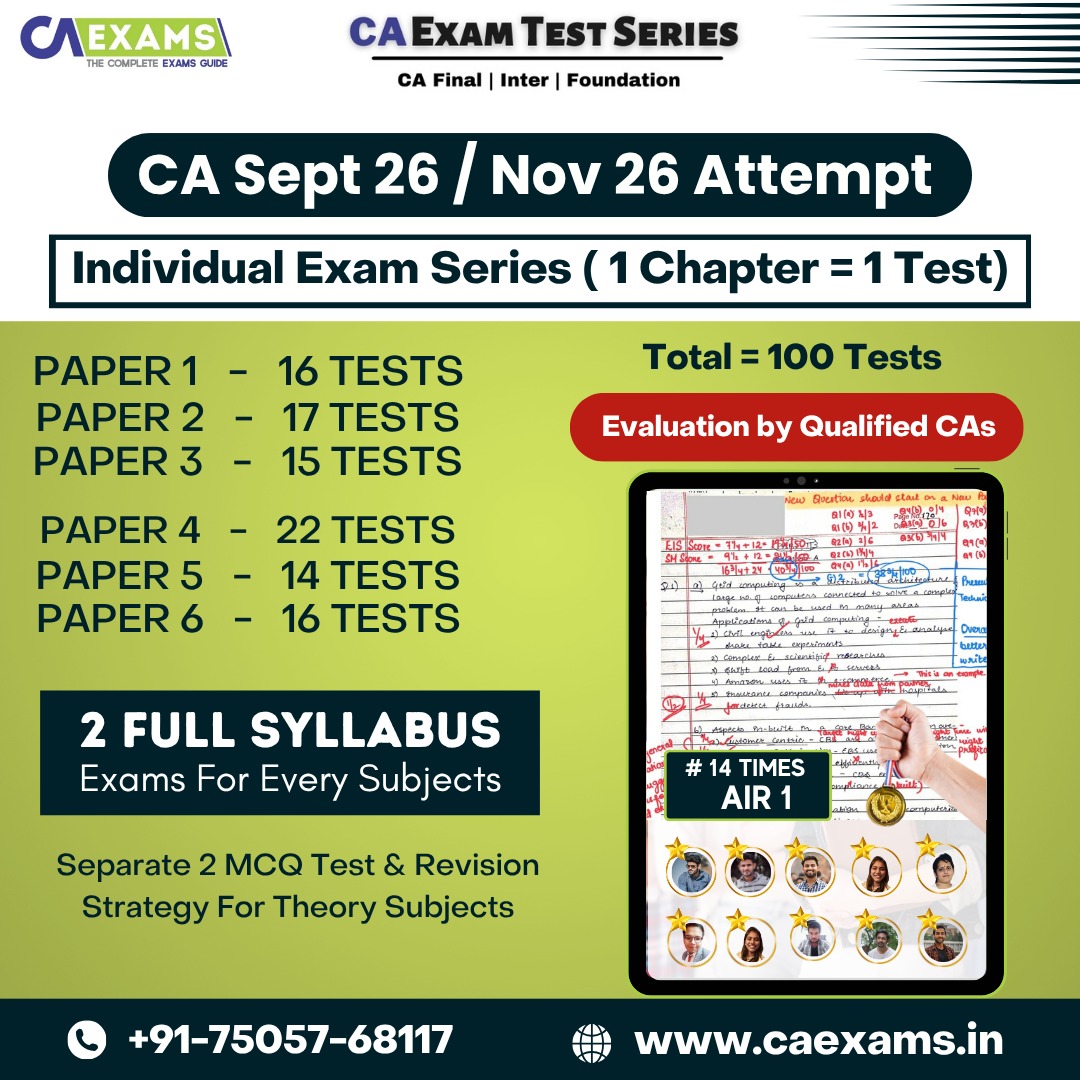
Given how unforgiving the CA Intermediate passing criteria can be, one weak paper is enough to fail an otherwise strong attempt, quality mock test practice becomes essential rather than optional. caexams.in is a trusted platform for CA Foundation, Intermediate, and Final aspirants, offering test papers designed strictly according to the latest ICAI exam pattern and syllabus for realistic, exam-like practice. Every test is prepared by experienced Chartered Accountants and subject matter experts who understand exactly where CA Intermediate students tend to lose marks, whether it's timing issues in Financial Management or presentation gaps in Law and Taxation. After each test, students receive a detailed, topic-wise evaluation along with a marking scheme and improvement suggestions, usually within 48 to 72 hours, which helps convert borderline scores into comfortable passes before the real exam. CA Exams also provides personalized mentorship and a study planner tailored to each student's pace, along with flexible online and offline testing options, making it easier to prepare group-wise or for both groups together with genuine confidence.
Conclusion
So, can I crack CA Intermediate in the first attempt? Yes, but it requires more than the general effort that worked at the Foundation level. With Both Groups pass percentages hovering around 8 to 10% in recent sessions, this stage genuinely filters for structured, consistent preparation. Understand the group-wise demands, check your exemptions, keep your Taxation notes updated, and practice extensively under timed conditions. Combine this with expert-evaluated mock tests from a platform like CA Exams, and clearing CA Intermediate in your first attempt becomes a realistic, achievable target rather than just a hopeful one. Even if you don't clear both groups on your first try, every attempt sharpens your understanding of exactly where you stand, which is valuable progress in itself.

FAQs
Can I crack CA Intermediate in my first attempt?
Yes, it is possible, though the Both Groups pass percentage typically ranges between 8% and 10%, making structured, consistent preparation essential for success.
What is the CA Intermediate pass percentage for both groups?
Recent sessions show Both Groups pass percentages around 8.47% in May 2026 and 9.39% in January 2026, reflecting the exam's demanding nature.
How many papers are there in CA Intermediate?
CA Intermediate has six papers of 100 marks each, divided equally into Group I and Group II, with three papers in each group.
Is there negative marking in CA Intermediate?
No, unlike CA Foundation, CA Intermediate does not have negative marking, though 30% of questions in each paper are objective type.
Which CA Intermediate paper causes the most Both Groups failures?
Financial Management within Group II is often the paper where Both Groups attempts fail, mainly due to underestimated numerical demands.
Should I attempt both CA Intermediate groups together or separately?
It depends on your available study time; attempting together saves overall time, while attempting separately allows deeper focus on fewer papers at once.
What is the passing criteria for CA Intermediate?
Candidates need a minimum of 40% in each paper and an overall aggregate of 50% within a group, or across all six papers if attempting both groups together.
Do exemptions carry forward in CA Intermediate?
Yes, if you scored 60 or more marks in a paper during a previous attempt, that score is typically carried forward as an exemption for the next attempt.
How many hours should I study daily for CA Intermediate?
Most students preparing for both groups together study around 10 to 12 hours daily, especially in the final months before the exam.
How can CA Exams help me crack CA Intermediate in my first attempt?
CA Exams offers ICAI pattern-based mock tests, expert evaluation within 48 to 72 hours, and personalized mentorship, helping students strengthen weak papers before the real exam.