Can a CA Become an Entrepreneur: From Finance Professional to Business Owner
Discover how Chartered Accountants can become successful entrepreneurs by using their financial expertise, business knowledge, and strategic decision-making skills.
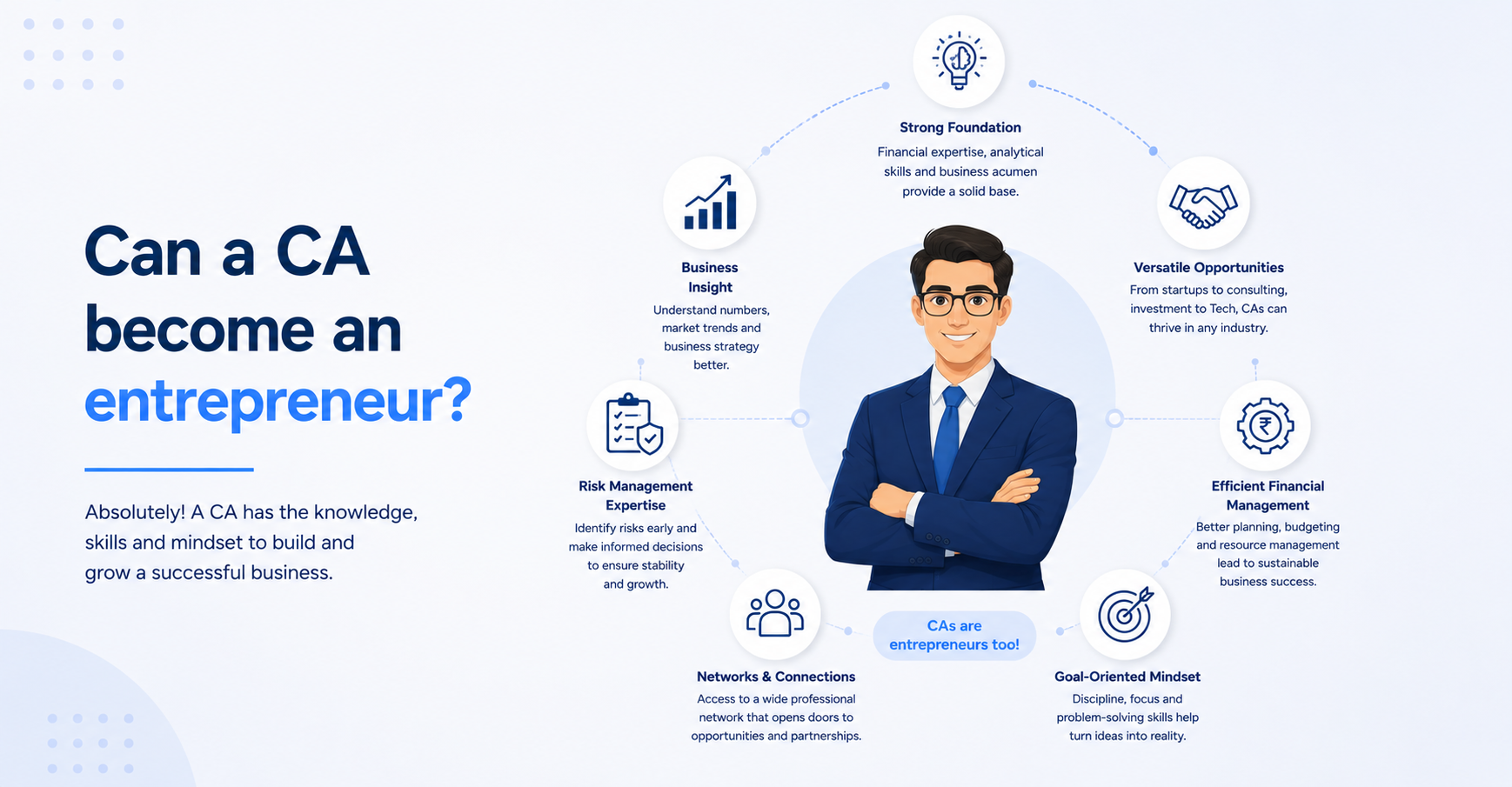
Table of Content
- Why Chartered Accountants Have Entrepreneurial Potential
- Can a CA Become an Entrepreneur?
- Skills That Help CAs Become Successful Entrepreneurs
- Financial Knowledge Reduces Startup Risks
- Business Exposure Creates Valuable Insights
- Popular Business Opportunities for Chartered Accountants
- Technology Has Expanded Entrepreneurial Opportunities
- Why CAs Understand Business Risks Better
- Challenges CAs May Face as Entrepreneurs
- The Shift from Service Provider to Business Builder
- Why Many Modern CAs Are Choosing Entrepreneurship
- Qualities That Help CAs Succeed as Entrepreneurs
- The Future Looks Bright for Entrepreneurial CAs
- Conclusion
Entrepreneurship is often associated with innovators, startup founders, and business leaders who create products, solve problems, and build successful organizations. Many people assume that Chartered Accountants are primarily focused on accounting, taxation, auditing, and compliance-related work. However, the reality is that Chartered Accountants possess many of the skills that are essential for building and running a successful business. Their understanding of finance, business operations, risk management, and strategic planning provides them with a strong foundation for entrepreneurship.
In recent years, an increasing number of Chartered Accountants have moved beyond traditional professional roles and entered the world of entrepreneurship. Some have established consulting firms, technology startups, financial advisory companies, educational platforms, outsourcing businesses, and various other ventures. Their ability to understand business fundamentals, manage financial resources, and make data-driven decisions often gives them an advantage when starting and growing a business. As the business landscape continues to evolve, entrepreneurship is becoming an attractive career path for many Chartered Accountants.
Why Chartered Accountants Have Entrepreneurial Potential
Starting a business requires much more than a good idea. Entrepreneurs must manage finances, control costs, understand risks, allocate resources efficiently, and make strategic decisions. These are areas where Chartered Accountants already possess significant expertise.
Through their education and professional experience, CAs gain exposure to different industries, business models, financial systems, and management practices. This knowledge helps them understand how businesses succeed and why some fail. As a result, many Chartered Accountants already possess the mindset and capabilities needed to become successful entrepreneurs.
Can a CA Become an Entrepreneur?
The simple answer is yes. Chartered Accountants can become highly successful entrepreneurs because they possess strong financial knowledge, business understanding, problem-solving skills, and strategic thinking abilities.
Many successful businesses have been founded or co-founded by finance professionals who understood how to manage resources effectively and make informed business decisions. The CA qualification does not limit someone to practice or employment. Instead, it provides a strong platform for exploring entrepreneurial opportunities across multiple industries.
Skills That Help CAs Become Successful Entrepreneurs
A Chartered Accountant develops several skills that directly support entrepreneurship.
Important Entrepreneurial Strengths of CAs
- Financial Management – Understanding cash flow, profitability, and budgeting.
- Risk Assessment – Identifying challenges before they become major problems.
- Strategic Thinking – Evaluating long-term business opportunities.
- Problem Solving – Finding practical solutions to business challenges.
- Decision-Making Ability – Making informed choices based on data and analysis.
These capabilities provide a strong advantage when starting and managing a business.
Financial Knowledge Reduces Startup Risks
One of the biggest reasons startups fail is poor financial management. Many entrepreneurs struggle with budgeting, pricing, cash flow management, and financial planning.
Chartered Accountants already understand these areas. They know how to prepare budgets, monitor expenses, forecast cash flows, and evaluate business performance. This financial expertise helps them avoid common startup mistakes and improve the chances of long-term success.
Business Exposure Creates Valuable Insights
During their professional journey, Chartered Accountants often work with businesses across different industries. They observe how organizations operate, manage challenges, and pursue growth opportunities. This exposure provides practical business knowledge that many first-time entrepreneurs may not possess. By working closely with business owners, directors, and management teams, CAs gain insights into:
- Business operations
- Growth strategies
- Financial management
- Risk management
- Market challenges
These experiences often become valuable when launching a new venture.
Popular Business Opportunities for Chartered Accountants
Entrepreneurship does not necessarily mean starting a traditional trading or manufacturing business. Modern Chartered Accountants have access to a wide range of opportunities.
Business Areas Where CAs Commonly Succeed
- Financial Consulting Firms
- Virtual CFO Services
- Tax Advisory Practices
- Business Consulting Companies
- EdTech Platforms
- FinTech Startups
- Outsourcing Services
- Compliance Solutions
- Investment Advisory Businesses
- Training and Coaching Institutes
These opportunities allow CAs to leverage their existing expertise while building scalable businesses.
Technology Has Expanded Entrepreneurial Opportunities
Technology has significantly reduced the barriers to starting a business. Today, entrepreneurs can serve clients globally without requiring large offices or extensive infrastructure. Chartered Accountants can build technology-driven businesses through:
- Online consulting
- Digital accounting services
- Financial software solutions
- Business analytics platforms
- Educational websites
- Professional training programs
Digital transformation has created new opportunities for finance professionals to become entrepreneurs.
Why CAs Understand Business Risks Better
Every entrepreneur faces uncertainty. Market competition, economic conditions, customer behavior, and operational challenges can affect business performance. Chartered Accountants are trained to evaluate risks and develop strategies to manage them effectively. This risk-management mindset often helps them make more calculated business decisions.
Areas Where CAs Have an Advantage
- Financial Risk Analysis
- Cash Flow Planning
- Compliance Management
- Performance Monitoring
- Cost Control
- Business Forecasting
These skills help entrepreneurs build stronger and more sustainable businesses.
Challenges CAs May Face as Entrepreneurs
Although Chartered Accountants possess many strengths, entrepreneurship also requires skills beyond finance. Building a successful business often involves:
- Sales and marketing
- Brand building
- Team management
- Customer acquisition
- Product development
- Innovation
Some CAs may initially struggle in these areas because traditional professional roles focus more on technical expertise than business development. However, these skills can be learned through experience, networking, and continuous learning.
The Shift from Service Provider to Business Builder
One of the biggest adjustments for a Chartered Accountant entering entrepreneurship is changing their mindset.
As professionals, CAs often focus on delivering services and solving client problems. Entrepreneurs, however, must also focus on growth, innovation, marketing, and scaling operations. This transition requires thinking beyond technical work and developing leadership capabilities that support business expansion.
Why Many Modern CAs Are Choosing Entrepreneurship
The business environment has changed significantly over the past decade. Technology, globalization, and digital business models have created opportunities that did not exist earlier. Many Chartered Accountants are now exploring entrepreneurship because it offers:
- Greater independence
- Unlimited growth potential
- Wealth creation opportunities
- Flexibility
- Professional satisfaction
These benefits make entrepreneurship an attractive option for ambitious finance professionals.
Qualities That Help CAs Succeed as Entrepreneurs
Essential Entrepreneurial Traits
- Adaptability – Adjusting to changing market conditions.
- Leadership – Building and managing teams effectively.
- Innovation – Creating solutions for business problems.
- Persistence – Staying committed during challenges.
- Customer Focus – Understanding and meeting client needs.
When combined with financial expertise, these qualities create a strong foundation for entrepreneurial success.
The Future Looks Bright for Entrepreneurial CAs
As businesses become more complex and financial decision-making becomes more important, the demand for professional advisory services continues to grow. This creates significant opportunities for Chartered Accountants to establish businesses that provide specialized solutions.
From consulting and outsourcing to technology and education, the entrepreneurial possibilities for CAs are expanding rapidly. Professionals who combine financial expertise with innovation and business vision are likely to find numerous opportunities in the coming years.
The future is no longer limited to practice or employment. Entrepreneurship has become a realistic and rewarding path for many Chartered Accountants.
Conclusion
The answer to Can a CA become an entrepreneur is a definite yes. Chartered Accountants possess many of the skills required to build successful businesses, including financial management, strategic thinking, risk assessment, and business planning. Their exposure to different industries and business models provides valuable insights that can support entrepreneurial success.
While entrepreneurship requires additional skills such as marketing, leadership, and customer acquisition, these can be developed over time. With the right mindset, vision, and determination, Chartered Accountants can successfully transition from finance professionals to business owners and create ventures that generate long-term value and growth.

FAQs
Can a Chartered Accountant become an entrepreneur?
Yes. Chartered Accountants can become entrepreneurs by using their financial expertise, business knowledge, and strategic thinking to build and grow successful businesses.
Why are Chartered Accountants well-suited for entrepreneurship?
CAs understand finance, budgeting, risk management, compliance, and business operations, which are essential skills for running a successful business.
What businesses can Chartered Accountants start?
They can start consulting firms, Virtual CFO services, tax advisory businesses, outsourcing companies, FinTech startups, training institutes, and business advisory firms.
Does the CA qualification help in entrepreneurship?
Yes. The CA qualification develops analytical thinking, financial management skills, and business understanding that support entrepreneurial success.
What advantages do CAs have over other entrepreneurs?
Their financial expertise, risk assessment abilities, budgeting knowledge, and business exposure often give them a strong advantage when managing a business.
Can a CA start a technology-based business?
Yes. Many Chartered Accountants launch technology-driven businesses such as accounting software solutions, financial platforms, and online consulting services.
What challenges may a CA face as an entrepreneur?
Challenges may include marketing, sales, branding, customer acquisition, and team management, which require skills beyond finance.
Do Chartered Accountants need additional skills to become entrepreneurs?
Yes. Leadership, communication, marketing, networking, and innovation skills can help CAs succeed as business owners.
Why are more Chartered Accountants choosing entrepreneurship today?
Technology, globalization, and digital business models have created new opportunities that offer greater independence and growth potential.
What is the biggest strength of a CA entrepreneur?
The biggest strength is the ability to combine financial expertise with business decision-making, helping create sustainable and profitable ventures.