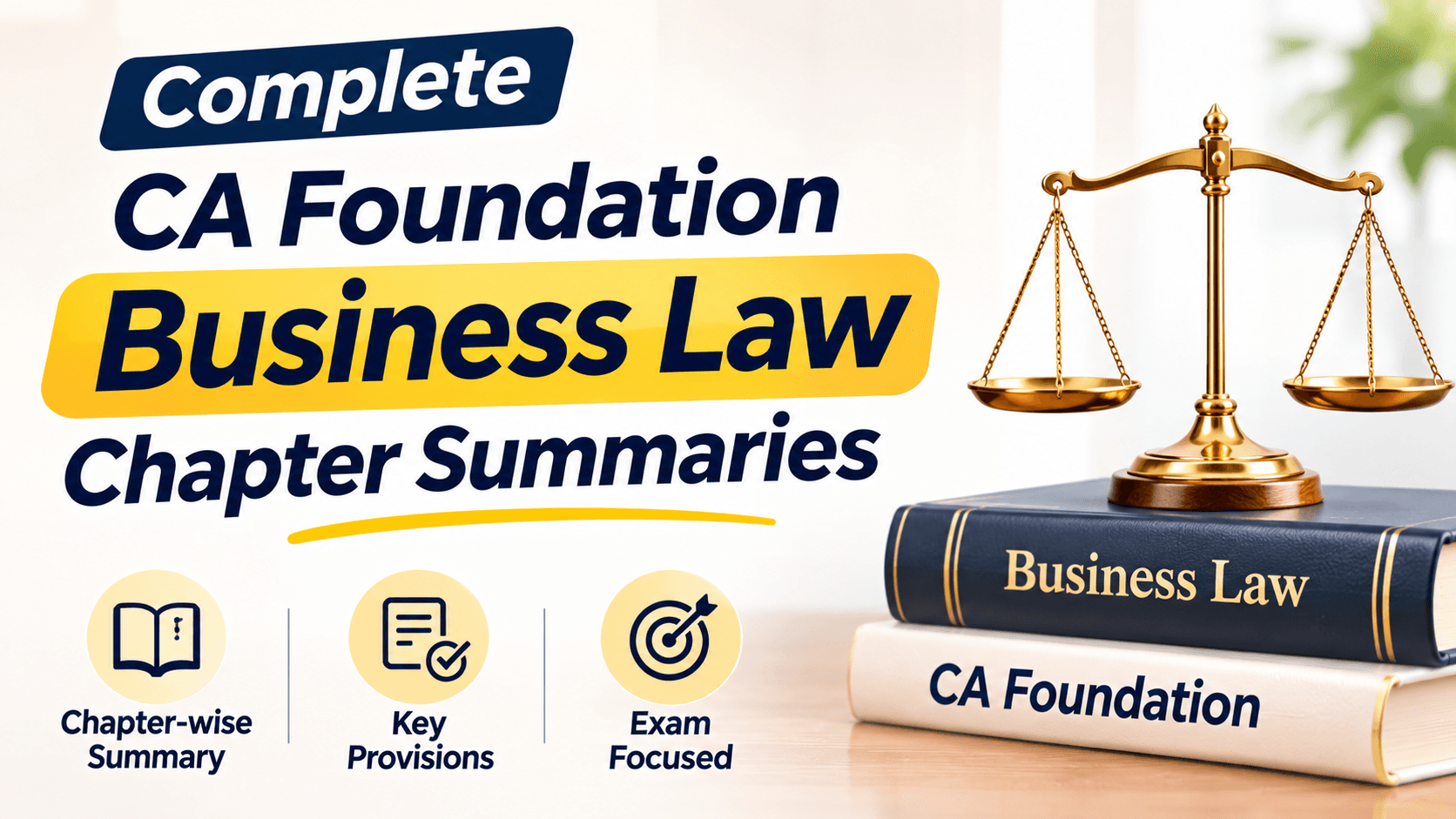
Complete CA Foundation Business Law Chapter Summaries
Learn how to use complete CA Foundation Business Law chapter summaries for concept clarity, quick revision, provision recall and exam-oriented answer writing.
In this article(11 sections)ShowHide
Business Law is an important part of CA Foundation preparation because students need to understand legal concepts, remember key provisions and apply them to questions. Reading the study material from beginning to end is essential, but revising every page repeatedly can become difficult when several subjects need attention.
Chapter summaries can make revision more organised by bringing the main concepts, definitions, conditions and distinctions into a compact format. They work best when they are prepared from the applicable ICAI study material and used alongside question practice. This guide explains how to structure and use chapter summaries without reducing Business Law to rote learning.
Why chapter summaries are useful
Business Law contains definitions, principles, requirements, exceptions and illustrations. If all information is kept in long paragraphs, it may be difficult to locate a particular point during revision. A well-organised summary gives each concept a clear place and helps students see how topics relate to one another.
A summary should not replace detailed study. It is a revision aid that helps you retrieve the framework of a chapter. When a point is unclear, return to the official material and read the complete explanation, including examples and relevant illustrations.
Begin with the applicable syllabus
Before preparing summaries, confirm the CA Foundation syllabus and study material applicable to your examination attempt. Check the latest ICAI announcements and any amendments or updates relevant to the subject. Notes prepared for an older attempt may not cover the current requirements.
Divide each chapter into its prescribed topics and subtopics. Use the official chapter sequence as the foundation for your notes so that you can check coverage easily. Mark topics as understood, partly understood or requiring further study.
What every chapter summary should include
Start with the chapter's central idea and learning objectives. Add key terms, definitions, main legal principles, important conditions and exceptions where they are part of the syllabus. Keep the explanation accurate and concise rather than copying complete textbook paragraphs.
Include short examples when they clarify how a principle works. For topics that involve a sequence or classification, use a flowchart or table. For distinctions, compare the relevant features side by side so that the difference is easy to recall.
Leave a small space for doubts, corrections and points you repeatedly forget. A summary should evolve as you solve questions and discover where your understanding needs improvement.
Organise legal concepts clearly
Legal concepts become easier to revise when information is arranged in a consistent order. For a provision-based topic, you may record the concept, its essential elements, conditions, exceptions and a simple illustration. For a classification-based topic, show each category with its distinguishing feature.
Use headings that describe the subject rather than vague labels such as 'important points'. Keep related concepts together, but do not merge rules that have different requirements. If two provisions appear similar, write the difference explicitly.
Accuracy is more important than decorative presentation. Avoid creating abbreviations that change the meaning of a legal term, and verify every short form before using it in revision.
Use summaries for active recall
After revising a chapter summary, close the page and try to explain the main concepts from memory. Write the headings first, then reconstruct the key points under each heading. Compare your attempt with the summary and mark missing or inaccurate information.
Turn headings into questions. For example, ask yourself what a term means, what conditions apply or how two concepts differ. This changes revision from passive reading into a test of what you can actually remember.
Return to difficult topics after a gap rather than repeating the same summary several times in one sitting. A short review the next day and another later in the week can help you identify whether the information is staying with you.
Connect provisions with practical situations
Understanding a legal rule includes knowing how it applies to a situation. After learning a concept, consider a simple example that demonstrates its essential elements. Then attempt a question in which the facts are slightly different and decide which part of the rule is relevant.
For case-based questions, identify the issue, recall the applicable principle, connect it with the facts and reach a reasoned conclusion. Do not write every point from the chapter if the question asks about only one specific issue.
Use examples to support understanding, but keep them aligned with the official material. If an illustration involves a particular legal condition, do not generalise it beyond what the rule permits.
Revise with questions and past papers
Once a chapter summary is ready, solve questions related to that chapter. Begin with basic questions to check definitions and concepts, then move to application-based questions. Review why an answer is correct instead of merely checking the final response.
Previous examination questions can help you understand the style and depth of questions. They should not be treated as a prediction of what will appear next. Cover the prescribed syllabus and use question papers to practise applying the concepts.
Maintain an error list with the topic, the mistake and the corrective action. If you confuse two terms, add a comparison to your summary. If you forget a condition, create a recall prompt for that point.
Create a chapter-wise revision schedule
Allocate revision sessions across all chapters rather than waiting until the end of the syllabus. A weekly plan can include new learning, summary review, question practice and a short revisit of older chapters.
Give additional time to chapters that are difficult or where your answers show repeated errors. Keep shorter maintenance sessions for topics you can already explain accurately. Review your schedule each week and adjust it according to actual progress.
Do not spend all your time making notes look perfect. Set a reasonable time limit for preparing each summary and reserve enough time for solving questions and revising the complete subject.
Common mistakes to avoid
A common mistake is copying the textbook into a shorter document without understanding it. This creates more material to read but may not improve recall. Write summaries in your own words while preserving the legal meaning and essential terminology.
Another mistake is relying only on summaries and skipping the prescribed study material. Summaries can omit context, explanations or details needed to understand a concept. Use them as a quick revision layer, not as your only source.
Students should also avoid treating a chapter as complete after reading its summary once. Test recall, solve questions and revisit the points where you make mistakes.
Quick Reference Table
| Summary element | What to include | Revision benefit |
|---|---|---|
| Chapter overview | Central idea and learning objectives | Quickly recalls the topic framework |
| Key concepts | Definitions and legal principles | Strengthens concept recall |
| Conditions and exceptions | Essential requirements and limitations | Reduces confusion between rules |
| Examples | Short illustrations linked to concepts | Supports practical understanding |
| Practice prompts | Questions and common errors | Turns notes into active revision |
How Studycaller Can Support Your Preparation
Studycaller can be considered as a supplementary learning and practice resource where relevant CA course material or tests are available. Check the current course coverage and use any practice feedback alongside the applicable ICAI study material. Supplementary notes and tests do not replace official content, amendment verification or independent revision.
CA Foundation Past papers notes
Free notes from the Studycaller library, picked for this article.
 Questions
CA Foundation · Business Economics
Economics practice papers chp 1 to 3 Many other subjects papers has been uploaded on this page! Follow for more!
RuqaiyaLikes 6Views 7.8k MCQs
CA Foundation · Business Economics
Business economics practice papers. Many papers has been uploaded on this page . follow for more!
RuqaiyaLikes 6Views 7.3k Questions
CA Foundation · Quantitative Aptitude
CA Foundation Business Mathematics, Logical Reasoning and Statistics Test No. 1
RuqaiyaLikes 5Views 6.5k Past papers
CA Foundation · Quantitative Aptitude
Past papers chapter wise mcqs
AnshikaLikes 18Views 16.1k
Frequently asked questions
How should I prepare CA Foundation Business Law chapter summaries?
Follow the applicable ICAI syllabus, divide each chapter into concepts and provisions, and summarise definitions, conditions, exceptions and examples accurately. Use the summaries for active recall and solve questions after revising each chapter.
Are chapter summaries enough for CA Foundation Business Law?
No. Summaries are revision aids, not substitutes for the prescribed study material. Read the detailed explanations, understand the legal principles and use summaries to revise key points before attempting questions.
What should a Business Law chapter summary contain?
Include the chapter overview, key terms, legal principles, conditions, exceptions, short illustrations and practice prompts. Keep the notes concise while preserving the meaning and terminology of the applicable material.
How can I remember Business Law provisions?
Understand the purpose and structure of each provision, then use active recall. Reconstruct the key elements from memory, compare similar concepts and practise applying the rule to short situations.
Should I make handwritten or digital Business Law notes?
Choose the format you can revise consistently. Handwritten notes may help some students process information, while digital notes are easier to update. Accuracy, organisation and regular use matter more than the format.
How often should I revise CA Foundation Business Law?
Revise each topic soon after learning it, revisit it after a few days and include it in later weekly revision. Use questions to identify which concepts need more frequent review.
Can I use previous papers to prepare chapter summaries?
Previous papers help you understand question styles and application, but the summary should be based on the current syllabus and official material. Do not omit topics simply because they appeared less often.
How can I improve answers in Business Law?
Identify the exact requirement, state the relevant principle accurately, explain the point in a logical order and apply it to the facts where needed. Practise writing within a reasonable time.
Are short notes useful in the final revision period?
Yes, if they are accurate and prepared during learning. Use them to recall the chapter framework, then test yourself with questions. Return to detailed material whenever a concept remains unclear.
How can Studycaller support CA Foundation Business Law preparation?
Studycaller can be considered as a supplementary practice resource where relevant CA Foundation tests are available. Use practice and feedback alongside the current ICAI study material and your own revision plan.