PDF · Handwritten Notes
SM Chapter 4 CA Inter Short Notes – Strategic Choices for Quick Revision
- Shared by
- Ansh
- Course
- CA Inter
- Subject
- Other Stuff
- Added
- 29 Sept 2025
Part of: CA Inter
Continue reading in the Studycaller app
The full PDF — free to read, save and share in the app.
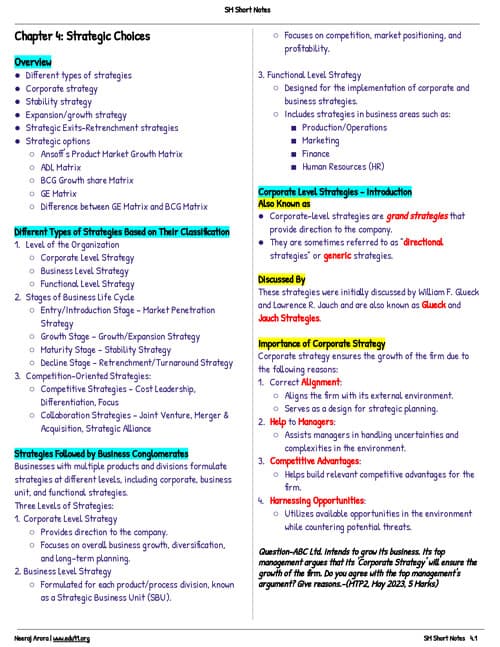
These SM Chapter 4 CA Inter short notes cover Strategic Choices from Strategic Management, the SM half of the FM and SM paper. The chapter overview lists the types of strategies, corporate strategy, stability, expansion and retrenchment strategies, and the main strategic options: Ansoff's Product Market Growth Matrix, ADL Matrix, BCG Growth Share Matrix, GE Matrix and the difference between the GE and BCG matrices. The pages explain the three levels of strategy, strategies across the business life cycle, Glueck and Jauch's corporate strategies, and the reasons and features of stability strategy. Past exam-style questions, including an MTP question from May 2023 and a September 2024 question with a model answer, are worked into the text. The notes suit CA Inter students who want a compact, point-wise version of the chapter for revision.
What SM Chapter 4 CA Inter Notes Cover
The notes open with a classification of strategies on three bases. By level of the organisation, they separate corporate, business and functional level strategies. By the stages of the business life cycle, they link the introduction stage to market penetration, growth to expansion, maturity to stability and decline to retrenchment or turnaround. By competition, they list competitive strategies (cost leadership, differentiation, focus) and collaboration strategies (joint venture, merger and acquisition, strategic alliance). The notes then explain how business conglomerates frame strategy at corporate, SBU and functional levels, with functional areas such as production, marketing, finance and HR. Corporate level strategies are introduced as grand, directional or generic strategies, credited to William F. Glueck and Lawrence R. Jauch. The four basic corporate strategies, stability, expansion, retrenchment and combination, are compared, and stability strategy is covered in detail with its meaning, major reasons and characteristics. The chapter overview also points to Ansoff, ADL, BCG and GE matrices in the later pages.
Key Points to Remember for the Exam
A few lines from these notes are worth memorising word for word. Stability strategy is not a do-nothing strategy: the firm serves the same or similar markets, offers the same or similar products and focuses on incremental functional improvements while tracking new developments. The five major reasons for stability are the maturity stage of the product, less risk and change, expansion being threatening, consolidation after rapid growth and a stable environment. Its characteristics include no redefinition of the business, a safety-oriented status quo, minimal fresh investment, minor product improvements, lower risk and modest growth. For corporate strategy, remember the four reasons it ensures growth: correct alignment with the environment, help to managers in handling uncertainty, building competitive advantage and harnessing opportunities while countering threats. Expansion strategy is defined as enlarging operations and increasing investment, reflecting dynamism and vigour. Also keep the life-cycle mapping of strategies ready, as it gives a quick structure for case-based answers.
How to Revise with These Short Notes
Use these notes as a second or third reading after you have gone through the ICAI study material for Strategic Choices once. Start with the overview list and try to recall each heading before reading the points under it. The notes include exam-style questions inside the text, such as the ABC Ltd. corporate strategy question from an MTP of May 2023 and a five-mark question on why start-ups rarely choose stability strategy. Attempt these on your own first, then compare with the reasons given in the notes; the answer guidance even reminds you to add reasons and scenarios of stability strategy. After this, practise related questions from RTPs, MTPs and past papers, focusing on case studies where you must identify the right corporate strategy. Keep a one-page chart of the Ansoff, ADL, BCG and GE matrices with their quadrants, and revise the GE versus BCG difference as a table. In the last week, skim only the bold headings and numbered reasons.
Who Should Use These SM Chapter 4 Notes
These notes are written for CA Inter students preparing the Strategic Management part of the FM and SM paper. They help most when you have already studied the chapter and need a short, structured version to revise before the exam, MTPs or a mock test. Students who find the study material lengthy can use the point-wise format to remember lists such as the reasons for stability strategy or the importance of corporate strategy. The notes are also useful for those who struggle to write theory answers, since the questions included show how marks are framed for five-mark answers. Because the page is filed under amendment notes, it can be used alongside the latest study material, but always check the current ICAI module for any change in content. Students in self-study or those revising a weak area of Strategic Management will find the life-cycle and level-wise classification a quick way to connect concepts across chapters.
Key topics in these notes
- Levels of strategy: corporate business functional
- Strategies across the business life cycle
- Competitive and collaboration strategies
- Glueck and Jauch corporate strategies
- Importance of corporate strategy
- Stability expansion retrenchment and combination strategies
- Reasons and characteristics of stability strategy
- Expansion or growth strategy
- Ansoff's Product Market Growth Matrix
- ADL Matrix
- BCG Growth Share Matrix
- GE Matrix vs BCG Matrix
Explore more FM AND SM notes
- ca inter
- strategic management
- sm chapter 4
- strategic choices
- corporate strategy
- stability strategy
- bcg matrix
- fm and sm
Related notes
- CA INTERMEDIATE STRATEGIC MANAGEMENT [SM] LAST DAY REVISION [LDR] MIND MAP CHARTBOOK
- Strategic Management.. chapter 4 ... handwritten notes...!! CA Intermediate examination
- Strategic Management...chapter 3 ... Handwritten notes.. CA Intermediate examination
- Strategic Management...Chapter 2 .. handwritten notes..!! CA Intermediate...
- Strategic management test paper (50 marks)
- Strategic management...chapter 5th .. CA Intermediate examination.
- CA INTERMEDIATE STRATEGIC MANAGEMENT [SM] MUST DO REVISION TOPICS LIST BY DARSHAN MAKWANA FOR SEPTEMBER, 2026
- Strategic management chapter 1... handwritten notes...!!
What to study next
Frequently asked questions
What is SM Chapter 4 in CA Inter?
SM Chapter 4 is Strategic Choices. It covers types of strategies, corporate strategies such as stability, expansion and retrenchment, and strategic options like the Ansoff, ADL, BCG and GE matrices.
What are the basic corporate strategies in SM Chapter 4?
The notes list four: stability, expansion, retrenchment and combination strategy. These are also called Glueck and Jauch strategies, or grand and directional strategies.
Is stability strategy a do-nothing strategy?
No. The notes stress that stability strategy keeps track of new developments and focuses on incremental improvements while serving similar markets with similar products.
What are the major reasons for choosing a stability strategy?
The notes give five reasons: the product is in its maturity stage, less risk and change, expansion seems threatening, consolidation after rapid expansion and a stable environment.
Why do start-ups rarely choose a stability strategy?
Start-ups focus on speed, agility, rapid growth and market penetration in their early stages. Stability suits mature businesses that want to maintain operations and market share, usually after expanding to full capacity.
Do these notes include past exam questions?
Yes, the pages include questions such as an MTP question from May 2023 on corporate strategy and a September 2024 question on stability strategy, each for 5 marks.
How can I get the full SM Chapter 4 short notes PDF?
Open it free in the Studycaller app to read the complete note.