PDF · Handwritten Notes
Shubham Singhal Law Book Edition 6: Chapter 5 Acceptance of Deposits by Company
- Shared by
- Your Welwisher
- Course
- CA Inter
- Subject
- Other Stuff
- Added
- 15 Mar 2026
Part of: CA Inter
Continue reading in the Studycaller app
The full PDF — free to read, save and share in the app.
This is Chapter 5, Acceptance of Deposits by Company, from the Shubham Singhal law book edition 6 question bank for CA Inter Corporate and Other Laws, labelled for May 2026 onwards. The chapter uses a question-and-answer format. Each question carries its source, such as RTPs, MTPs, the ICAI Module and past exams. Answers follow the exam pattern: relevant provisions first, then the conclusion. The pages cover Section 73(2) on deposits from members, Section 76 on deposits from the public, the 35 per cent and 100 per cent limits, and the government company limit. They also cover what is not treated as a deposit under Rule 2(1)(c), including listed non-convertible debentures and business advances. It suits CA Inter students who want quick practice on how ICAI frames questions on this chapter.
What Chapter 5 Deposits Covers in Detail
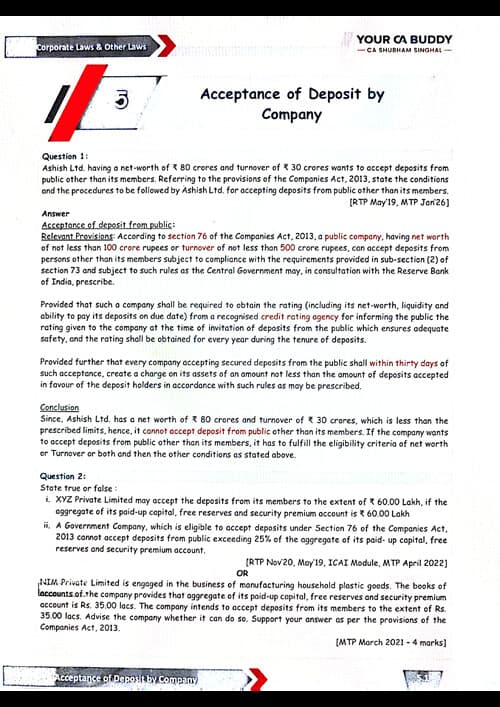
The chapter opens with a case on Ashish Ltd., which has a net worth of ₹80 crore and turnover of ₹30 crore. It explains why the company cannot accept public deposits: Section 76 needs a net worth of at least ₹100 crore or turnover of at least ₹500 crore. The same answer covers the yearly credit rating and the charge on assets for secured deposits, created within thirty days. A true/false question tests the 35 per cent limit for deposits from members and the 100 per cent limit for private companies, with details filed with the Registrar. It also corrects a 25 per cent claim for government companies. Later questions cover listed non-convertible debentures under Rule 2(1)(c)(ixa) and the full list of business receipts excluded under Rule 2(1)(c)(xii). The pages end with the Section 73(2) procedure for accepting deposits from members.
Key Points to Remember for the Exam
Learn these thresholds exactly, because the questions turn on them: - **Public deposits (Section 76):** net worth of at least ₹100 crore or turnover of at least ₹500 crore. - **Deposits from members:** up to 35 per cent of paid-up share capital, free reserves and securities premium. - **Private companies:** up to 100 per cent of the same aggregate from members, with details filed with the Registrar. - **Government companies:** the limit is also 35 per cent, not 25 per cent. For procedure, remember the sequence: - A resolution in general meeting. - A circular with a statement of financial position and credit rating, filed with the Registrar 30 days before it is issued. - At least 20 per cent of deposits maturing in the next year kept in a deposit repayment reserve account in a scheduled bank by 30 April. - A certificate of no default, or five years passed since a default was made good. Advances for goods or services count as deposits only if not appropriated within 365 days. Refundable amounts are deemed deposits fifteen days after they fall due.
How to Revise with These Notes
Start by reading the deposits chapter in the ICAI study material once, so the sections and rules are familiar. Then attempt each question in this chapter on your own before reading the answer. Many are tagged with their source, which shows which ones ICAI has repeated: - RTP May 2019 and Nov 2020 - MTP March 2021, April 2022, May 2023 and Jan 2026 - Exam papers of May 2017, May 2018 and Nov 2018 Compare your answers with the given format of relevant provisions, analysis and conclusion. That is the structure examiners expect in case-study questions. For the 4-mark and 6-mark theory questions, such as the list of amounts not treated as deposits or the Section 73(2) procedure, write the points from memory and check them against the answer. In the final days, revise only the numerical limits and time periods, and pair this chapter with the latest RTP and MTP for your attempt.
Who Should Use the Shubham Singhal Law Book Edition 6
This chapter of the Shubham Singhal law book edition 6 is for CA Inter students preparing Corporate and Other Laws, which the caption labels for May 2026 onwards. It suits students who have finished the concept reading and now want exam-style practice on deposits. It is also useful for those who find case questions on eligibility and limits confusing. Students following CA Shubham Singhal's classes can use it as their main question bank for this chapter. Others can use it alongside any concept book to test themselves on RTP and MTP questions. As the questions mirror ICAI Module and past-paper wording, the chapter also works as a last-week revision sheet. It covers both theory lists and short practical cases on Sections 73 and 76 of the Companies Act, 2013.
Key topics in these notes
- Section 76 public deposits eligibility
- Net worth ₹100 crore or turnover ₹500 crore
- Section 73(2) deposits from members
- 35% limit on paid-up capital free reserves and securities premium
- Private company 100% limit from members
- Government company deposit limit
- Listed non-convertible debentures under Rule 2(1)(c)(ixa)
- Amounts not deposits under Rule 2(1)(c)(xii)
- Deposit repayment reserve account
- Credit rating and charge for secured deposits
Explore more Corporate and Other Laws notes
- ca inter law
- corporate laws
- acceptance of deposits
- companies act 2013
- shubham singhal
- question bank
- section 73
- section 76
Related notes
- Question Bank, Latest Edition 6 Shubham Singhal Law Chapter 4 Share Capital and Debentures Email me to acces whole pdf ₹2 per chapter - char
- CA INTER LAW LATEST QUESTION BANK CH 1 - 4 BY SHUBHAM SINGHAL
- CA INTERMEDIATE CORPORATE AND OTHER LAWS [LAW] COPORATE LAW LIMITS CHART | COMPANIES ACT, 2013 LIMITS CHART BY CA HARSH GUPTA FOR SEPTEMBER,
- CA INTERMEDIATE CORPORATE AND OTHER LAWS [LAW] SUPER 100 QUESTIONS ALONG WITH ANSWERS BY CA SHUBHAB SINGHAL FOR SEPTEMBER, 2026 JANAURY, 202
- CA Inter Corporate & Other Laws - Question Bank by CA Shubham Singhal - For May 26, Sep 26 & Jan 27
- Law question bank by shubham singhal sir All chapters
- All New Latest Law Question Bank. CA SUBHAM SINGHAL SIR. ALL CHAPTERS Are Present.
- CA INTER LAW QUESTION BANK BY CA SHUBHAM SINGHAL CH 10-15
What to study next
Frequently asked questions
What is in Chapter 5 of the Shubham Singhal law book edition 6?
Chapter 5 covers Acceptance of Deposits by Company in question-and-answer form. It includes Section 73, Section 76 and the Acceptance of Deposits Rules, 2014.
Which exam is this Shubham Singhal law question bank for?
It is for CA Inter Corporate and Other Laws. The upload is labelled as applicable for May 2026 onwards.
Can a company with ₹80 crore net worth accept public deposits?
No. Under Section 76, a public company needs a net worth of at least ₹100 crore or turnover of at least ₹500 crore to accept deposits from the public.
How much can a private company accept as deposits from its members?
A private company may accept deposits from members up to 100 per cent of its paid-up share capital, free reserves and securities premium account. It must file the details with the Registrar.
Are listed non-convertible debentures treated as deposits?
No. Under Rule 2(1)(c)(ixa), listed non-convertible debentures that do not create a charge on the company's assets are not considered deposits.
What is the deposit repayment reserve account requirement?
By 30 April each year, a company must keep at least 20 per cent of the deposits maturing in the next financial year in a separate account in a scheduled bank.
How can I get the full Chapter 5 Deposits PDF?
Open it free in the Studycaller app to read all pages of the chapter.