PDF · Handwritten Notes
GST Summary Book by Jasmeet Singh: CA Inter Taxation Summary Notes on Supply Under GST
- Shared by
- Keyur
- Course
- CA Inter
- Subject
- Other Stuff
- Added
- 25 May 2026
Part of: CA Inter
Continue reading in the Studycaller app
The full PDF — free to read, save and share in the app.
The GST Summary Book by Jasmeet Singh is a 60-page set of summary notes for CA Inter Taxation (Paper 3, GST portion) that turns the provisions into short charts, formulas and examples. The opening chapter on Supply under GST, prepared by CA Jasmeet Singh Arora, covers the taxable event, forward and reverse charge, and the meaning of goods, services, money and actionable claims. It then explains the types of supply, Section 7(1)(a) to 7(1)(c), Schedule I deemed supplies, related and distinct persons, Section 7(1A) classification and the start of Schedule III. The notes suit students who have finished the main GST classes and want a compact book for quick revision before the CA Inter exam, with a layout that makes it easy to recall provisions in the exam hall.
What the GST Summary Book by Jasmeet Singh covers
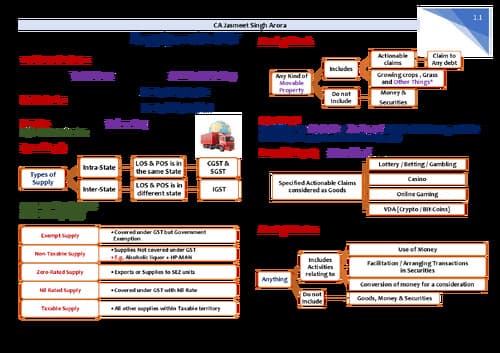
The first chapter, Supply under GST, opens with the taxable event: supply of goods, services or both within the taxable territory, with tax paid by the supplier under forward charge or by the recipient under reverse charge. It defines goods as movable property including actionable claims, growing crops and grass, and lists specified actionable claims treated as goods, such as lottery, betting, gambling, casino and online gaming. Money is defined with its inclusions, like cheques, drafts and letters of credit, and the exclusion of currency held for numismatic value. The types of supply chart separates exempt, non-taxable, zero-rated, nil-rated and taxable supply, and intra-State (CGST and SGST) from inter-State (IGST). The chapter then covers Section 7(1)(a), 7(1)(aa) on clubs and RWAs, 7(1)(b) on import of services, Schedule I transactions, Section 7(1A) classification and the start of Schedule III, the negative list. Abbreviations like LOS, POS, SOG and SOS keep each page short.
Key points to remember for the CA Inter GST exam
Several points in these notes are frequent exam traps. Supply under Section 7(1)(a) needs consideration and must be in the course or furtherance of business, while Schedule I treats certain transactions as supply even without consideration: permanent transfer of business assets on which ITC was availed (shown through a laptop donation example), supplies between related or distinct persons, principal and agent transactions, and import of services from a related person or own establishment outside India. Under Section 7(aa), members and their club or RWA are treated as two distinct persons. Spouse and children are always related, while parents, grandparents and siblings are related only if dependent; holding 25 per cent or more of shares in both entities also makes persons related. On classification, transfer of title in goods is a supply of goods while a right to use is a supply of services, job work is a service, customised software is always a service, and agreeing to refrain from, tolerate or do an act is a supply of services, such as non-compete fees or cancellation charges.
How to revise with these GST summary notes
Use this book as a final layer after you have studied the ICAI study material once. Read each chart, then try to rebuild it from memory on a blank page, for example the five types of supply or the five Schedule I transactions, and check what you missed. For each section the notes cite, such as Section 7(1)(a), 7(1)(aa), 7(1)(b), 7(1A) and Schedule III, open the matching ICAI module page and attempt the illustrations there. Next, solve the GST questions in recent RTPs and MTPs and mark which chart answers each one; this shows which provisions are tested in case-study form. Past exam papers often ask whether a given transaction is a supply and whether it is goods or services, so practise those with the classification table from page 1.3. In the last week, a quick pass through all 60 pages should be enough to refresh the whole GST portion.
Who should use these notes and which paper they help
These notes are written for CA Inter students taking the Taxation paper, where GST forms the indirect tax portion alongside income tax. They suit students who have completed lectures and now need a short book for second and third revision, and students who find long study material hard to revise in the last weeks. The chart format, with arrows, plus signs and short Hindi phrases like kuch na karna for refraining from an act, works well for visual learners. Students preparing for CMA Intermediate or other commerce exams that test basic GST concepts such as supply, related persons and composite supply may also find the opening chapter useful. Since GST provisions change with amendments, check that the edition matches your attempt by comparing it with the latest ICAI study material and RTP before relying on it fully.
Key topics in these notes
- Taxable event under GST
- Forward charge and reverse charge
- Meaning of goods services and money
- Specified actionable claims as goods
- Types of supply: exempt nil-rated zero-rated non-taxable
- Intra-State and inter-State supply
- Section 7(1)(a) 7(1)(aa) and 7(1)(b)
- Schedule I supply without consideration
- Related persons and distinct persons
- Section 7(1A) classification of goods and services
- Schedule III negative list
Explore more Taxation notes
Related notes
- CA INTERMEIDATE INDIRECT TAX [GST] SARANSH | SUMMARY CHART NOTES FOR LAST MOMENT QUICK REVISION BY THE ICAI FOR SEPTEMBER, 2026 AND JANAURY,
- CA INTERMEDIATE INDIRECT TAX [GST] CONCEPT BOOK AND QUESTION BOOK BY CA JASMEET SINGH ARORA | PHYSICS WALLAH | PW | CA WALLAH FOR MAY, 2026
- TAXATION -GST Summary Notes by Jasmeet Sir
- Time of supply summary notes exam quick revision September 2026 and Jan 2027 exam
- GST chapter 2 supply under GST Short notes and exam tips
- CA INTERMEIDATE DIRECT TAX [INCOME TAX] SARANSH | SUMMARY CHART NOTES FOR LAST MOMENT QUICK REVISION BY THE ICAI FOR SEPTEMBER, 2026 AND JAN
- GST Summary book by Amit Mahajan sir September/January 2025 Exam
- GST chart book by CA jasmeet singh arora for May 26 and onwards.
What to study next
Frequently asked questions
What is the GST Summary Book by Jasmeet Singh?
It is a 60-page set of chart-style summary notes on GST by CA Jasmeet Singh Arora for CA Inter Taxation. It starts with the chapter on Supply under GST.
Is the GST Summary Book by Jasmeet Singh useful for CA Inter?
Yes, it is uploaded for CA Inter Taxation and condenses GST provisions into charts and examples for quick revision. Use it alongside the ICAI study material.
Which topics are covered in the Supply under GST chapter?
It covers the taxable event, meaning of goods, services and money, types of supply, Section 7, Schedule I transactions, related and distinct persons, Section 7(1A) classification and Schedule III.
Is a supply without consideration taxable under GST?
As the notes explain, Schedule I transactions such as permanent transfer of business assets with ITC availed and supplies between related or distinct persons are treated as supply even without consideration.
Who are related persons under GST as per these notes?
Spouse and children are always related, while parents, grandparents and siblings are related only if dependent. Employers and employees, partners, and persons holding 25 per cent or more of shares of both entities are also covered.
Is customised software a supply of goods or services?
The notes classify customised software as always a supply of services, while general software bought offline is goods and general software downloaded online is services.
How can I get the full GST Summary Book PDF?
Open it free in the Studycaller app to read all 60 pages.