PDF · Handwritten Notes
CA Intermediate Direct Tax (Income Tax) Colourful Handwritten Revision Notes
- Shared by
- CA NOTE HUB
- Course
- CA Inter
- Subject
- Other Stuff
- Added
- 13 Aug 2026
Part of: CA Inter
Continue reading in the Studycaller app
The full PDF — free to read, save and share in the app.
These CA Intermediate Direct Tax (Income Tax) colourful handwritten revision notes are AI-generated, notebook-style pages for the Taxation paper. The uploader lists them for the September 2026 and January 2027 attempts. The full file runs to 117 pages, and the preview opens with Chapter 1A: Basic Concepts. It starts with why a welfare state needs revenue, then gives a direct tax vs indirect tax comparison table. It goes on to the charging section, previous year, assessment year, the definitions of person and assessee, the five heads of income and the step-by-step computation of gross total income. Each page uses highlighted keywords, section numbers in headings and small drawings. That makes the notes useful for quick revision once you have read the ICAI study material, rather than a first reading of the law.
What these CA Inter Income Tax handwritten notes cover
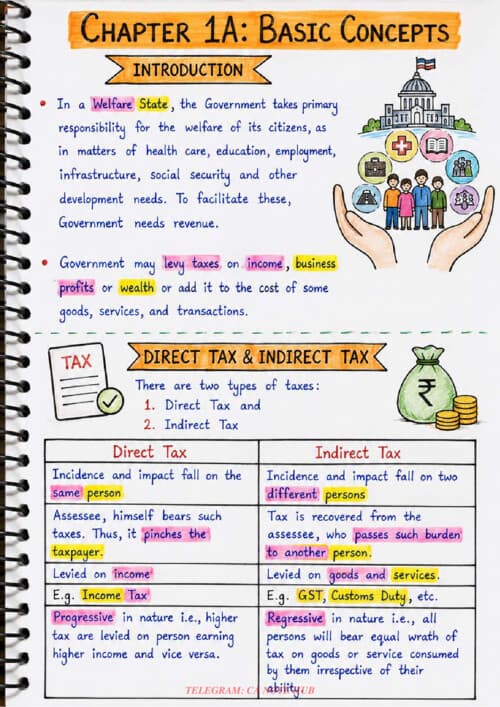
The preview pages cover Chapter 1A: Basic Concepts of Income Tax in a colourful handwritten format. Page one explains the welfare state idea and why the Government levies taxes on income, business profits or wealth, or adds tax to the cost of goods and services. A comparison table then sets out direct tax and indirect tax by incidence and impact, who bears the burden, what is taxed, examples (Income Tax versus GST and Customs Duty) and progressive versus regressive nature. Page two deals with the charging section, Section 4. It covers previous year under Section 3, including the rule for a business, profession or new source of income that starts during the year, and assessment year under Section 2(9). A worked timeline shows PY 2025-26 assessed in AY 2026-27. Page three lists who counts as a person under Section 2(31), the four limbs of assessee under Section 2(7) and the heads of income under Section 14, and ends with a five-step computation flow.
Key points to remember for the exam
Several points from these pages often come up in theory and MCQ questions. First, income of the previous year is charged to tax in the immediately following assessment year. Second, the financial year from 1 April to 31 March must be used as the previous year by every assessee. Third, for a newly set up business or profession, or a newly arising source of income, the previous year starts on the date of setting up or the date the source comes into existence, and ends on 31 March. Fourth, assessment year means the 12-month period starting on 1 April. The notes also list the eight categories of person: individual, HUF, firm including LLP, AOP, BOI, company, local authority and artificial juridical person. They give the four meanings of assessee, including an assessee in default. Finally, learn the five heads of income in order: Salaries, House Property, PGBP, Capital Gains and Other Sources. Also learn the computation sequence: residential status first, then income under each head, then clubbing, then set-off and carry forward of losses, which gives gross total income.
How to revise with these notes
Use these notes after one full reading of the ICAI study material for the attempt you are writing. The pages compress each provision into a highlighted line, so they work best as a recall check. Read a heading such as 'Previous Year [Section 3]' and try to state the rule yourself before reading the bullet points. Turn the direct versus indirect tax table and the five-step computation chart into flash cards. When you practise RTPs, MTPs and past papers, mark which section each question tests and come back to the matching page in these notes to fix the gap. Because the uploader lists these notes for the September 2026 and January 2027 attempts, check each figure and example against the latest ICAI material and amendment updates before the exam. That matters most for the assessment year examples. Spread the 117 pages across the last few weeks so the whole Income Tax portion gets at least two revisions.
Who should use these notes and for which attempt
These notes suit CA Intermediate students preparing the Taxation paper, which covers Income Tax Law along with GST. They are listed for the September 2026 and January 2027 attempts. The visual layout helps students who remember diagrams, tables and colour-coded keywords better than dense text, and those who want a fast last-month revision of Direct Tax. Beginners can also use the Basic Concepts chapter to get comfortable with terms like previous year, assessment year, person and assessee before moving on to residential status and the heads of income. CA Foundation students moving to Intermediate, and commerce students studying basic Indian income tax, may find the opening chapter a clear starting point. The notes are AI-generated revision material, not the official study material. Treat them as a summary that sits alongside the ICAI module and your class notes, not as a replacement for them.
Key topics in these notes
- Welfare state and need for taxes
- Direct tax vs indirect tax
- Charging section – Section 4
- Previous year – Section 3
- Newly set up business or new source of income
- Assessment year – Section 2(9)
- Person – Section 2(31)
- Assessee – Section 2(7)
- Heads of income – Section 14
- Computation of gross total income steps
Explore more Taxation notes
Related notes
- CA INTERMEDIATE DIRECT TAX | INCOME TAX AMENDMENTS SHEET FOR MAY, 2026 | JUNE, 2026 | SEPTEMBER, 2026 | DECEMBER, 2026 | JANAURY, 2027 BY DA
- CA INTERMEIDATE DIRECT TAX [INCOME TAX] SARANSH | SUMMARY CHART NOTES FOR LAST MOMENT QUICK REVISION BY THE ICAI FOR SEPTEMBER, 2026 AND JAN
- INCOME TAX PGBP ADJUSTMENTS SHEET BY CA AMIT MAHAJAN FOR SEPTEMBER, 2026 AND JANUARY, 2027
- Input Tax Credit Master notes All concepts covered for September 2026
- INCOME TAX CASE SCENARIO BASED MCQs BOOKLET BY CA YASH KHANDELWAL FOR SEPTEMBER, 2026 AND JANAURY, 2027
- CA INTERMEIDATE INDIRECT TAX [GST] SARANSH | SUMMARY CHART NOTES FOR LAST MOMENT QUICK REVISION BY THE ICAI FOR SEPTEMBER, 2026 AND JANAURY,
- Direct tax adjustment very short notes last minute revision
- GST LAST DAY REVISION [LDR] | MARATHON NOTES BY CA VISHAL BHATTAD FOR SEPTEMBER, 2026
What to study next
Frequently asked questions
Which attempts are these CA Inter Income Tax handwritten notes for?
The uploader lists them for the CA Intermediate September 2026 and January 2027 attempts. Check figures against the latest ICAI study material for your attempt.
What does Chapter 1A Basic Concepts cover in these notes?
It covers the welfare state and need for taxes, direct versus indirect tax, the charging section, previous year, assessment year, person, assessee, heads of income and the computation of gross total income.
What is the difference between previous year and assessment year?
The previous year is the financial year in which income is earned. The assessment year is the next 12-month period starting on 1 April in which that income is assessed, for example PY 2025-26 is assessed in AY 2026-27.
What are the five heads of income under Section 14?
Salaries, Income from House Property, Profits and Gains of Business or Profession (PGBP), Capital Gains, and Income from Other Sources.
Are these handwritten notes written by hand?
The caption describes them as AI-generated colourful handwritten-style revision notes, laid out like notebook pages with highlights and small drawings.
How many pages are in the full Direct Tax notes PDF?
The full note has 117 pages, and the first three are shown in the preview.
How can I get the full CA Inter Income Tax notes PDF?
Open it free in the Studycaller app to read all pages.