PDF · MCQs
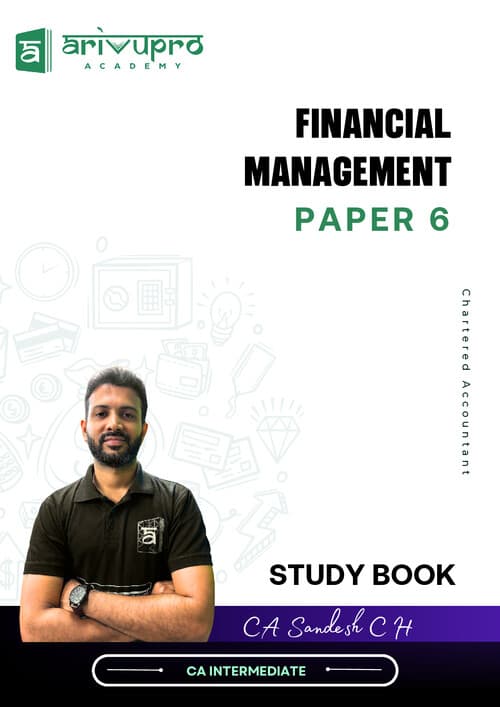
CA Inter Financial Management Summary Notes – Paper 6 Study Book (9 Chapters)
- Shared by
- Vaibhav
- Course
- CA Inter
- Subject
- FM AND SM
- Added
- 3 Feb 2026
Continue reading in the Studycaller app
The full PDF — free to read, save and share in the app.
These Financial Management summary notes for CA Inter Paper 6 are a full study book of 358 pages that covers the FM portion chapter by chapter. The index lists nine chapters: Scope and Objectives of Financial Management, Types of Financing, Ratio Analysis, Cost of Capital, Capital Structure, Leverages, Investment Decisions, Dividend Decision and Management of Working Capital. The opening chapter explains the four stages of business decision making, the meaning and aspects of financial management, sources of funds such as equity, debentures and bank funding, and the evolution of the subject from the traditional to the modern phase. Content is written in short bullet points, which makes it suitable for CA Intermediate students who want one compact book for first reading, quick revision and last-week preparation for the FM paper.
What These Financial Management Summary Notes Cover
The book follows a clear chapter index with page ranges, so you can see how much space each topic gets. Ratio Analysis runs from 3.1 to 3.52, Cost of Capital to 4.32, Capital Structure to 5.42, Leverages to 6.33, Investment Decisions to 7.81, Dividend Decision to 8.20 and Management of Working Capital to 9.73, which shows the heavier numerical chapters get the most coverage. Chapter 1 opens with a four-stage table: deciding which assets to buy, estimating total investment, working capital requirement and choosing sources of finance. It then defines financial management, splits it into procurement of funds and effective utilisation of funds, and compares equity, debentures and bank funding on risk, cost and control. Utilisation is discussed for fixed assets through capital budgeting and for working capital. The chapter also covers the traditional, transitional and modern phases of evolution and introduces finance functions, dividing them into long-term and short-term decisions, starting with investment decisions.
Key Points to Remember for the FM Exam
Several theory points from the opening pages are commonly asked in written answers. Remember that financial management addresses three major decision areas: investment, financing and dividend decisions, with the overall goal of maximising shareholders' wealth. Know why equity is the safest source from the firm's risk point of view, since it is not repaid except on liquidation, yet usually the most expensive, because shareholders expect returns higher than prevalent interest rates and dividends are an appropriation of profit, not a deductible expense under the Income Tax Act. Equity issue can also dilute control. Debentures are cheaper because of the tax advantage on interest, but carry higher risk because interest and repayment are compulsory whether or not profits are made. Learn the definition of capital budgeting as the planning process for long-term investments such as new machinery, replacement, new plants and research projects. Finally, be able to write the three phases of evolution of financial management in a few lines each.
How to Revise with These Notes
Use this study book as your main revision layer and keep the ICAI study material alongside it for detailed illustrations. On a first pass, read one chapter of the notes, then solve the related illustrations from the study material so the formulas in chapters like Cost of Capital, Leverages and Investment Decisions stick. For revision, go through the bullet points chapter by chapter using the index page ranges to plan your days; the longer chapters such as Investment Decisions and Working Capital need more sittings. After each chapter, attempt the RTP and MTP questions on that topic and compare your working with the suggested answers. In the final weeks, solve past exam papers under time limits and return to the notes only for the concepts you got wrong. Theory chapters like Scope and Objectives and Types of Financing can be revised quickly from the bullet lists the night before the exam.
Who Should Use This CA Inter FM Study Book
These notes suit CA Intermediate students preparing for Paper 6, where Financial Management is studied along with Strategic Management. The pages shown cover the FM part, so students should use separate material for the Strategic Management half. The book helps students who find the ICAI module too long and want a structured, point-wise version of every FM chapter in one place. It is useful for first-time learners who need simple explanations, such as the stage-wise example of an entrepreneur starting a business, and for repeat-attempt students who want a fast way to revise the whole syllabus. Because it includes both theory chapters and heavy numerical chapters like ratio analysis, capital structure and working capital management, it works for complete preparation rather than only last-minute reading. Check the latest ICAI syllabus for your attempt before relying on any chapter list.
Key topics in these notes
- Scope and objectives of financial management
- Procurement and utilisation of funds
- Equity vs debentures vs bank funding
- Evolution of financial management
- Finance functions and decisions
- Types of financing
- Ratio analysis
- Cost of capital
- Capital structure
- Leverages
- Investment decisions and capital budgeting
- Dividend decision and working capital management
Explore more FM AND SM notes
- financial management
- ca inter
- fm notes
- cost of capital
- capital budgeting
- ratio analysis
- working capital
- leverages
Related notes
- CA INTERMEIDATE FINANCIAL MANAGEMENT [FM] SARANSH | SUMMARY CHART NOTES FOR LAST MOMENT QUICK REVISION BY THE ICAI FOR SEPTEMBER, 2026 AND J
- CA INTERMEDIATE FINANCIAL MANAGEMENT [FM] BRAHMASTRA REVISION SERIES SOLUTION BOOK BY CA NITIN GURU FOR SEPTEMBER, 2026 AND ONWARDS
- CA INTERMEIDATE STRATEGIC MANAGEMENT [SM] SARANSH | SUMMARY CHART NOTES FOR LAST MOMENT QUICK REVISION BY THE ICAI FOR SEPTEMBER, 2026 AND J
- swapnil sir SM chart book
- CA INTERMEDIATE FINANCIAL MANAGEMENT [FM] SUPER 80 SOLVED QUESTIONS BY CA AMIT SHARMA FOR SEPTEMBER, 2026
- CA INTERMEDIATE FINANCIAL MANAGEMENT [FM] BRAHMASTRA REVISION SERIES QUESTION BANK BY CA NITIN GURU FOR SEPTEMBER, 2026 AND ONWARDS
- CA INTERMEDIATE FINANCIAL MANAGEMENT [FM] SUPER CHARTBOOK BY CA MOHNISH VORA FOR SEPTEMBER, 2026 AND JANUARY, 2027
- Financial management formula cheat sheet best for all formulas quick revision
Comments from students
Janani · 5 Apr 2026
Do you have Audit study book of arivu pro
What to study next
Frequently asked questions
What chapters do these CA Inter Financial Management notes cover?
The index lists nine chapters: Scope and Objectives, Types of Financing, Ratio Analysis, Cost of Capital, Capital Structure, Leverages, Investment Decisions, Dividend Decision and Management of Working Capital.
How many pages is this FM study book?
The full note runs to 358 pages, with chapter page ranges given in the index.
Are these notes for CA Inter Paper 6?
Yes, the cover marks it as Paper 6 Financial Management study book for CA Intermediate.
Do these notes include Strategic Management?
The pages previewed cover only the Financial Management chapters, so use separate material for Strategic Management.
Why is equity the most expensive source of finance?
As the notes explain, shareholders expect returns higher than prevalent interest rates and dividends are not allowed as an expense under the Income Tax Act.
Can I get the FM notes pdf free?
You can preview the first pages here and open the full note free in the Studycaller app.
Are these notes enough for the FM exam?
They cover the full FM chapter list in summary form, but practise ICAI illustrations, RTPs, MTPs and past papers alongside them.