PDF · Amendment Notes
CA Foundation Economics Formula Sheet: All Chapters Formulas in One Place
- Shared by
- Heet Hingrajiya
- Course
- CA Foundation
- Subject
- Quantitative Aptitude
- Added
- 20 Dec 2024
Part of: CA FoundationMathsAmendment Notes
Most read note on this topic
1 more note on this topic ↓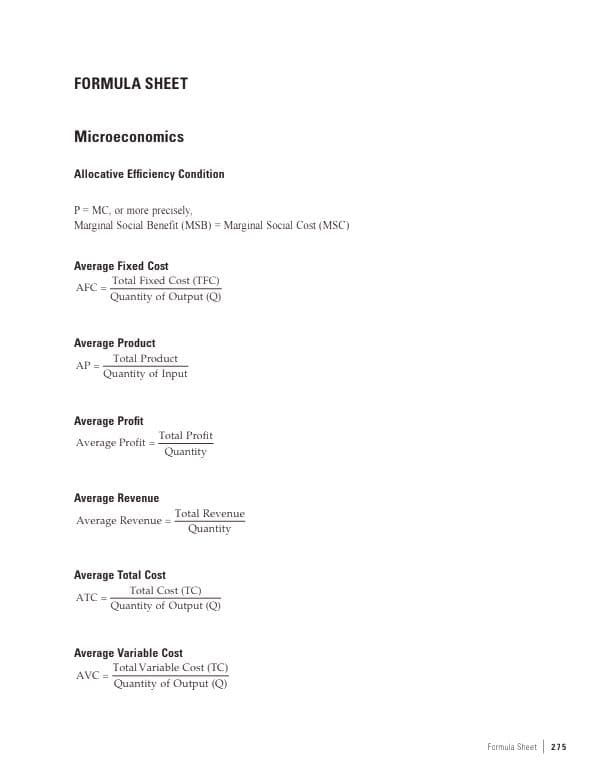
Continue reading in the Studycaller app
The full PDF — free to read, save and share in the app.
This CA Foundation economics formula sheet puts the main microeconomics formulas in one place, so you do not have to search through chapters during revision. The pages shown list cost formulas such as AFC, AVC, ATC, MC and total cost. They also cover revenue and profit formulas, including average revenue, marginal revenue, profit and the MR = MC rule. You will also find average and marginal product, the arc and point formulas for price elasticity of demand, cross-price elasticity and elasticity of supply. Efficiency conditions, the optimal consumption rule, the MRP = MFC hiring rule and the Gini coefficient are included too. It suits CA Foundation students preparing Business Economics, and any commerce student who wants a short, formula-only sheet for last-minute practice before an exam.
What This Economics Formula Sheet Covers
The sheet is arranged alphabetically by formula name, so each formula is easy to find. On costs, it gives Average Fixed Cost (TFC divided by Q), Average Variable Cost, Average Total Cost, Marginal Cost (change in TC or TVC divided by change in Q) and Total Cost as TFC plus TVC. On revenue and profit, it covers Average Revenue, Marginal Revenue, Average Profit, Profit as TR minus TC, and P = MR = AR for a competitive firm. Production formulas include Average Product, the Marginal Product of Labour and the slope of the total product curve. For elasticity, there is the simple point formula, the more precise arc (midpoint) formula, cross-price elasticity and elasticity of supply. The sheet also lists the allocative, distributive and production efficiency conditions, the socially optimal output rule (MSB = MSC), the optimal combination of resources and the Gini coefficient, which is shown with a Lorenz curve diagram.
Key Formulas to Remember for the Exam
Some formulas on this sheet appear again and again in numerical questions. The profit-maximising rule MR = MC is the base of most market-structure problems. Marginal cost is measured as the change in total cost, or the change in total variable cost, for each extra unit of output. Fixed cost does not affect MC. For a firm in perfect competition, price equals marginal revenue and average revenue. Price elasticity of demand can be worked out with the point formula, using old values as the base, or the arc formula, using average values. The arc method gives the same answer whichever direction the price moves. Cross elasticity tells you whether two goods are substitutes (positive) or complements (negative). The optimal consumption rule, MUx/Px = MUy/Py, is the equi-marginal principle used in consumer equilibrium. Factors are hired until MRP equals MFC, where MRP is the marginal product multiplied by marginal revenue. Learning these relationships, not just the symbols, helps with both MCQs and short numericals.
How to Revise With These Notes
Use this sheet after you finish a chapter in the ICAI study material, not in place of it. Write each formula from memory, then check it against the sheet. When you solve questions from RTPs, MTPs and past papers, keep the sheet open and mark the formulas you had to look up. Those are your weak areas. For elasticity, practise the same question with both the point and arc formulas so you can see why the answers differ and which method a question expects. For cost and revenue, build a small table of Q, TC, TVC and TR values and work out AC, MC, AR and MR. This makes the links between the curves clear. Some terms here, such as MFC, the Gini coefficient and the efficiency conditions, are written in general textbook language. Match them with the terms used in your own syllabus before the exam. In the final week, a quick daily read of the sheet keeps the formulas fresh.
Who Should Use This CA Foundation Economics Formula Sheet
This CA Foundation economics formula sheet is most useful for students preparing the Business Economics paper. That paper has numerical MCQs on demand elasticity, production, cost, revenue and market equilibrium. It also helps students who studied under the older CA CPT pattern, B.Com and BBA students taking microeconomics or managerial economics, and anyone who needs a compact list of economics formulas for quick reference. The pages shown focus on microeconomics: cost, revenue, product, elasticity and efficiency formulas. Check the full note for any other chapters before relying on it for complete coverage. Beginners should first learn each concept from their study material and then use the sheet to recall formulas. Students who are revising can use it as a one-place checklist before mock tests and the final exam. It is not a replacement for theory, but it saves time when you need a formula quickly.
Key topics in these notes
- Average fixed variable and total cost
- Marginal cost and total cost
- Average and marginal revenue
- Profit and MR = MC rule
- Average and marginal product of labour
- Price elasticity of demand: point and arc formula
- Cross-price elasticity of demand
- Elasticity of supply
- Optimal consumption rule (equi-marginal)
- MRP = MFC factor hiring rule
- Allocative distributive and production efficiency
- Gini coefficient and Lorenz curve
Explore more Accounting notes
- ca foundation
- business economics
- economics formulas
- microeconomics
- elasticity of demand
- cost and revenue
- formula sheet
Related notes
- Accounts - All chapters PYQs MTPs RTPs at one place (Chapterwise) (BY- CA Darshan Jain Sir) Best for practice.
- Account all important true or false at one place (Exclusive September 26) by Hardik Manchanda
- CA foundation Accounts All chapters True/false in one place✨
- All chapters detailed covered with MCQ and Question
- ICAI CERTIFIED ACCOUNTS ANSWER SHEET TOPPERS COPY SEPT 25
- Account RTP, MTP, PYQ of all chapters By Hardik Manchanda sir
- Economics shortcut notes
- True false all chapters accounts
More notes on this topic (1)
Comments from students
Lakshitha · 19 Aug 2025
How many pages available in this pdf?
What to study next
Frequently asked questions
What formulas are in this CA Foundation economics formula sheet?
It lists microeconomics formulas for cost (AFC, AVC, ATC, MC, TC), revenue and profit, average and marginal product, and price, cross and supply elasticity. It also covers efficiency conditions, the optimal consumption rule, the MRP = MFC hiring rule and the Gini coefficient.
Is there a CA Foundation economics all formulas PDF?
Yes, this note puts economics formulas in one place as a PDF. You can preview the first pages here and open the full note free in the Studycaller app.
What is the difference between the point and arc formula for elasticity?
The point formula divides the change by the old quantity and old price. The arc formula divides by the average of the old and new values, which gives a more precise result.
What is the profit-maximising condition in economics?
A firm maximises profit at the output where marginal revenue equals marginal cost (MR = MC), provided it should produce at all.
How is marginal cost calculated?
Marginal cost is the change in total cost divided by the change in output. Because fixed cost does not change, it also equals the change in total variable cost divided by the change in output.
Is this formula sheet useful for managerial economics?
Yes, the cost, revenue, elasticity and production formulas here are standard microeconomics tools. They are used in managerial economics courses as well.
How can I get the full economics formula sheet?
Open it free in the Studycaller app to read all pages of the note.