PDF · Past Papers
Sale of Goods Act Past Year Questions with Answers and Step-wise Marks for CA Foundation
- Shared by
- Tech Yash
- Course
- CA Foundation
- Subject
- Business Laws
- Added
- 12 Dec 2023
Part of: CA FoundationBusiness LawsPast Papers
Continue reading in the Studycaller app
The full PDF — free to read, save and share in the app.
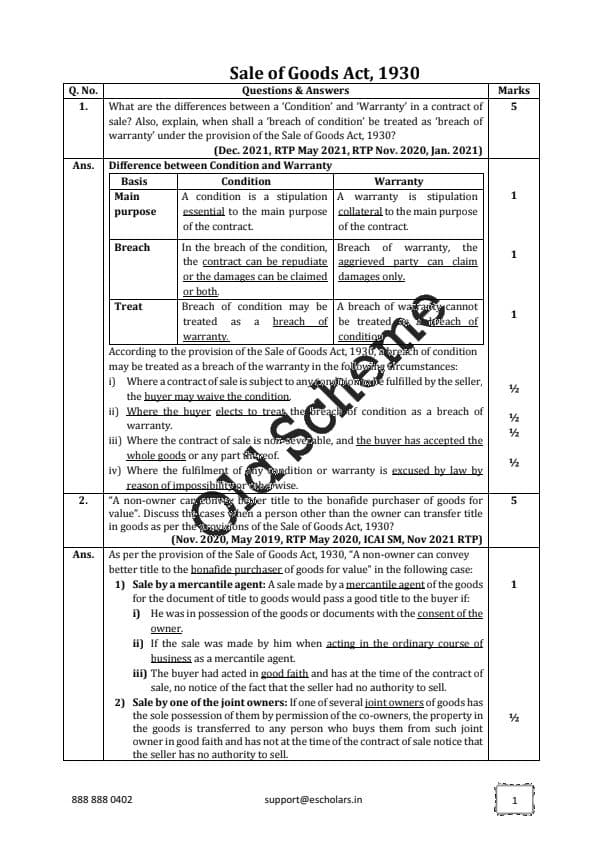
Sale of Goods Act past year questions with answers for CA Foundation Business Laws are collected in this note, with each answer broken into step-wise marks. The pages shown cover frequently repeated questions on the Sale of Goods Act, 1930, tagged with the exam or RTP they appeared in, such as Dec 2021, Nov 2020, May 2019, Nov 2018 and RTPs from 2020 and 2021. Topics include the difference between condition and warranty, when a breach of condition is treated as a breach of warranty, transfer of title by a non-owner, and the doctrine of Caveat Emptor with its exceptions. Answers are written in an exam style that opens with the provision, then lists points, with marks shown beside each part. It suits CA Foundation students who want to practise how law answers are written and scored.
What these Sale of Goods Act notes cover
The note is a question-and-answer compilation for the Sale of Goods Act, 1930, laid out in a table with question number, question, answer and marks. The first question asks for the differences between a condition and a warranty, answered in a comparison table on main purpose, consequence of breach and whether one can be treated as the other. It then lists four situations where a breach of condition is treated as a breach of warranty: waiver by the buyer, election by the buyer, acceptance of goods under a non-severable contract, and fulfilment excused by law. The second question explains when a non-owner can pass good title, covering sale by a mercantile agent, joint owner, person in possession under a voidable contract, seller or buyer in possession, estoppel, unpaid seller, and sales under other Acts. The third question explains Caveat Emptor and its exceptions, such as fitness for purpose, brand name purchases, sale by description and merchantable quality.
Key points to remember for the exam
Condition versus warranty is a repeated question, so learn the three bases of difference: a condition is essential to the main purpose, a warranty is collateral; breach of condition allows repudiation and damages, breach of warranty allows only damages; and a breach of condition may be treated as a breach of warranty, but never the reverse. For transfer of title by a non-owner, remember the good faith and no-notice requirement that runs through mercantile agent, joint owner and seller-in-possession cases, and that a voidable contract must not have been rescinded before the sale. For Caveat Emptor, start with the meaning, let the buyer beware, then list each exception with a short heading. The mark split beside each answer shows that headings and conditions carry separate marks, so writing every point with its heading helps you collect step-wise marks even in a partly correct answer.
How to revise Sale of Goods Act past year questions
Read the chapter once from the ICAI study material so the sections and illustrations are familiar. Then use this note to check how each concept is asked: the exam and RTP tags beside every question show which topics come back again and again, such as condition and warranty and non-owner title. Attempt each question yourself in a timed setting, about one and a half minutes per mark, before reading the model answer. Compare your answer with the mark split and note which points you missed. After that, solve the latest RTPs and MTPs for the chapter, since several questions here are drawn from RTPs. Keep a one-page summary of lists like the eight cases of non-owner title and the exceptions to Caveat Emptor, and revise it in the final week before the paper.
Who should use these CA Foundation Business Laws notes
These notes are written for CA Foundation students preparing Business Laws, where the Sale of Goods Act, 1930 is a core chapter with descriptive questions. They are most useful once you have read the chapter and want practice with real past questions and a clear idea of how marks are given. Students who lose marks in law because their answers lack structure will benefit from the format used here: provision first, then numbered points, then a conclusion where relevant. The note also works as a quick last-round revision tool, because the questions repeated across attempts and RTPs are grouped in one place. Students in other courses who study the Sale of Goods Act at a basic level can also use it to understand condition and warranty, transfer of title and Caveat Emptor, though the style follows the CA Foundation pattern.
Key topics in these notes
- Sale of Goods Act 1930
- Condition vs warranty
- Breach of condition treated as breach of warranty
- Transfer of title by non-owner
- Sale by mercantile agent
- Sale under voidable contract
- Unpaid seller and resale
- Doctrine of Caveat Emptor
- Exceptions to Caveat Emptor
- Merchantable quality and sale by description
- Past year and RTP questions with mark split
Explore more Business Laws notes
- sale of goods act
- ca foundation
- business laws
- past year questions
- caveat emptor
- condition and warranty
- rtp questions
Related notes
- Companies Act 2013 All past year question with answer• With step by step guide how to attemp answer in law and get marks according to ICAI.
- LLP Act All past year question with answer• With step by step guide how to attemp answer in law and get marks according to ICAI.
- Indian Partnership Act All past year question with answer• With step by step guide how to attemp answer in law and get marks according to IC
- Indian Contract Act All past year question with answer with step by step marks according to ICAI.
- 35+ marks guanteed in BCR all past year question with suggested answer . All formats of notice , article, email , precise writing, notemakin
- Ca foundation Business Laws Question Bank (question covered upto RTP jan26)
- THE INDIAN CONTRACT ACT, 1872 🔥 THE SALE OF GOODS ACT, 1930🔥 THE INDIAN PARTNERSHIP ACT, 1932🔥
- Indian contact act 1872,unit 3 predicted questions by CA Arun s nair and CA joyal saji
Comments from students
Harsha · 23 Dec 2023
Which attempt this book June 2023 or December 2023
What to study next
- Newer: Indian Partnership Act All past year question with answer• With step by step guide how to attemp answer in law and get marks according to
- Next: Indian Contract Act All past year question with answer with step by step marks according to ICAI.
- All CA Foundation Business Laws Past Papers
- Exam guide: CA Foundation question papers (all subjects)
Frequently asked questions
What is the difference between condition and warranty under the Sale of Goods Act?
A condition is a stipulation essential to the main purpose of the contract, while a warranty is collateral to it. Breach of condition allows the buyer to repudiate the contract and claim damages, but breach of warranty allows only damages.
When is a breach of condition treated as a breach of warranty?
When the buyer waives the condition, elects to treat it as a warranty, accepts goods under a non-severable contract, or when fulfilment is excused by law due to impossibility or otherwise.
Can a non-owner transfer good title to a buyer?
Yes, in cases such as sale by a mercantile agent, a joint owner in sole possession, a person holding goods under a voidable contract, a seller or buyer in possession, estoppel, an unpaid seller, and sales under other Acts, generally where the buyer acts in good faith.
What does Caveat Emptor mean and what are its exceptions?
Caveat Emptor means let the buyer beware. Exceptions shown in the note include fitness for a particular purpose, sale by description and merchantable quality, with goods bought under a brand name treated separately.
Do these notes show step-wise marks for each answer?
Yes, each answer has marks shown beside its parts, so you can see how a 5 or 6 mark law answer is split.
Which exams are the questions taken from?
The pages shown include questions from Dec 2021, Jan 2021, Nov 2020, May 2019 and Nov 2018 exams, along with RTPs and the ICAI study material.
How can I get the full Sale of Goods Act past year questions PDF?
Open it free in the Studycaller app.