PDF · Handwritten Notes
Indian Partnership Act 1932 Handwritten Notes PDF for CA Foundation Business Laws
- Shared by
- Piyush kumar
- Course
- CA Foundation
- Subject
- Business Laws
- Added
- 22 Mar 2024
Part of: CA FoundationBusiness LawsHandwritten Notes
Continue reading in the Studycaller app
The full PDF — free to read, save and share in the app.
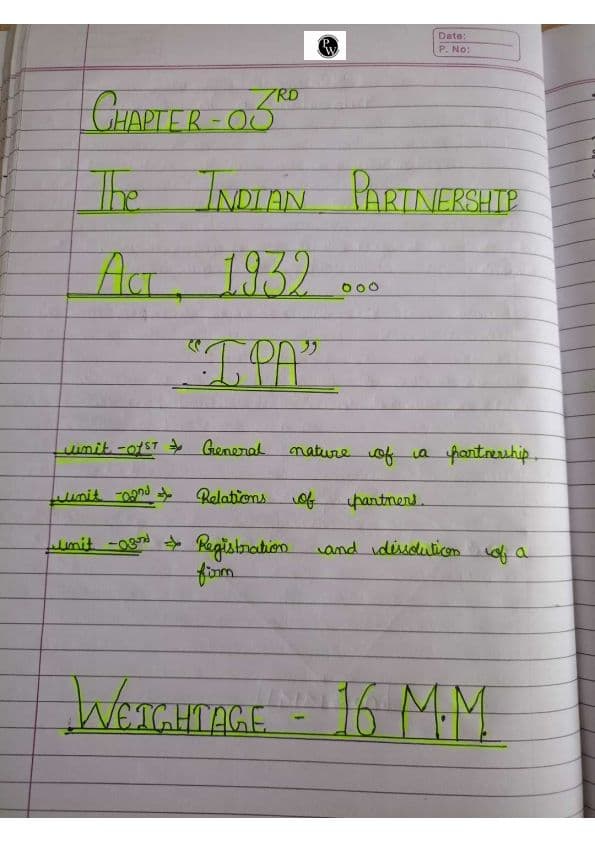
These Indian Partnership Act 1932 handwritten notes PDF cover Chapter 3 of CA Foundation Business Laws in a clear, highlighted notebook style. The chapter is split into three units: general nature of a partnership, relations of partners, and registration and dissolution of a firm. The opening pages explain why people enter into partnership, the idea of mutual agency, the definition of partnership, and the difference between partners, firm and firm name. They also discuss who can become a partner and why one partnership firm cannot become a partner in another, using a simple diagram. The note runs to 62 pages and marks the chapter's weightage as 16 marks. It suits CA Foundation students who want short, readable notes for revising the Partnership Act alongside the study material.
What these Indian Partnership Act 1932 notes cover
The notes begin with a chapter cover listing the three units of the Indian Partnership Act, 1932: general nature of a partnership, relations of partners, and registration and dissolution of a firm. Unit 1 opens with the reasons people enter into partnership, namely the expertise of another person (skills and experience), resources of another person, sharing of responsibilities and a higher risk-taking appetite. It then explains mutual agency, where every partner is an agent of the other partners but only for the business of the firm. The definition of partnership is written out in full: the relation between persons who have agreed to share the profits of a business carried on by all or any of them acting for all. The notes separate partners, firm and firm name, mention that the Act itself does not fix a maximum number of partners while the Central Government has the power to prescribe it, and show who can become a partner, with a diagram of XYZ & Co., ABC & Co. and LMN & Co.
Key points to remember for the exam
A few ideas from the opening pages come up again and again in Business Laws answers. First, learn the definition of partnership word for word, because its elements (agreement, sharing of profits, business, and business carried on by all or any acting for all) are the base for deciding whether a partnership exists. Second, mutual agency is the real test: each partner acts as agent of the others, but only for the firm's business. Third, remember the terms: individually they are partners, collectively a firm, and the name used for business is the firm name. Fourth, a natural person who is a major, of sound mind and not disqualified can be a partner, and an artificial legal person such as a company or LLP can also be one. Finally, a partnership firm is not a separate legal entity, so it cannot become a partner in another firm. The notes highlight this point in green, which shows how important it is.
How to revise with these handwritten notes
Use these notes as a quick revision layer after you have read the chapter once from the ICAI study material. Go unit by unit: first general nature, then relations of partners, then registration and dissolution, since the notes follow that order. After each unit, close the notes and try to write the definition of partnership and the meaning of mutual agency from memory, then check against the highlighted lines. The diagram showing that one firm cannot be a partner in another firm is useful for short theory and case-based questions, so redraw it once while revising. Next, attempt the Partnership Act questions from RTPs, MTPs and past papers, and mark any point you missed back into the relevant page of the notes. Because the notes state a weightage of 16 marks for this chapter, give it steady time in your last-month plan rather than leaving it for the final day.
Who should use these notes and for which paper
These notes are meant for CA Foundation students preparing the Business Laws paper, where the Indian Partnership Act, 1932 is studied as Chapter 3 in these notes. They suit first-time readers who find bare law language heavy, since the handwriting breaks each idea into short questions such as why people enter into partnership, what partnership is, who partners are and who can become a partner. They also help students in their final revision who need a compact version of the chapter instead of the full study material. Commerce students studying partnership law at school or college level can use the conceptual pages too, though the structure follows the CA Foundation syllabus. If you are weak in law theory, read these notes alongside practice questions so that the definitions and principles turn into well-written exam answers.
Key topics in these notes
- Chapter 3 Indian Partnership Act 1932
- General nature of a partnership
- Relations of partners
- Registration and dissolution of a firm
- Why people enter into partnership
- Mutual agency
- Definition of partnership
- Partners firm and firm name
- Maximum number of partners
- Who can become a partner
- Firm not a separate legal entity
Explore more Business Laws notes
Related notes
- Nikesh sir hand written home work provided during class The Indian partnership act 1932 lec 13 to 15
- Nikesh sir hand written home work provided during class The Indian partnership act 1942 lec 8to 12 but in lecture 10 no home work
- Best handwritten notes for revision Indian Partnership Act 1932
- Business Law ( Indian partnership act 1932) Notes by cj sir
- Hand written notes of business law
- THE INDIAN CONTRACT ACT, 1872 🔥 THE SALE OF GOODS ACT, 1930🔥 THE INDIAN PARTNERSHIP ACT, 1932🔥
- Business law Notes Ch1-indian regulatory framework
- Business law Chapter 2 The Indian Contract Act ,1872 Unit 1 General Nature of Contract
Comments from students
Yash khatri · 22 Apr 2024
Chap 2 equation exercise (H)
Hajra · 19 Apr 2024
International trade
Nandini · 7 Apr 2024
Notes of all subjects
Khwaish jain · 23 Mar 2024
Indian contract act notes?
What to study next
Frequently asked questions
What do these Indian Partnership Act 1932 handwritten notes cover?
They cover the chapter in three units: general nature of a partnership, relations of partners, and registration and dissolution of a firm. The opening pages explain mutual agency, the definition of partnership and who can become a partner.
Are these notes useful for CA Foundation Business Laws?
Yes, they are written for CA Foundation Business Laws and treat the Indian Partnership Act, 1932 as Chapter 3, with the weightage noted as 16 marks.
What is mutual agency in a partnership?
As the notes explain, every partner is an agent of the other partners, but only for the business of the partnership firm.
Can a partnership firm become a partner in another firm?
No. The notes explain that a partnership firm is not a separate legal entity, so it cannot become a partner in another partnership firm, and show this with a diagram.
Is there a maximum number of partners in the Partnership Act?
The notes state that the Partnership Act does not give a maximum number of partners, but the Central Government has the power to prescribe it.
Who can become a partner as per these notes?
A natural person who is a major, of sound mind and not disqualified, as well as an artificial legal person such as a company or LLP.
How can I get the full Indian Partnership Act 1932 notes PDF?
Open it free in the Studycaller app to read all 62 pages of the note.