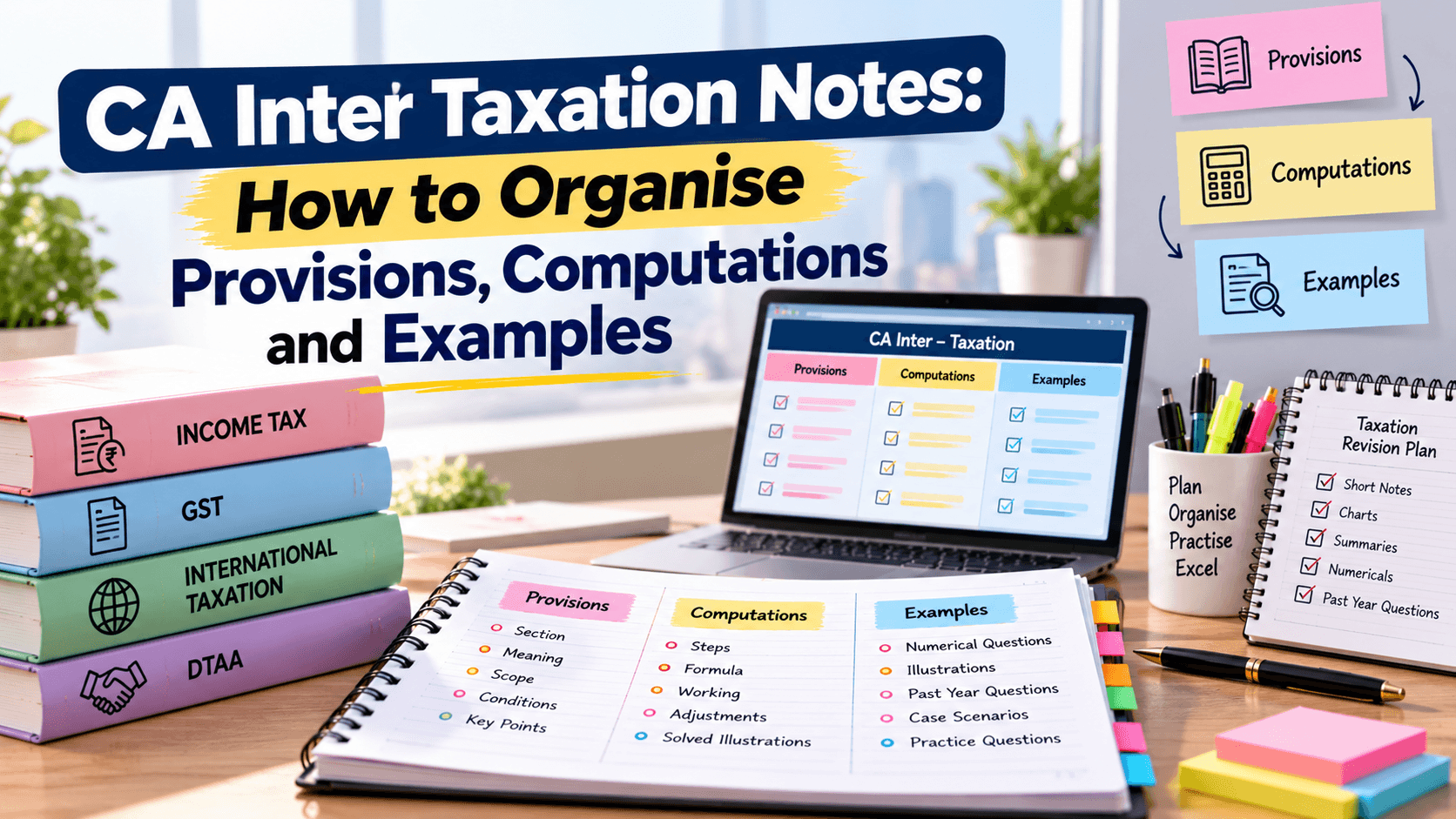
CA Inter Taxation Notes: How to Organise Provisions, Computations and Examples
Learn how to organise CA Inter Taxation notes with clear provisions, step-by-step computations, practical examples, revision tables and a simple system for exam…
In this article(13 sections)ShowHide
Taxation can feel difficult when provisions, exceptions, rates, due dates and calculations are scattered across different notebooks. The challenge is not simply to write everything down; it is to find the right rule quickly, understand how it applies and use it accurately in a question.
Well-organised CA Inter Taxation notes should work as both a learning resource and an exam-time revision tool. A practical system separates the law from the computation method, connects each rule with a worked example and makes updates easy to identify. Use the current ICAI study material and applicable syllabus for your attempt as the primary reference.
1. Build a Consistent Structure Before You Start
Use the same basic layout for every chapter. When each topic follows a familiar pattern, you spend less time deciding where information belongs and more time understanding it. A chapter can be divided into: concept, provision, conditions, exceptions, computation steps, example, common errors and revision cues.
Keep a short chapter index at the front of your notebook or digital folder. List the chapter name, page or file location, last revision date and whether you have practised questions from it. This simple index is especially useful when you are revising several chapters in a short period.
Do not copy every sentence from a textbook. Write a provision in your own concise words only after you understand it, while preserving essential legal conditions and terminology. If a rule is difficult to paraphrase safely, record the key wording and add a plain-language explanation below it.
2. Separate Provisions, Conditions and Exceptions
Provisions are easy to misapply when the main rule and its exceptions appear in one long paragraph. Give them separate labels. Under each provision, record the trigger, eligibility or applicability conditions, treatment, limits and exceptions. This makes the rule easier to scan during revision.
Use a small template for important provisions: **Rule:** what the law provides; **Applies when:** relevant facts or conditions; **Does not apply when:** exclusions and exceptions; **Exam cue:** facts in a question that should make you consider the provision. Add the section or rule reference where relevant to the current syllabus.
Create a comparison table when two provisions look similar. For example, compare their conditions, treatment, limits and exceptions side by side rather than writing them on separate pages. Keep the table brief and verify every entry against the current ICAI material and applicable law.
3. Turn Computations into Repeatable Steps
Computational questions become more manageable when you use a fixed sequence. First identify what the question asks for, then extract the facts, classify each item, apply the relevant provision, calculate in a logical order and present the final answer clearly. Avoid jumping straight to arithmetic before deciding the correct treatment.
Create a separate computation sheet for each recurring format. It should show the order of working, the items included or excluded, any limits or adjustments, and the final presentation format. Leave a little space for alternative treatments that depend on the facts of a question.
For an income-tax computation, a high-level working sheet may include income heads, adjustments, gross total income, deductions where applicable, total income, tax calculation, rebate or relief where relevant, surcharge and cess where applicable, and final tax payable or refund. This is only a structural aid: use the sequence and provisions prescribed for your syllabus and the relevant assessment year.
For GST, keep separate working formats for topics such as time of supply, place of supply, input tax credit, tax liability and payment, where included in your syllabus. Record the facts that determine the treatment before applying a formula. A formula without its conditions can be misleading.
4. Attach One Clear Example to Every Important Rule
A provision is easier to remember when you can see it applied. After writing a rule, add one short example with simple figures. Explain why the provision applies, show the calculation and state the conclusion. The aim is not to create a large question bank inside your notes; it is to make the rule understandable at a glance.
Use a consistent format: **Facts**, **Relevant rule**, **Working**, **Conclusion**. If the provision has a common exception, add a second mini-example that changes one important fact. This helps you see which detail changes the result and prevents rote learning.
Keep examples aligned with the law and syllabus applicable to your examination attempt. If rates, thresholds, dates or statutory provisions change, mark the affected examples for review instead of assuming an older calculation remains valid.
5. Organise Income Tax and GST Notes Separately
Income Tax and GST require different kinds of thinking, so keep their main notes separate even if you store them in one binder or digital workspace. Use distinct section dividers, colours or folder names, but do not rely on colour alone; every page should have a clear title and chapter reference.
For Income Tax, organise material around the chapter structure in your applicable syllabus. Common useful note types include definitions, charging and scope provisions, residential status, income classification, deductions, computation sequences, rates and special cases where relevant. The exact topics and their order should follow your current ICAI study material.
For GST, consider separate sheets for core concepts, supply-related provisions, time and place of supply, value, input tax credit, registration, invoices and records, returns, payment and other topics prescribed for your attempt. These are organisational examples, not a substitute for checking the current syllabus.
Create a one-page map for each subject showing how chapters connect. For instance, a GST question may require you to consider more than one issue before arriving at a tax result. A chapter map reminds you to check connected provisions rather than treating each rule in isolation.
6. Use Tables for Rates, Limits, Dates and Comparisons
Tables are useful when the same type of information must be compared repeatedly. Use them for rates, limits, due dates, eligibility conditions, exceptions and differences between similar concepts. Keep each table focused on one question; a table that tries to hold an entire chapter becomes hard to revise.
Add a 'verified for' note to time-sensitive tables. Tax laws and exam applicability can change, so include the relevant assessment year, financial year or syllabus reference where appropriate. Confirm the information from the official material before finalising notes for a new attempt.
Make important exceptions visible. You can use a separate exception column or a short note directly beneath the table. Avoid using colours to imply legal meaning unless you also label the meaning in words.
7. Keep Amendments and Updates Traceable
One of the biggest risks in taxation notes is mixing old and current rules. Keep an update log at the beginning of each subject or chapter. Record the topic, what changed, the source checked, the applicable period or attempt and the date you updated your notes.
Do not silently overwrite an old provision if you still use the notebook for past practice. Mark outdated material clearly and direct yourself to the updated rule. For digital notes, archive old versions in a separate folder so you do not accidentally revise from them.
Before each exam attempt, review the official ICAI announcements, applicable study material and statutory updates specified for that attempt. Do not assume that a coaching handout or a previous attempt's notes automatically covers all changes.
8. Highlight Common Errors Without Overloading the Page
After solving a question, record the reason for each meaningful mistake. Examples include applying the wrong provision, overlooking a condition, classifying an item incorrectly, using a rate from an old reference, missing a step or presenting an unclear working. A short error note is more useful than writing 'revise this chapter'.
Maintain a mistake log with four columns: question or topic, mistake made, correct approach and next review date. Revisit it during weekly revision. If the same error appears repeatedly, add a small warning beside the relevant provision or computation format.
Use highlighting sparingly. Reserve one mark for core rules, another for exceptions and a symbol for common mistakes. Too many colours, boxes and decorative headings make the page visually busy and reduce the value of highlighting.
9. Make Notes Easy to Revise in Short Sessions
Prepare three layers of notes. The first layer is the detailed chapter note created while learning. The second is a compact revision sheet containing the main provisions, computation sequence and exceptions. The third is a rapid-recall list of formulas, tricky comparisons and mistakes that you repeatedly make.
At the end of a study session, close the book and try to recall the main rule or write the computation sequence from memory. Then compare your recall with your notes and fill only the gaps. This active-recall step helps reveal whether the notes support understanding or merely look familiar.
Use spaced revision rather than leaving the entire subject for the final days. A practical schedule is to review a topic the next day, again later in the week, and once more after a longer interval. Adjust the intervals to your schedule and how well you can recall the topic.
10. Practise Questions and Improve the Notes
Notes should change as your understanding improves. After completing a set of questions, identify which information you needed but could not find quickly. Add that missing condition, comparison or working format to the relevant page. Remove repeated explanations that do not add value.
Practise a mixture of basic questions and exam-style problems. For every difficult question, ask whether the difficulty came from knowledge, interpretation, calculation or presentation. Each cause needs a different fix: revise the provision, identify the facts more carefully, practise the working, or improve the answer format.
Use mock tests and past examination questions according to the current syllabus and availability. After each test, update the error log and revise the notes for the topics that caused repeated errors. A test series can provide structured practice and feedback, but it should support—not replace—your study material and independent revision.
11. A Simple Weekly Workflow
Choose one or two chapters for focused work instead of trying to rewrite the entire subject. Start by reading the official material, then prepare concise notes, solve examples and test your recall. Finish by updating your mistake log and marking the next revision date.
At the end of the week, spend a short session checking whether your notes are complete, accurate and easy to navigate. Test yourself by locating a provision, explaining its conditions and completing a computation without reading the solution first.
Do not measure progress by the number of pages written. Measure it by how accurately you can identify the applicable rule, complete the working and explain the result under time pressure. A small, reliable set of notes is usually more useful than a large collection that you rarely revise.
Conclusion
Effective CA Inter Taxation notes connect provisions with conditions, computations, examples and common errors. Keep Income Tax and GST organised separately, make updates traceable and build short revision sheets from your detailed notes. Most importantly, use the notes while solving questions and improve them based on actual mistakes. Follow the latest ICAI material and attempt-specific updates so your revision stays relevant.
Quick Reference: What Each Note Page Should Contain
| Note element | What to record | Purpose |
|---|---|---|
| Provision | Rule, conditions, exceptions and reference | Accurate application |
| Computation | Sequence, adjustments and final format | Consistent working |
| Example | Facts, relevant rule, working and conclusion | Understand application |
| Update log | Change, source, applicable period and date | Avoid outdated rules |
| Mistake log | Error, correction and review date | Targeted improvement |
| Revision sheet | Core rules, exceptions and common traps | Fast recall |
CA Inter GST notes
Free notes from the Studycaller library, picked for this article.
Practice Questions · CA Inter Taxation
CA inter GST super 30 question by CA Vishal bhattad sir
Harsh 43 49.5k
Amendment Notes · CA Inter Taxation
CA INTER GST LATEST QUESTION BANK BY AMIT MAHAJAN FOR MAY SEP 26 JAN 27
Interverse 36 30.3k
Summary Notes · CA Inter Taxation
GST Summary book by Amit Mahajan sir September/January 2025 Exam
Abhinav 26 20.8k
Practice Questions · CA Inter Taxation
Gst QB
Vicky 24 25.8k
Frequently asked questions
How should I make CA Inter Taxation notes?
Follow a consistent chapter format: concept, provision, conditions, exceptions, computation steps, one worked example and common mistakes. Use the current ICAI material as your base and keep short revision sheets for quick review.
Should Income Tax and GST notes be kept separately?
Yes. Keep their main notes in separate sections or folders because their concepts and computation formats differ. A shared index can still help you navigate both subjects without mixing provisions or working methods.
What should a taxation provision note include?
Record the main rule, when it applies, key conditions, exceptions, limits and an exam cue. Add a relevant section or rule reference when useful, and verify the wording against the material applicable to your attempt.
How can I remember taxation provisions for exams?
Understand the reason behind a provision, connect it with a short example and practise recalling it without looking. Review it at spaced intervals and use questions to identify conditions or exceptions you tend to forget.
How do I organise tax computation formats?
Create a separate step-by-step sheet for each recurring computation type. Show the order of adjustments, items included or excluded, applicable limits and final presentation. Always adapt the format to the question and current syllabus.
Should I copy textbook language into my notes?
Avoid copying whole chapters. Summarise rules in concise language after understanding them, while retaining essential legal terms and conditions. If paraphrasing could change the meaning, keep the key wording and add a plain-language explanation.
How often should I update CA Inter Taxation notes?
Review them whenever official material or applicable amendments change, and check them again before each attempt. Maintain an update log with the topic, source, applicable period and date so old rules are not mistaken for current ones.
Are tables useful for Taxation revision?
Tables are especially useful for comparing similar provisions and revising rates, limits, dates and exceptions. Keep each table focused, identify the applicable period and verify every entry before relying on it in an exam.
How can mock tests improve my taxation notes?
Mock tests reveal whether errors come from knowledge, interpretation, calculation or presentation. Record repeated mistakes, add missing conditions or working steps to your notes, and practise the revised approach in another question.
Are short notes enough to prepare for CA Inter Taxation?
Short notes are useful for revision but should not replace the prescribed study material, question practice or applicable updates. Build concise notes after understanding the chapter and use them alongside regular problem-solving and self-testing.