What Makes a CA Student Successful? Habits of CA Toppers Explained
Discover what actually separates successful CA students from the rest — study habits, mindset, and preparation strategies backed by real topper patterns.
In this article(3 sections)ShowHide
Every year, thousands of CA aspirants sit for the same exams, study from the same ICAI material, and follow roughly the same syllabus. Yet only a fraction clear each level on their first attempt, and an even smaller number make it to the All India Rank list. If the syllabus is identical and the exam is the same, what actually separates a CA topper from a student who struggles or reattempts?
The honest answer isn't talent. It's a specific, learnable set of habits, decisions, and mindsets that compound over months of preparation. This article breaks down exactly what makes one CA student consistently outperform another — not through vague motivational advice, but through the real, practical differences that show up in study patterns, exam temperament, and how students respond to setbacks.
What Actually Separates Successful CA Students From the Rest?
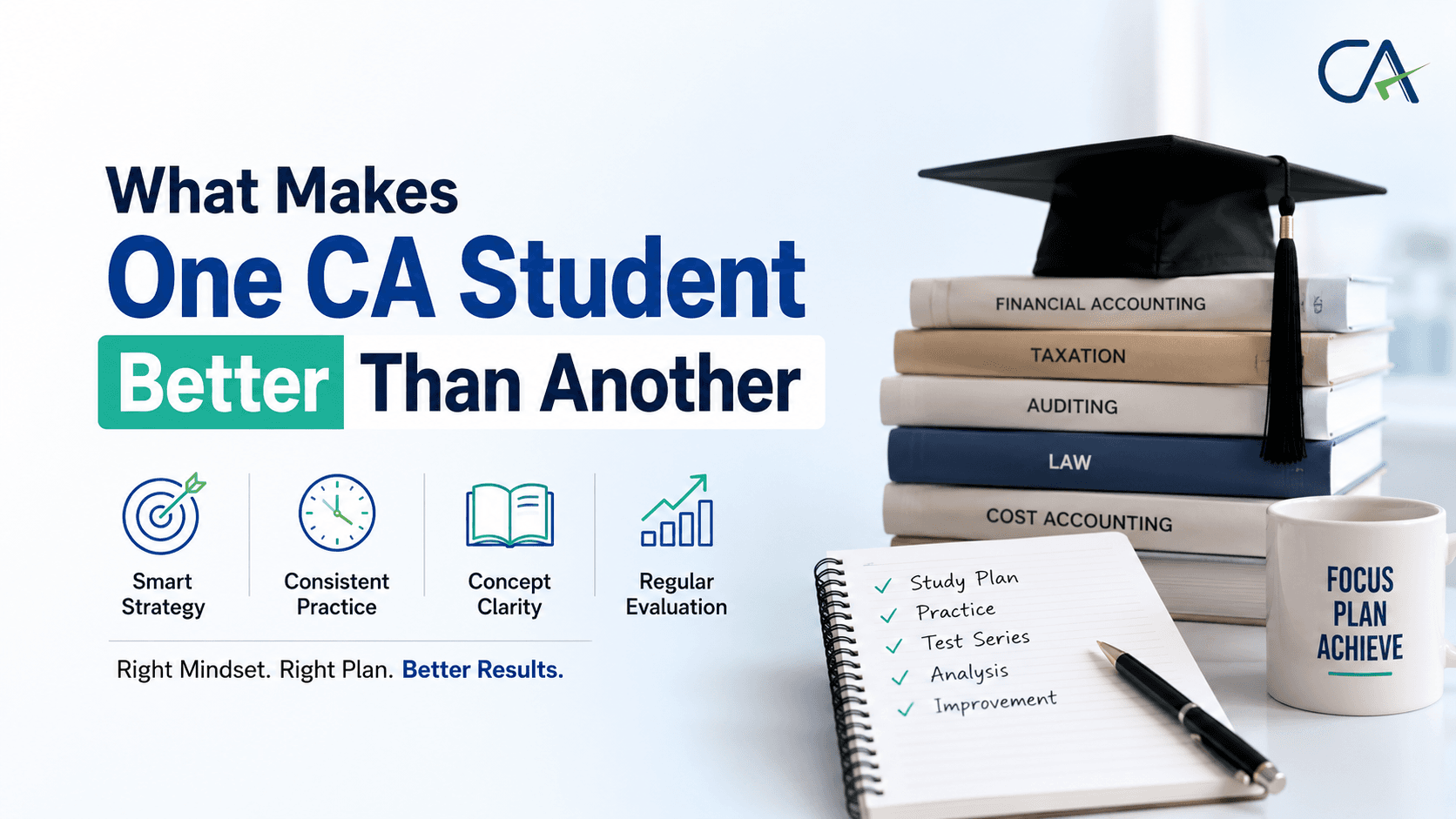
In short: successful CA students are defined less by raw intelligence and more by consistency, conceptual depth, structured practice, and emotional resilience. They study fewer hours with more focus, prioritize understanding over memorization, and treat mock tests as a core part of preparation — not an afterthought. The sections below unpack each of these factors in detail.
1. Consistency Beats Intensity
One of the clearest patterns among CA toppers is steady, daily effort rather than sporadic bursts of intense studying. A student who studies 4 focused hours every day for four months will almost always outperform one who studies erratically — a marathon session one week, followed by days of little to no study the next.
This matters because CA subjects, particularly Accounting, Taxation, and Auditing, build on cumulative understanding. Concepts learned in week one are directly applied in week ten. Gaps created by inconsistent study don't just disappear — they compound, making later topics harder to grasp and forcing rushed, shallow revision closer to the exam.
Consistent students also build stronger long-term retention, since spaced repetition (returning to a topic regularly over time) is scientifically proven to strengthen memory far more effectively than cramming.
2. Conceptual Clarity Over Rote Memorization
A common mistake among struggling CA students is treating preparation as a memorization exercise — memorizing formats, provisions, and standard answers without understanding why they work the way they do. This approach might carry a student through straightforward, direct questions, but CA exams — especially at the Intermediate and Final levels — increasingly test application-based, case-study-style questions that require genuine understanding, not recall.
Topper-level students consistently report spending more time understanding the "why" behind a concept — why a particular accounting treatment applies, why a section of law exists, why a cost allocation method changes the outcome — rather than memorizing the "what." This deeper understanding means they can apply concepts to unfamiliar scenarios in the exam, rather than freezing when a question doesn't match a memorized pattern exactly.
3. Structured Practice, Not Just Passive Reading
Reading study material multiple times feels productive, but it's one of the least effective preparation methods on its own. Successful CA students treat active practice — solving questions, attempting full papers, and reviewing mistakes — as the primary preparation method, with reading material as support rather than the main event.
This is where tools like Revision Test Papers (RTPs), Mock Test Papers (MTPs), and structured test series genuinely matter. Practicing under timed, exam-like conditions does several things passive reading can't:
- Reveals which concepts you think you understand but actually don't, until tested
- Builds genuine speed and time management under real pressure
- Trains you in ICAI's actual answer presentation and stepwise marking style
- Converts theoretical knowledge into exam-ready skill
Students who consistently attempt structured test series — like a well-designed CA Inter Test Series — tend to walk into the actual exam with far less uncertainty about their own readiness, simply because they've already been tested under similar conditions multiple times before.
4. Time Management, Both in Preparation and in the Exam Hall
There are two distinct kinds of time management that separate strong CA students from the rest.
During preparation: Toppers tend to build a realistic study schedule early, allocate more time to high-weightage and personally weaker subjects, and protect dedicated revision time rather than treating it as an afterthought squeezed in before the exam.
During the exam itself: Many capable, well-prepared students still underperform simply because they run out of time — spending too long on one question and rushing through others as a result. Strong students practice pacing specifically, not just content, learning to allocate time per mark and per section so they can complete the full paper with time to review.
5. How Students Respond to Failure
Perhaps the most underrated factor: how a student handles a bad mock test, a failed attempt, or a subject they consistently struggle with.
Weaker-performing students often respond to setbacks with either denial (avoiding the weak subject entirely) or discouragement (losing motivation broadly, not just in that one area). Stronger students treat every mistake — in a mock test or a real attempt — as diagnostic information: a signal pointing to exactly what needs more work, not a judgment of their overall ability.
This mindset shift is significant. A student who reattempts a level after analyzing precisely what went wrong tends to improve sharply on the second attempt. A student who reattempts without that honest analysis often repeats the same mistakes.
6. The Value of Mentorship and External Feedback
Self-study alone has a real limitation: it's difficult to objectively evaluate your own weaknesses. A student might believe their answer-writing is strong, when in reality, their presentation is costing them marks in ways they can't see without external evaluation.
This is where mentorship, expert feedback, and detailed evaluation genuinely change outcomes. Getting a test paper evaluated by someone experienced with ICAI's actual marking scheme — rather than just checking your own answers against a solution key — surfaces blind spots that self-assessment misses entirely: unclear structuring, missing workings, or answers that are technically correct but poorly presented.
7. Protecting Physical and Mental Health
CA preparation is a genuine marathon, often spanning many months per level. Students who ignore sleep, skip meals, or push through months without any rest tend to experience burnout precisely when it matters most — during the final weeks before the exam, when sustained focus is most critical.
Toppers consistently report treating basic health — adequate sleep, regular breaks, and some form of physical activity — as part of their preparation strategy, not a luxury separate from it. A well-rested mind retains information significantly better than an exhausted one, no matter how many hours were technically spent studying.
8. Revision Strategy: Working Smarter, Not Just Harder
Finally, how a student revises in the final weeks before the exam is often the clearest differentiator of all. Weaker students frequently try to revise everything equally in the last month, running out of time before covering their genuinely weak areas properly.
Stronger students use data from their own mock test performance to guide revision — spending disproportionate time on topics where they're actually losing marks, rather than topics that simply feel comfortable and familiar. This targeted approach means their last month of preparation directly addresses their real gaps, not just repeats what they already know well.
Topper Habits vs. Average Preparation: A Quick Comparison
| Factor | Struggling Students | Successful Students |
| Study pattern | Inconsistent, bursts of cramming | Daily, consistent effort |
| Learning approach | Memorization-focused | Concept and application-focused |
| Practice | Reading-heavy, low test attempts | Regular mock tests and RTPs/MTPs |
| Time management | Reactive, rushed near deadlines | Planned, pacing practiced deliberately |
| Response to failure | Avoidance or discouragement | Diagnostic analysis and adjustment |
| Feedback | Self-assessment only | Seeks expert evaluation |
| Health | Often neglected under pressure | Treated as part of the strategy |
| Final-month revision | Broad, unfocused | Targeted at genuine weak areas |
Conclusion
The gap between a CA topper and a struggling student rarely comes down to inherent ability. It comes down to a set of specific, repeatable habits — consistency over intensity, understanding over memorization, structured practice over passive reading, and honest self-evaluation over avoidance. None of these require exceptional talent; they require discipline and the right approach, both of which can be built by any sincere aspirant.
If there's one practical takeaway, it's this: start treating your preparation like it will be measured, not just completed. Attempt mock tests early and often, get honest feedback on your answers, and let your actual performance — not your comfort level — guide what you study next. That single shift in approach is what quietly separates one CA student from another.
CA Inter MTP notes
Free notes from the Studycaller library, picked for this article.
MTPs · CA Inter Taxation
Taxation chapterwise compilation of MTP RTP and PYQ of last 11 attempts set according to MAY-24 attempt
RAJ VORA 25 31.1k
Past Papers · CA Inter FM AND SM
FM &SM chapter wise RTP, MTP, PYQ of last 11 attempts. Sufficient for scoring exemption!
MANAN KABRA 24 16.2k
MTPs · CA Inter Taxation
Tax chapter wise RTP MTP PYQ including MCQ from last 8 attempts. Sufficient for practice and boosting confidence. Follow for more
MANAN KABRA 19 15.2k
MTPs · CA Inter Auditing and Ethics
Audit chapter wise RTP MTP PYQ including MCQ and true false from last 6 attempts. Sufficient for practice and boosting confidence. Follow fo
MANAN KABRA 19 14.1k