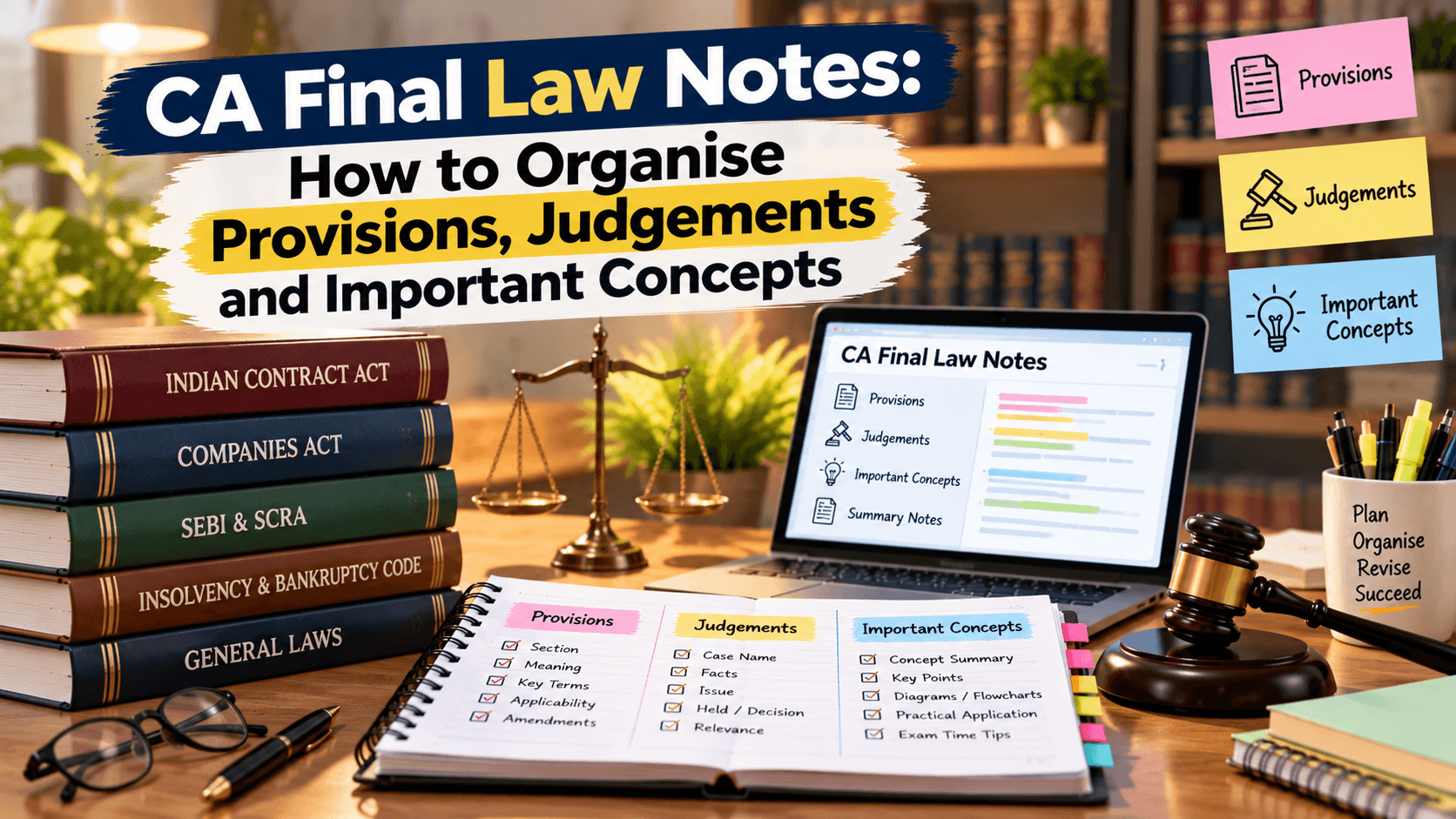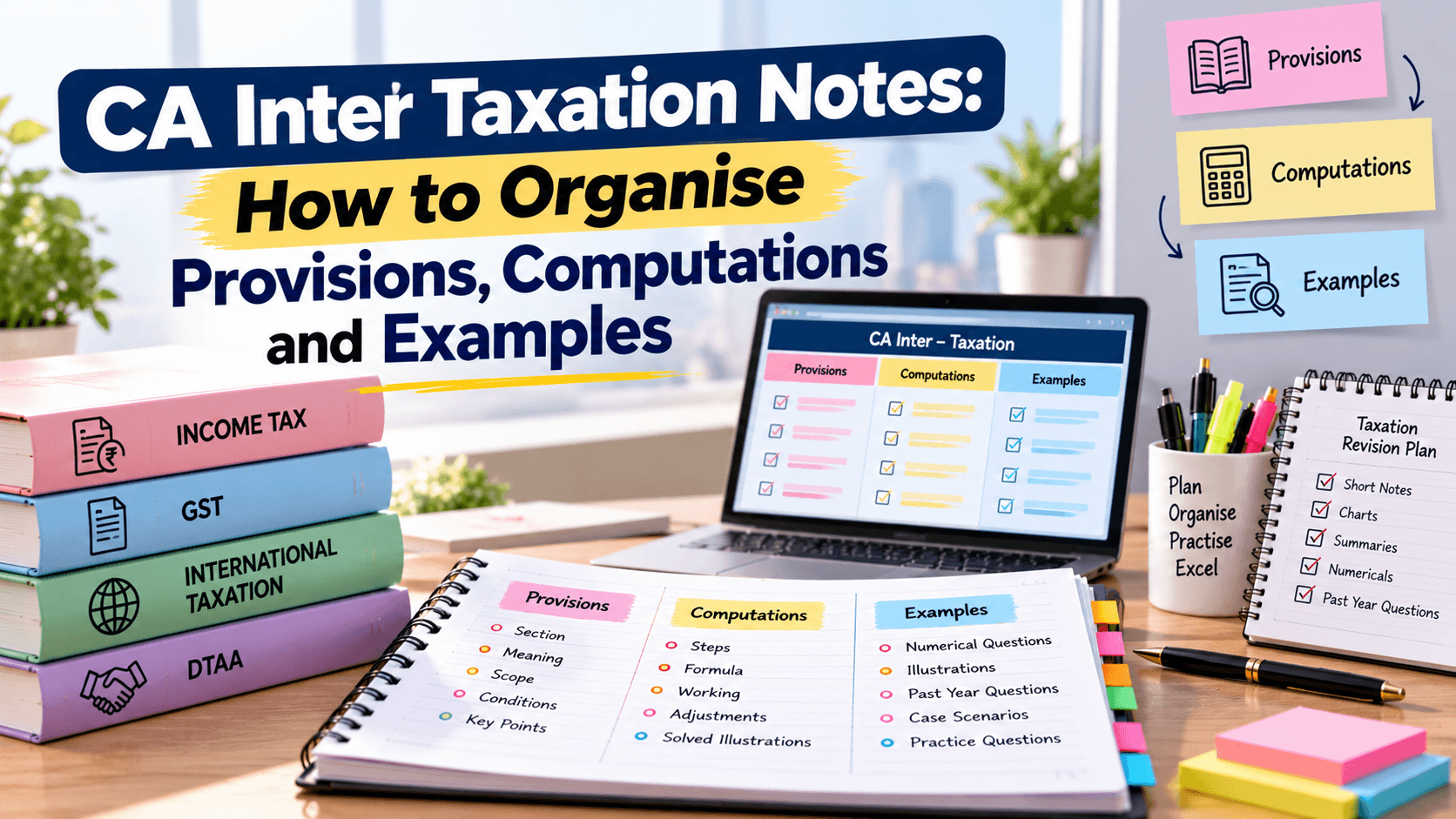
How to Structure CA Final Notes for Case-Based and Application-Oriented Questions
Learn how to structure CA Final notes for case-based and application-oriented questions with concise concepts, provisions, practical examples, revision cues and…

In this article(12 sections)ShowHide
CA Final preparation involves more than remembering concepts and provisions. Many questions require students to interpret a situation, identify the relevant issue, apply the correct principle and present a logical conclusion. Notes that only reproduce textbook paragraphs can be difficult to use when solving these questions under time pressure.
A better approach is to create notes that help you move from a concept to its application. With a consistent structure, you can revise the rule, recognise when it applies, practise using it in a case and quickly identify common traps. This guide explains how to build those notes without making them too lengthy to revise.
Why Case-Based Questions Need a Different Note-Making Method
Traditional notes often focus on definitions, lists and explanations. Those are useful for learning, but case-based questions ask you to do something with that knowledge. You may need to identify a fact that changes the outcome, distinguish between two similar provisions, calculate an amount, or justify a conclusion using the relevant rule.
Your notes should therefore connect four elements: the concept, the trigger that tells you when it applies, the method of applying it, and the conclusion or presentation expected. The aim is not to predict the exact exam question. It is to make the knowledge flexible enough to use in unfamiliar situations.
For CA Final, keep the latest applicable syllabus, study material, amendments and official exam guidance at the centre of your preparation. Notes are a personal revision tool, not a replacement for prescribed material.
Use a Repeatable Template for Every Important Topic
A consistent layout reduces the time spent searching through your notes. Use the same basic template for standards, provisions, frameworks, calculations and practical concepts, adapting it to the subject where necessary.
Start with a short concept summary in your own words. Add the relevant provision, standard, condition or formula, then write down the facts that usually determine whether it applies. Include a small worked example or a case-style prompt, followed by a step-by-step application method. Finish with a conclusion format, common errors and a few quick revision questions.
Do not copy every explanation from a textbook. If a point is already clear and easy to find in the official material, your notes can simply point to the page or chapter. Use your notes to capture the connections, exceptions and mistakes that you personally need to remember.
A Note Structure That Connects Rules to Facts
For each major concept, create a compact “rule to result” section. The rule states what the provision or concept requires. The facts section lists the details in a case that may affect the answer. The application section explains how to compare those facts with the rule. The result section records the likely outcome and any qualification that must be mentioned.
For example, if a question asks whether a particular treatment is appropriate, your notes should prompt you to identify the relevant criteria, check the facts against each criterion, note any exception and then state the conclusion. The example should be based on the subject and applicable material you are studying; avoid using a generic example as a substitute for checking the exact provision.
A useful page should make the thinking process visible. When you return to it during revision, you should be able to see not only what the rule says, but also how to use it.
Organise Notes by Subject and Question Type
Use one main section for each CA Final subject and divide it into chapters or syllabus areas. Within each chapter, use consistent subheadings such as core concepts, important provisions or standards, application triggers, working notes, case examples, common errors and revision questions.
Some topics are better organised by question type as well. For example, you may maintain a separate index of questions involving comparisons, exceptions, calculations, interpretation, professional judgement or multi-step analysis. This index helps you practise a skill across several chapters instead of revising each topic in isolation.
Avoid creating too many separate notebooks or files. If the same rule appears in several places, choose one primary location and use cross-references elsewhere. A simple index with topic name, note location and last revision date is often enough.
A Practical Table for Building Application-Oriented Notes
Use the following framework when preparing or updating notes. The examples are general prompts; customise them to the exact subject, syllabus and current applicable provisions.
| Note section | What to include | Self-check |
|---|---|---|
| Core concept | Explain the idea in 2–4 lines using your own words. | Can I explain it without reading? |
| Rule or standard | Record the applicable provision, criteria, formula or standard. | Have I checked the latest prescribed material? |
| Application triggers | List facts or conditions that determine which rule applies. | Which details in a case would change the outcome? |
| Application steps | Write the sequence for applying the rule to facts. | Can I repeat the process on a new question? |
| Case prompt | Add a short question and source reference. | What is the decisive fact and why? |
| Common error | Record the mistake you made and a correction cue. | How will I avoid repeating it? |
| Recall check | Add 2–3 quick questions or a mini checklist. | Can I retrieve the rule without looking? |
How to Summarise Provisions Without Losing Important Detail
Concise notes should remove repetition, not remove meaning. When summarising a provision or standard, retain the conditions, exceptions, thresholds, time limits, definitions and consequences that can change the answer. If a small qualification affects the result, it belongs in your notes.
Use short sentences and visual cues to separate the main rule from exceptions. You might mark conditions with “IF”, exceptions with “EXCEPT”, and consequences with “THEN”. Use abbreviations only when you understand them instantly and apply them consistently. A page full of unexplained initials is not a revision aid.
For numerical or multi-step topics, record the sequence of steps and the reason for each step. Include a compact worked example and identify where students commonly use the wrong figure, assumption or treatment. Always check technical summaries against the latest official study material and relevant updates.
Build a Case-Question Bank Alongside Your Notes
Notes become more useful when they link directly to practice. For each major topic, add two or three case-based prompts that test different aspects of the concept. One prompt can test straightforward application, another can introduce a relevant exception, and a third can combine the concept with a related topic.
Keep the prompt short and record the source of the question, such as a study-material illustration, practice question or mock test. After attempting it, add a brief note on the decisive fact, the rule applied and the reason your answer was correct or incomplete. Do not write out the entire solution again unless you need it for a complex method.
The aim is to build a searchable collection of patterns, not to memorise model answers word for word. A new exam question may use different names, amounts or circumstances. Understanding the decision process helps you adapt.
Use a Mistake Log to Personalise Your Notes
A mistake log helps you focus on the points that are most likely to cost you marks. After each test or practice session, classify errors into a few categories: concept not understood, rule forgotten, exception missed, facts misread, calculation error, weak structure or time pressure.
For every repeated error, update the relevant note with a short warning or checklist. If you regularly overlook a condition, place it beside the rule rather than at the bottom of a long page. If you understand the concept but struggle to structure the answer, add a response outline and practise it with a fresh question.
Review this log weekly. Remove or mark resolved issues when your practice shows consistent improvement, while keeping recurring mistakes visible. This makes your notes personal and practical rather than a second copy of the study material.
Write Notes That Help You Present a Clear Exam Answer
Your notes should support a disciplined answer structure. For a case-based question, a useful sequence is: identify the issue, state the relevant principle or provision, apply it to the facts, and give a reasoned conclusion. Adapt the structure to the specific requirement and the subject; some numerical questions need workings, while some theory questions need comparison or explanation.
Practise using the command word in the question. “Explain”, “analyse”, “distinguish”, “comment” and “calculate” do not all call for the same response. Your notes can include a small reminder of what each type of instruction requires, but the actual answer should remain focused on the question asked.
For calculations, show clear workings and label assumptions where needed. For theory, use headings or numbered points when they make the logic easier to follow. Avoid writing everything you know about a topic if it does not answer the requirement.
A Weekly Routine for Maintaining Your Notes
Set aside a short period after studying a topic to create the first version of your notes. Keep it brief at the start; you can improve it after attempting questions. Once or twice a week, update notes using errors from practice and revise the topics that are due for review.
A practical routine might include: learning the concept from prescribed material, writing a concise rule summary, solving a few case-based questions, checking the answer, adding any missed condition to the notes, and retesting the point after a gap. The spacing between reviews can depend on your schedule and how well you remember the topic.
Do not spend so long designing notes that you reduce time for solving questions. Colour-coding, diagrams and digital tools are useful only when they improve understanding or make revision faster. The most effective format is the one you can maintain consistently.
How Studycaller Can Fit Into Your Preparation
Studycaller can be included in a broader preparation routine as a support for structured practice and revision. Use practice questions or test-series work, where available, to check whether your notes help you identify the issue, select the right rule and apply it accurately. Let your performance guide what needs to be added or simplified.
Before choosing any resource, check that it matches your CA Final stage, relevant syllabus and current attempt requirements. Keep official ICAI material as the reference point for technical accuracy and updates. The purpose of a learning resource is to improve your preparation process, not to replace independent practice or careful review.
Final Checklist Before You Revise
Before a revision session, check whether each topic page includes the main concept, relevant rule or standard, conditions and exceptions, an application method, at least one case-style prompt, common mistakes and a short recall check. If a page contains only copied paragraphs, revise it into a format that helps you solve a question.
During final revision, prioritise high-value concepts, repeated mistakes and areas where you need to connect several ideas. Use active recall by covering the notes and explaining the rule in your own words, then attempt a question without looking at the solution. Return to the full material whenever you need to confirm a technical detail.
Well-structured notes will not guarantee a particular result, but they can make revision more focused and help you practise the reasoning required for case-based and application-oriented questions. Keep the system simple, update it through practice, and use it consistently.
CA Final notes students love
Free notes from the Studycaller library, picked for this article.
Summary Notes · CA Final Others
Ca Subham singhal spom( Set A )notes
Nikita Agrawal 40 32.4k
Detailed Notes · CA Final Integrated Business Solutions
Shubham Singhal Law Book SPOM
Rahul 32 19.6k
Summary Notes · CA Final Others
SPOM set A Law Notes
A Lal 16 17.2k
MCQs · CA Final Others
MCQ for set c (Arbitration and conciliation act)
Nikita Agrawal 12 23.9k
Frequently asked questions
How should CA Final students make notes for case-based questions?
Organise each topic around the core concept, relevant provision, application triggers, steps for applying the rule, a short case prompt and common mistakes. This helps connect theory with the reasoning required to answer unfamiliar situations.
Should I write the full ICAI study material in my notes?
Usually, no. Keep your notes concise and focused on concepts, exceptions, links between topics and personal mistakes. Use the prescribed ICAI material to verify technical details and revisit full explanations whenever a concept remains unclear.
What should application-oriented CA Final notes include?
Include the rule or standard, the conditions that activate it, exceptions, a step-by-step application method, a worked example and a quick recall question. For numerical topics, preserve the sequence of workings and assumptions that affect the result.
How can I make CA Final notes easier to revise?
Use consistent headings, short explanations, clear examples and a small number of visual cues. Keep each topic easy to scan, add cross-references instead of duplicating content, and use active recall to test whether you can retrieve key points.
How many case-based questions should I add to each topic?
There is no fixed number. Start with a straightforward application question, then add questions that test exceptions or combine concepts. Choose examples that expose different reasoning steps rather than collecting many questions that test the same point.
How do I use mock-test mistakes to improve my notes?
Classify each mistake, identify its cause and update the relevant topic page with a specific correction cue. Retest the concept later. This turns your notes into a personalised revision resource instead of a static summary.
Should CA Final notes be handwritten or digital?
Both formats can work. Handwritten notes may suit quick diagrams and personal recall, while digital notes make searching and updating easier. Choose the format you can maintain and revise quickly, and avoid spending too much time on presentation.
How should I structure an answer to a case-based question?
Identify the issue, state the relevant principle or provision, apply it to the facts and give a reasoned conclusion. Adapt this sequence to the question requirement, especially where calculations, comparisons or a specific form of explanation is required.
How often should I update CA Final notes?
Update them after completing a topic and after practice tests reveal a gap or repeated mistake. Review important points weekly and check official material for relevant amendments or syllabus updates before the examination.
How can Studycaller support CA Final note preparation?
Studycaller can be part of a wider routine for practice and revision. Use questions or test-series resources, where available, to check whether your notes support accurate application, then verify technical points against current ICAI material.