How to Find Updated CA Notes According to the Latest ICAI Syllabus
Learn how to find updated CA notes aligned with the latest ICAI syllabus, check revision changes, avoid outdated material, and choose reliable notes for better CA exam preparation
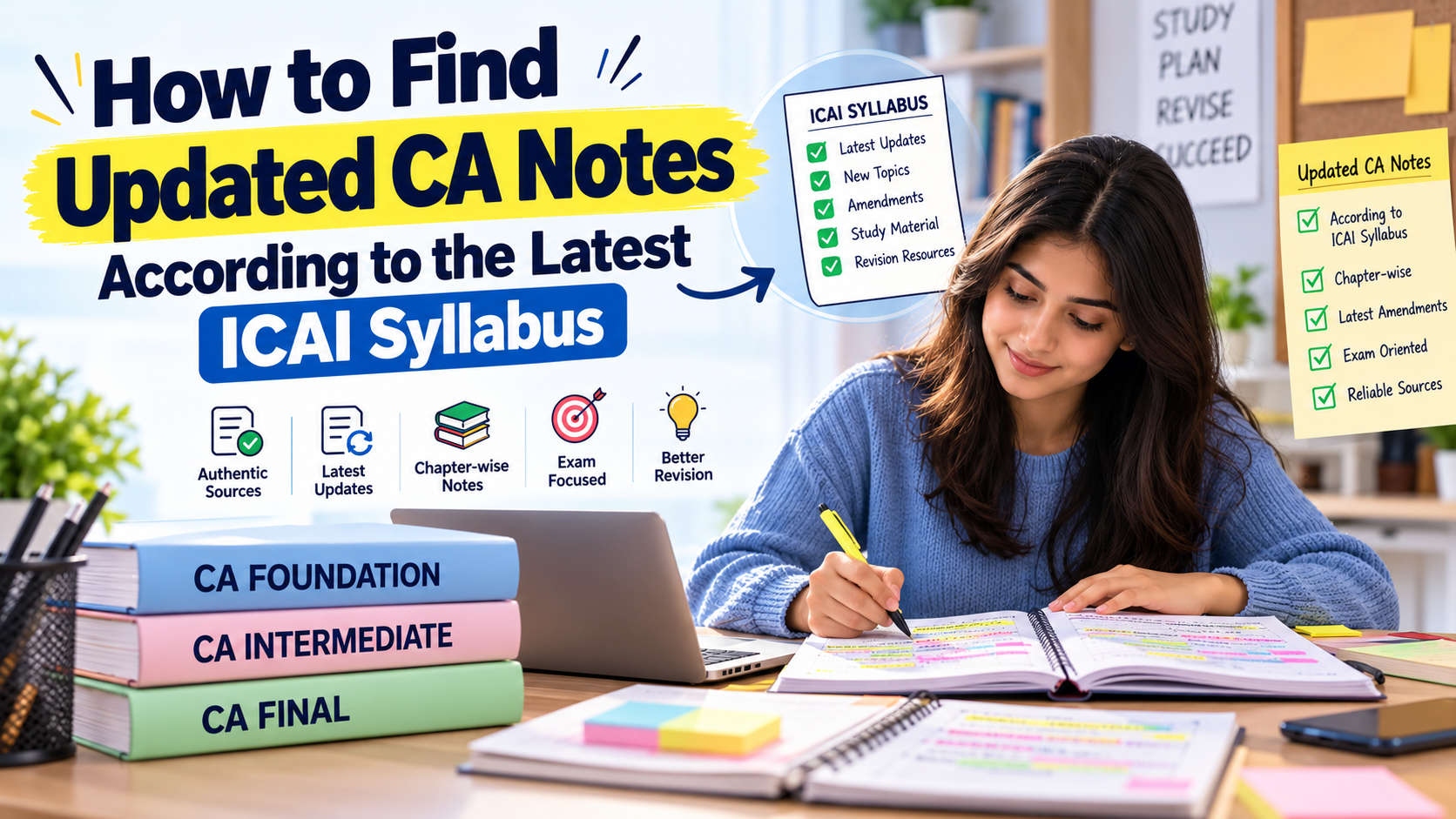
Table of Contents
- Why Updated CA Notes Matter for Exam Preparation
- Start With the Latest ICAI Syllabus
- Check the Version and Applicable Attempt
- Match Notes Subject by Subject
- Do Not Ignore Amendments and Updates
- What Makes CA Notes Reliable and Useful?
- How to Find Updated CA Notes Online
- How Studycaller Can Help You Choose Better Notes
- Common Mistakes Students Make While Choosing CA Notes
- A Simple Workflow to Verify Your CA Notes
- Final Checklist Before You Start Revision
- Frequently Asked Questions
How to Find Updated CA Notes According to the Latest ICAI Syllabus
Preparing for a CA examination is not only about studying for long hours. It is also about studying the right material at the right time. One of the most common mistakes students make is continuing with old notes even after the syllabus, study material, amendments, or examination requirements have changed. A set of notes may look complete, but if it does not match the current ICAI syllabus, it can create unnecessary confusion during revision.
The good news is that finding updated CA notes does not have to be difficult. You simply need a practical way to check whether the notes match the current syllabus, cover the relevant topics, reflect applicable amendments, and support the way questions are asked in the examination. This guide explains what to check before choosing CA notes and how platforms such as Studycaller can help students make the selection process more systematic.
Why Updated CA Notes Matter for Exam Preparation
CA preparation involves a large amount of information, and students naturally look for notes that make revision faster. But speed is useful only when the material is accurate. Updated notes reduce the risk of spending valuable study time on topics that have been changed, removed, reorganised, or superseded.
This becomes particularly important for subjects affected by amendments, notifications, changes in law, revised provisions, accounting or auditing developments, and syllabus restructuring. Even when the core concept remains familiar, the examination relevance can change from one attempt to another.
There is another practical advantage. When notes follow the current syllabus, students can create a cleaner revision plan. Instead of repeatedly asking, “Is this topic still applicable?”, they can concentrate on understanding concepts, practising questions, and improving answer-writing speed.
Start With the Latest ICAI Syllabus
The safest starting point is always the applicable ICAI syllabus for your examination attempt. Do not select notes simply because a friend used them successfully in an earlier attempt or because they are available on an old website page.
First identify your level—Foundation, Intermediate, or Final—and then identify the specific attempt for which you are preparing. Read the official syllabus and subject structure carefully. Note the names of papers, modules or sections, and any changes that affect the scope of preparation.
Once you know the current structure, use it as a checklist. Every set of notes you consider should be compared against that checklist. This simple habit can prevent a surprisingly common problem: having attractive notes that are not completely aligned with the examination you are actually taking.
Use the syllabus as your master checklist
Instead of asking whether notes “look updated,” compare them against the syllabus topic by topic. Visual appearance is not proof of relevance. A well-designed PDF can still contain old content, while simple-looking notes may be completely current.
Check the Version and Applicable Attempt
One of the easiest ways to identify outdated CA notes is to check whether the material clearly mentions its applicable attempt, syllabus version, or update period. Reliable notes should give students enough information to understand when the material was prepared or last revised.
For example, if you are preparing for a particular Foundation, Intermediate, or Final attempt, notes created several attempts earlier should not automatically be treated as current. They may still be useful for understanding basic concepts, but they should not be your only revision source without verification.
| What to Check | Why It Matters |
|---|---|
| Applicable attempt | Confirms whether the notes are intended for your examination cycle. |
| Syllabus coverage | Helps identify missing, added, or reorganised topics. |
| Update date | Shows whether recent changes may have been incorporated. |
| Amendment coverage | Important for subjects where rules, laws, or provisions change. |
| Source or preparation details | Makes it easier to judge reliability and relevance. |
Match Notes Subject by Subject
Do not assume that one source will be equally strong for every paper. CA students often have different requirements across subjects. A student may prefer concise theory notes for one paper, detailed concept notes for another, and question-focused revision material for a practical subject.
Begin by making a simple subject-wise comparison. Write down the chapters or major areas from the current syllabus and mark whether each one is covered in the notes. This takes some time initially, but it can save hours later.
Look for complete coverage, not maximum volume
More pages do not necessarily mean better notes. The objective is not to collect the largest possible amount of material. The objective is to find notes that contain the right concepts, relevant provisions, useful examples, important formats, and exam-oriented explanations without burying the student under unnecessary information.
Check whether the notes support revision
Good CA notes should be easy to revisit. Headings, subheadings, summaries, formulas, charts, examples, and clearly separated concepts can make repeated revision much easier. If you need excessive time just to locate an important point, the notes may not be practical for the final stages of preparation.
Do Not Ignore Amendments and Updates
For many CA subjects, checking the syllabus alone is not enough. Students also need to know whether the material incorporates the applicable amendments, notifications, changes in provisions, and other relevant updates for their attempt.
This is especially important when you are using notes that were originally prepared months earlier. A note can be perfectly accurate at the time it was written and still require updates later.
When checking a resource, look for a clearly identified amendment section or update indicator. If the source does not explain how recent changes have been incorporated, verify those areas separately rather than assuming everything is current.
Students should also avoid combining random screenshots, old PDFs, social media posts, and outdated notes without checking their dates. Multiple sources do not automatically create better preparation. In fact, mixing versions can lead to contradictory information and make revision harder.
What Makes CA Notes Reliable and Useful?
Updated notes should be judged on more than their publication date. A genuinely useful resource combines current content with clear presentation and an exam-focused approach.
- Current syllabus alignment: The notes should follow the structure relevant to the student's examination attempt.
- Accurate concepts: Explanations should be clear enough to understand the topic rather than encouraging blind memorisation.
- Relevant updates: Applicable amendments and changes should be identified clearly.
- Revision-friendly format: Students should be able to revise important information quickly.
- Practical examples: Examples can make difficult provisions, calculations, and applications easier to remember.
- Exam relevance: Notes should help students connect concepts with the type of questions they may need to answer.
A useful test is simple: after studying a topic, can you close the notes and explain the concept in your own words? If yes, the notes are doing their job. If you are merely highlighting page after page without understanding the material, the problem may be the study method as much as the notes.
How to Find Updated CA Notes Online
The internet has made study resources easier to access, but it has also made it easier to find outdated material. Search results may show old PDFs, archived pages, previous-attempt notes, or resources that continue to circulate long after their original relevance.
Start with targeted searches rather than broad searches such as “CA notes PDF.” Include the level, subject, syllabus, and relevant attempt in your search. Then inspect the page before downloading anything.
Check the publication or update information, the syllabus reference, subject coverage, and the credibility of the source. If a page provides no indication of the applicable syllabus and appears several years old, treat it cautiously.
It is also worth checking whether the resource is maintained. A page that regularly updates its study material is generally easier to trust than a static page that has not been reviewed for a long period. However, always cross-check important academic or regulatory information against the applicable official source.
How Studycaller Can Help You Choose Better Notes
For students who want a more organised preparation process, Studycaller can be considered as a useful place to explore CA-focused learning resources. The bigger advantage of using a structured learning platform is that students do not have to depend entirely on scattered material found across different websites.
When evaluating notes through Studycaller or any other platform, students should still follow the same verification process: identify the relevant attempt, compare the notes with the syllabus, check updates, and make sure the material fits their revision requirements.
The aim should not be to collect every resource available. Instead, build a small, reliable study system. One dependable set of notes, the applicable ICAI material, question practice, and a clear revision routine can be more effective than maintaining folders filled with dozens of PDFs.
Use Studycaller as part of a complete preparation system
Notes are most useful when they work alongside regular revision and question practice. You can use concise notes for concept recall, return to detailed material when a topic is unclear, and use mock or practice questions to check whether you can actually apply what you have studied.
This approach keeps notes in their proper role. They are a revision tool, not a replacement for understanding the syllabus and practising questions.
Common Mistakes Students Make While Choosing CA Notes
Many students spend more time searching for resources than checking whether those resources are actually useful. A few common mistakes can make the preparation process unnecessarily complicated.
Choosing notes only because they are popular
A resource may be popular among students and still not match your exact attempt or learning style. Popularity can be one consideration, but syllabus alignment should come first.
Using previous-attempt notes without verification
Old notes can be useful for basic concepts, but students should verify them before relying on them for current preparation. This is especially important for subjects that are affected by changes and amendments.
Downloading too many PDFs
Having five versions of the same chapter does not improve retention. It often creates decision fatigue. Choose a reliable primary resource and use another source only when you need clarification or additional practice.
Ignoring the difference between notes and study material
Concise notes are designed for revision, while detailed study material may be necessary for building concepts. Students should understand this difference instead of expecting one document to perform every function.
A Simple Workflow to Verify Your CA Notes
If you are unsure whether your current notes are updated, use the following five-step process before investing more time in them.
| Step | Action | Purpose |
|---|---|---|
| 1 | Identify your exact CA level and attempt. | Defines the correct preparation target. |
| 2 | Open the applicable syllabus and subject structure. | Creates your master checklist. |
| 3 | Compare every major topic with your notes. | Finds missing or unnecessary content. |
| 4 | Check amendment and update information. | Reduces the risk of studying superseded content. |
| 5 | Test the notes with questions and revision. | Shows whether the notes actually support exam preparation. |
This process is simple enough to use for every subject. It also gives you a clear answer when deciding whether to continue with an existing notebook, update it, or replace it with a better resource.
Final Checklist Before You Start Revision
Before making a set of CA notes your primary revision source, ask yourself a few questions. Does it match my current syllabus? Does it clearly cover the relevant subjects and topics? Have applicable updates been incorporated? Can I revise from it quickly? Does it help me understand and apply concepts?
If the answer is yes, you have a much stronger foundation for revision. If several answers are no, do not wait until the final weeks to discover the problem. Spend a little time now checking and organising your material.
The best CA notes are not necessarily the longest or the most attractive. They are the ones that are current, accurate, relevant, easy to revise, and aligned with the student's actual examination requirements. By checking the latest syllabus first and then verifying notes carefully, students can avoid outdated content and study with greater confidence.
With a structured resource approach and platforms such as Studycaller supporting the preparation journey, the goal becomes much clearer: study less randomly, revise more effectively, and keep your preparation connected to the syllabus that actually matters.

FAQs
Frequently Asked Questions
How can I check whether my CA notes are updated?
Compare your notes with the syllabus applicable to your examination attempt, then check the update date, topic coverage, and relevant amendments. Notes should clearly cover the current syllabus rather than relying only on older concepts or previous-attempt material.
Where can I find CA notes according to the latest ICAI syllabus?
Look for notes from reliable CA learning platforms and compare them with the applicable ICAI syllabus before studying. Studycaller can also be explored as part of a structured preparation system, while important academic updates should be verified carefully.
Can I use old CA notes for my current attempt?
Old notes may help with basic concepts, but they should not automatically become your primary resource. Check them against the current syllabus and applicable amendments first. Replace or update sections wherever the content no longer matches your examination requirements.
Why is syllabus alignment important for CA notes?
Syllabus alignment ensures that your study time is focused on topics relevant to the examination. It also reduces the possibility of spending hours revising removed, changed, or unnecessary content while missing topics that are currently included.
Should CA notes include amendments?
Yes, where amendments are applicable to the subject and examination attempt, your notes should reflect them clearly. Students should check whether updates have been incorporated instead of assuming that an older set of notes automatically contains every relevant change.
Are concise CA notes better for revision?
Concise notes can be highly useful during revision because they reduce the time required to review familiar concepts. However, they should be supported by detailed learning material and question practice whenever a topic requires deeper understanding.
How should I compare two sets of CA notes?
Compare their syllabus coverage, applicable attempt, update information, accuracy, clarity, amendment coverage, and revision-friendly structure. Choose the resource that meets your current preparation needs rather than simply selecting the longer or more popular set.
Can Studycaller help students find useful CA notes?
Studycaller can be considered as part of a structured CA preparation approach. Students should still verify that any notes they use match their current syllabus and attempt, while combining them with appropriate study material and question practice.
How many sets of CA notes should I use?
Most students do not need several competing sets of notes. One reliable primary resource, supported by official material and additional resources when necessary, can make revision more focused and reduce confusion caused by repeated or contradictory information.
What should I check before downloading CA notes online?
Check the source, applicable attempt, syllabus alignment, update date, subject coverage, amendment status, and overall clarity. Avoid downloading material simply because it ranks in search results or looks attractive without confirming that it is relevant to your current preparation.