How CA Inter Students Should Maintain Separate Notes for Each Paper
Learn how CA Inter students can maintain separate paper-wise notes with consistent chapter folders, revision summaries, practice logs, and a simple tracking system from…
In this article(12 sections)ShowHide
CA Intermediate preparation involves managing several papers, each with its own concepts, question styles, and revision requirements. When notes for different subjects are mixed together, finding a particular topic can take longer than expected. You may also end up rewriting the same information in multiple places or overlooking important practice questions when revision begins.
Maintaining separate notes for each paper gives your preparation a clearer structure. It helps you locate concepts quickly, track mistakes subject by subject, and revise without sorting through unrelated material. This guide explains how CA Inter students can organise paper-wise notes, keep them concise, connect related topics where useful, and maintain a system that remains manageable throughout preparation. Studycaller can be part of your wider study routine as you organise your resources.
Why Should CA Inter Students Maintain Separate Notes for Each Paper?
Separate notes reduce the effort required to find and revise information. If each paper has its own clearly labelled section, you can go directly to the relevant chapter rather than searching through a combined notebook. This is especially helpful when you need to review one topic quickly before attempting a test or revising a weak area.
Paper-wise organisation also makes it easier to identify gaps. You may have detailed theory notes for one subject but very few solved examples for another. When each paper has a separate structure, you can see what is missing and decide whether you need a concept summary, additional practice, a formula sheet, or a record of repeated mistakes.
Separate notes do not mean creating a new notebook for every small topic. The aim is to keep each paper distinct while using a consistent format across all papers. This makes the system easy to maintain and prevents note-making from becoming a project that consumes more time than actual study.
Set Up a Simple Paper-Wise System
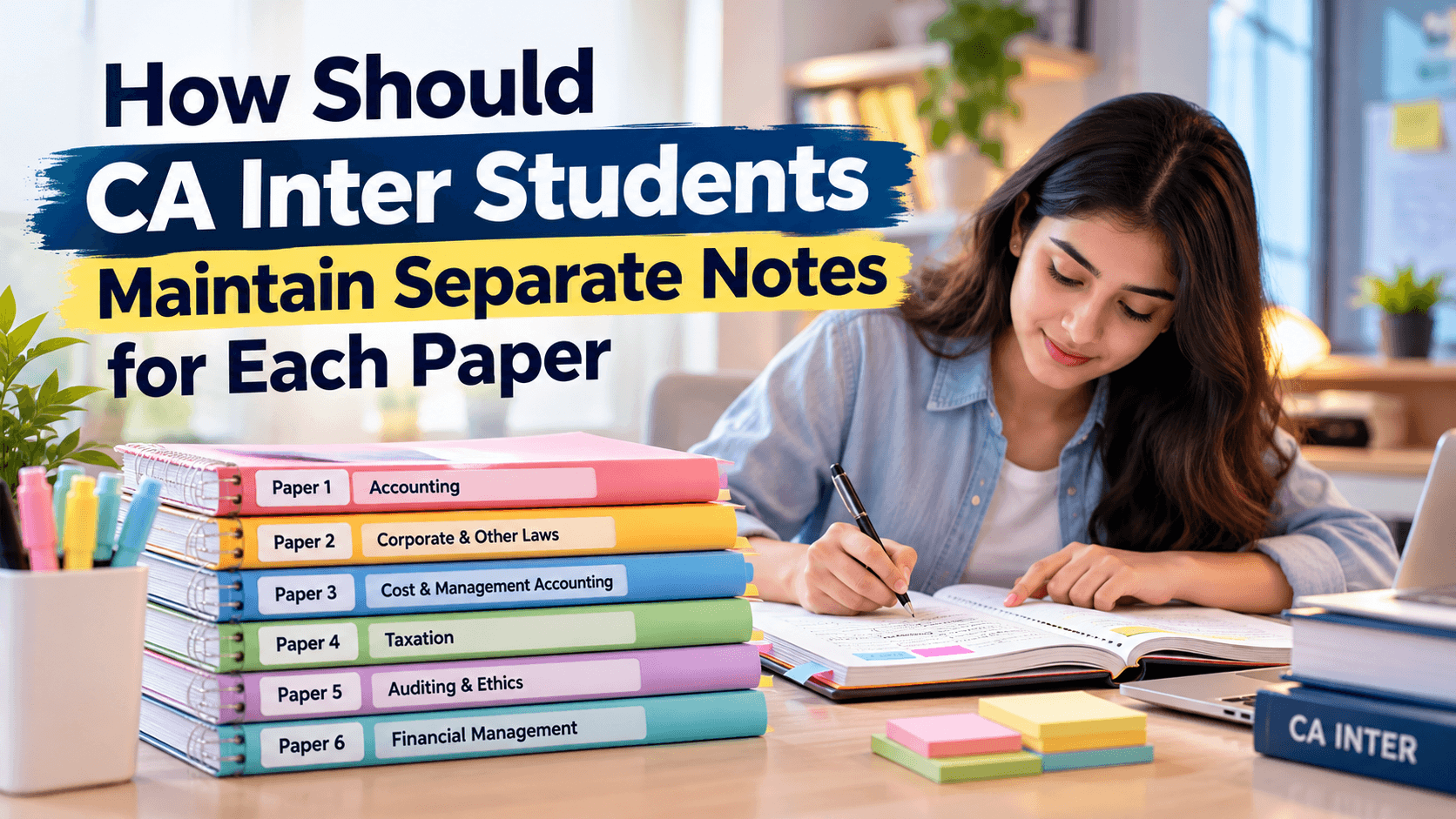
Start by creating one main notebook or folder for each paper included in the syllabus applicable to your attempt. Inside each paper, arrange material by module, chapter, and topic. Use the official syllabus and prescribed study resources to confirm the correct structure instead of relying on an old folder arrangement.
If you use physical notebooks, write the paper name clearly on the cover, number the pages, and add an index at the beginning. Use dividers or marked sections for different chapters. If you use digital notes, create a main folder for CA Intermediate and a separate subfolder for each paper. Within each, use consistent chapter names and avoid vague file names such as “new notes” or “final version 2.”
| Organisation level | What to store | Example |
|---|---|---|
| Paper | All notes and revision resources for one paper | Paper name as listed in the current syllabus |
| Chapter | Chapter overview and topic list | Chapter number and title |
| Topic | Concept explanations, rules, formulas, or methods | A specific topic heading |
| Practice | Question references and worked examples | Source, question number, and attempt date |
| Revision | Short summaries and error reminders | Topic summary with last-reviewed date |
Keep one main version of each concept. If you prepare a short revision sheet, make it a condensed reference linked to the detailed note rather than a second copy that needs to be updated independently. This reduces duplication and the risk of keeping conflicting information.
Use the Same Chapter Template for Every Paper
A repeatable chapter template helps you maintain consistency. You do not need to include every section for every chapter, but having a standard structure makes it easier to see what each set of notes contains.
1. Chapter overview
Begin with the chapter title and a short list of its main topics. Add a brief explanation of what the chapter covers and identify any concepts you find difficult. Keep the overview concise so it works as a quick starting point during revision.
2. Core concepts
Record the essential explanations, definitions, rules, methods, or formulas. Use your own wording where appropriate, but preserve technical terminology and conditions that affect accuracy. For a long concept, break the explanation into headings rather than writing one large paragraph.
3. Examples and practice references
Include a representative example when it helps explain a method. Record the source and question number for additional practice instead of copying every question into your notes. For practical topics, show important working steps and the reason behind adjustments; for theory-oriented topics, include a question prompt to test recall.
4. Common mistakes
Write down mistakes you have actually made, such as forgetting a condition, choosing the wrong method, skipping a calculation step, or leaving an answer incomplete. Personal reminders are often more useful than generic lists of important points because they target the gaps in your own preparation.
5. Revision status
Record when you last reviewed the chapter and what you need to do next. The next action might be to recall a concept, solve a fresh question, reattempt an incorrect problem, or verify an update. This keeps your notes connected to a practical revision plan.
Adapt Your Notes to the Type of Subject
Keep separate notes for every paper, but do not force every paper into exactly the same style. Different subjects may require different balances of explanation, calculation, examples, and written practice. The structure should support the skill you need to demonstrate in the exam.
For theory-oriented topics
Use clear headings, concise explanations, definitions, conditions, and comparison tables where similar concepts are easy to confuse. Add a short question prompt below the summary and practise explaining the concept without looking. Where case-based application is relevant, record the sequence of identifying the issue, stating the rule, applying it to the facts, and reaching a conclusion.
For practical or calculation-based topics
Keep methods, formulas, formats, working notes, and representative solved examples together. Do not record only the final answer. Show the steps that help you select the method, handle adjustments, and check the result. Add an error log for calculation mistakes, missed details, and incorrect assumptions.
For papers combining concepts and application
Use a mix of concise theory summaries and application practice. Identify which part of the topic needs memorisation and which part requires problem-solving or structured writing. Keep a clear link between the concept note and the questions you use to test it.
| Note feature | Theory-oriented topics | Practical topics |
|---|---|---|
| Main focus | Concepts, terminology, conditions, and application | Methods, calculations, adjustments, and working |
| Useful format | Headings, short summaries, comparison tables | Step-by-step examples, formats, and checklists |
| Practice activity | Recall and written answers | Independent question solving |
| Common review point | Missing conditions or unclear explanation | Wrong method, skipped step, or calculation error |
Use the paper names and topic coverage that apply to your current CA Intermediate attempt. Since syllabus structures can change, verify the current official material before creating a permanent folder system or copying older notes into it.
Keep Practice Records and Error Logs Separate for Each Paper
A paper-wise error log shows you where marks are being lost. After a test or practice session, record the question or topic, the error, the reason, and the action you will take next. Avoid writing only “revise again”; specify what needs to change.
| Topic or question | What went wrong | Next action |
|---|---|---|
| Enter chapter or question reference | Forgot a key condition | Add a concise reminder and practise recall |
| Enter chapter or question reference | Selected the wrong method | Compare similar methods and solve a new question |
| Enter chapter or question reference | Skipped a working step | Rewrite the solution with full working and reattempt |
| Enter chapter or question reference | Answer was incomplete | Practise a structured response under a time limit |
Keep the detailed error log within the relevant paper folder so you can review the pattern for that subject. If the same mistake occurs repeatedly, add a short reminder to the chapter notes as well. Reattempt incorrect questions after a gap instead of relying on the solution you just read.
Create Short Revision Notes Without Duplicating Everything
Short notes are useful when they help you recall a topic quickly. They should not become another full set of notes that you must maintain. Create them after you have understood the chapter and attempted questions, so you know which points actually need to be condensed.
For each chapter, select only the information that benefits from quick review: essential concepts, formulas and conditions, a process or answer framework, distinctions between similar topics, and your recurring mistakes. Include a reference to the full explanation if a short summary could be misunderstood without additional context.
Use a simple visual system. A few consistent markers for important concepts, examples, and personal errors are enough. Avoid highlighting whole pages or using too many colours; the goal is to make key information easy to locate, not to decorate the notebook.
Test the revision sheet by closing it and trying to reproduce the main points. For a practical topic, solve a fresh question. For a theory topic, write a brief answer from memory. If the sheet does not help you recall or apply the topic, revise its structure instead of making it longer automatically.
Handle Overlapping Concepts Without Mixing Papers
Some concepts may be related across different areas of your preparation. Keep the main explanation under the paper where it belongs, then add a cross-reference if the connection is genuinely useful. This lets you recognise a relationship without mixing distinct rules, assumptions, or methods.
A short cross-reference can include the related topic, the paper or chapter where it appears, and one sentence explaining why the connection matters. Keep the detailed notes in their original locations. This avoids maintaining several versions of the same explanation and makes it easier to update a concept accurately.
Do not create links merely because two topics share similar words. Verify that the relationship helps with understanding or application. If the connection is not clear, keep the topics separate until you can explain the distinction confidently.
Should You Use Separate Notebooks or Digital Folders?
Both physical and digital systems can work well. Separate notebooks make it easy to write calculations by hand and keep paper resources together. Digital folders make notes searchable, easier to update, and simple to link across chapters. Choose based on the format you can maintain consistently.
If you prefer physical notes, use one notebook per paper or clearly separated sections, with an index and page numbers. If you prefer digital notes, use a folder structure that mirrors the syllabus and name files consistently. Back up important digital material and avoid keeping multiple files labelled as the “latest” version.
A hybrid system can also be effective. You might use digital notes for searchable concept summaries and question references, while maintaining handwritten pages for calculations or practice. Choose one main version for each concept and update it when corrections are needed. Do not rewrite everything simply to make the system look uniform.
Maintain Your Notes With a Weekly Routine
Spend a short period each week checking whether your notes still support your preparation. Add useful points from recent practice, correct errors, remove duplicate explanations, and decide what each paper needs next. This prevents a large note-making task from building up just before exams.
- At the start of the week: select chapters or topics for each paper based on your progress and upcoming practice.
- After studying: add only the explanations, steps, or reminders that will help with future revision.
- After a test: update the relevant paper’s error log and schedule reattempts for weak questions.
- At the end of the week: use short recall checks and practice questions to decide which chapters need more attention.
Keep your plan realistic. If one paper is weaker, give it extra time while retaining shorter revision sessions for the others. The objective is not to spend equal time on every paper every day; it is to keep each paper moving forward without allowing a strong subject to fade from memory.
Common Mistakes to Avoid While Maintaining Separate Notes
Mixing topics from different papers: This makes information harder to find. Keep the main explanation in its correct paper folder and use cross-references only when they add value.
Copying too much content: Rewriting the textbook can consume time without improving understanding. Summarise after learning the topic and keep references to the original material for deeper review.
Making notes but not practising: Reading a summary can create a feeling of familiarity without proving that you can use it. Test recall and solve questions independently.
Maintaining duplicate versions: Multiple copies may contain different corrections. Keep one main version and make short revision sheets that point back to it.
Ignoring the error log: If mistakes are recorded but never revisited, the log has little value. Schedule fresh attempts and move recurring reminders into the relevant chapter notes.
Using outdated material: Check that your notes match the syllabus and prescribed resources for your attempt. Update the main note and every revision sheet affected by a change.
How Studycaller Fits Into Your CA Intermediate Preparation
Studycaller can be part of your broader preparation routine as you organise study resources and revision tasks. Before adding supplementary notes or practice material, decide what you need: a clearer explanation, more questions, a concise summary, or help tracking errors. Use resources that match your current syllabus and fill a real gap.
Keep prescribed study material as your main reference and use additional resources to support understanding and practice. Collecting multiple overlapping PDFs can make preparation harder if there is no clear system for deciding which resource to follow. A paper-wise folder structure, a simple revision tracker, and regular question practice can keep your material manageable.
The most useful notes are the ones you can find, understand, and apply. With Studycaller as part of your wider workflow, focus on maintaining a clear structure and using practice results to decide what to revise next rather than measuring progress by the number of pages you have written.
Conclusion
CA Inter students can maintain separate notes for each paper by using a clear folder structure, a consistent chapter template, subject-appropriate examples, and paper-wise error logs. Keep short revision notes linked to the detailed explanation and use cross-references only when related concepts genuinely support understanding.
Start by organising one paper, then apply the same structure to the others. Review your notes weekly, test yourself without looking, and use practice results to identify what needs more work. This simple system can make revision easier to navigate and help you use study time more purposefully.
CA Inter notes students love
Free notes from the Studycaller library, picked for this article.
Detailed Notes · CA Inter Corporate and Other Laws
Law Rapid Revision Book CA Shubham Singhal Sir
Keyur 115 99.3k
RTPs · CA Inter Taxation
BB DT Compiler (Question Bank) Latest Edition. May/Sept 26 and Jan 2027 exam.
Rahul 78 34.1k
Practice Questions · CA Inter FM AND SM
Ca inter fm most important questions just give 1 🏆.Bhot hardwork se Milla hai
Ashraf 50 20.3k
Amendment Notes · CA Inter Corporate and Other Laws
CA inter law notes By shubham singhal Detailed notes from may 25 onwards Follow for more....
Arya Shelke 47 24.5k
Frequently asked questions
1. Should CA Inter students maintain separate notes for every paper?
Yes, keeping a distinct section or folder for each paper makes topics easier to locate and revise. Use a consistent structure across papers, but adapt the note format to the subject’s concepts, calculations, and practice requirements.
2. Is it better to use separate notebooks or one large notebook?
Separate notebooks or clearly divided sections both work. Choose the arrangement that lets you find information quickly and maintain it consistently. If using one notebook, keep an index, clear paper dividers, and enough space for each chapter.
3. What should each CA Inter paper’s notes include?
Include chapter summaries, important concepts or methods, representative examples, practice references, common mistakes, and revision dates. Adjust the balance for the subject, keeping theory explanations clear and practical workings easy to follow.
4. How can I avoid duplicating information across different papers?
Keep the main explanation in the paper where it belongs. If another paper uses a related concept, add a short cross-reference to the original note instead of copying the entire explanation into a second location.
5. Should I make separate short notes for revision?
Short revision sheets can be helpful if they condense the main notes into essential points, formulas, conditions, or personal reminders. Keep them linked to the detailed material so important context is not lost during revision.
6. How do paper-wise error logs help in CA Intermediate preparation?
They show which mistakes recur in each subject and what action is needed. Record the question, reason for the error, and next step, then reattempt weak questions after a gap to check whether the correction has worked.
7. Can I maintain CA Inter notes digitally?
Yes. Digital notes can be searched and updated easily. Organise folders by paper and chapter, use consistent file names, keep one main version of each concept, and back up important resources so they remain accessible.
8. How often should I update my paper-wise notes?
Update notes after meaningful study sessions, practice tests, or verified corrections. Review the structure weekly and check technical content against the applicable syllabus and prescribed resources for your exam attempt.
9. Should I write everything from ICAI study material in my notes?
No. Notes should support revision rather than reproduce the complete material. Summarise after understanding the topic, preserve essential technical details, and keep references to the prescribed resources when you need to revisit a fuller explanation.
10. How can Studycaller support my CA Inter note-making routine?
Studycaller can be part of your preparation workflow when its resources match your needs. Use supplementary material to address a specific concept or practice gap, while keeping the prescribed study material and current syllabus as your main reference.