Free CA Notes vs Paid CA Notes: Which Is Better for CA Students?
Free CA Notes vs Paid CA Notes: compare quality, coverage, revision value, cost and convenience to choose the right CA notes for your preparation.
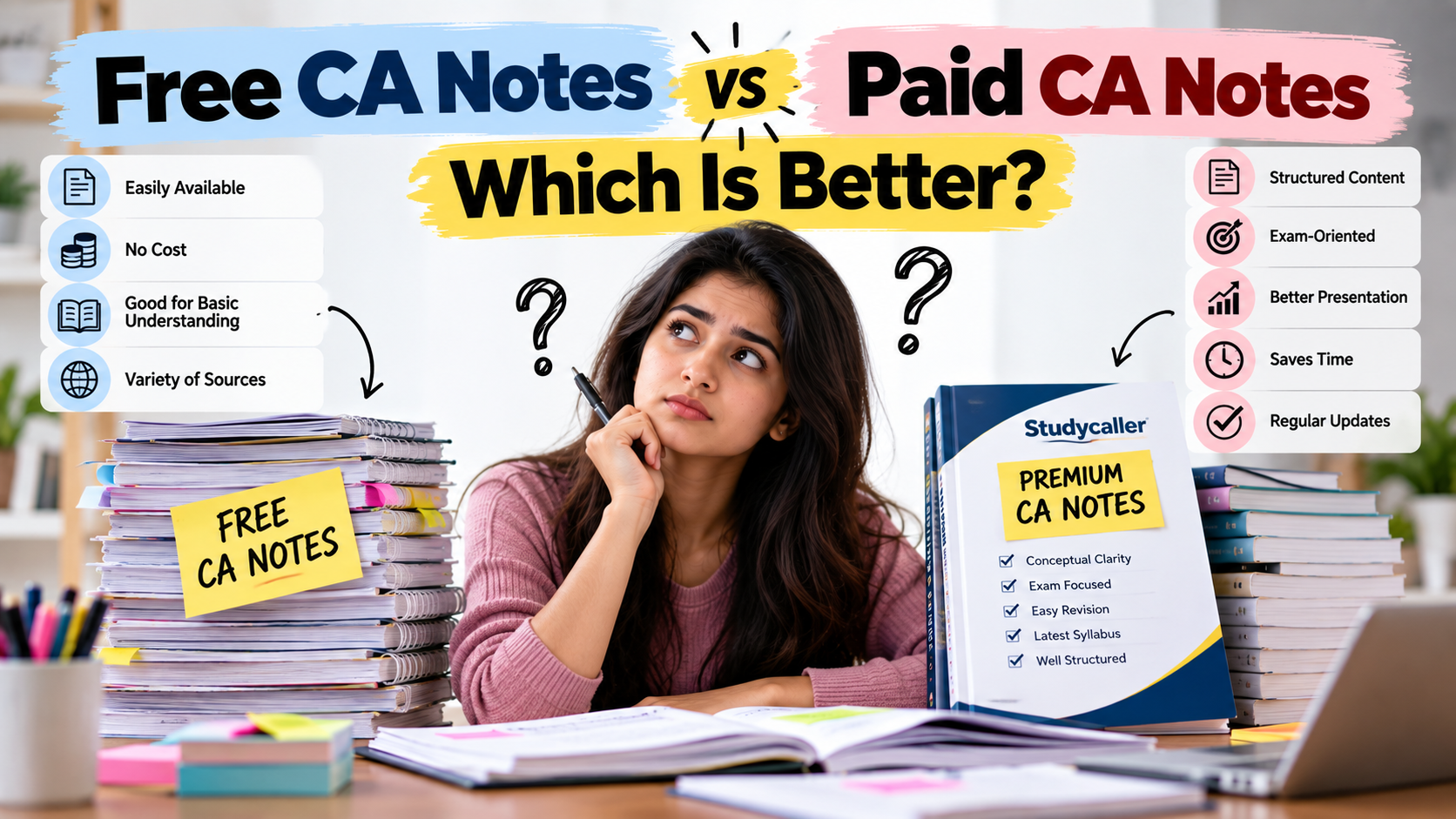
Table of Contents
- Free CA Notes vs Paid CA Notes: What Is the Real Difference?
- What Are Free CA Notes?
- What Are Paid CA Notes?
- Quality and Accuracy of CA Notes
- Coverage and Syllabus Alignment
- Which Notes Are Better for Revision?
- Time-Saving and Convenience
- Cost: Free Does Not Always Mean Better Value
- Personalisation and Study Support
- Free vs Paid CA Notes Comparison
- When Free CA Notes May Be Enough
- When Paid CA Notes May Be Worth Considering
- How to Choose the Right CA Notes
- Where Studycaller Fits Into the CA Notes Journey
- Common Mistakes Students Make With CA Notes
- A Practical CA Notes Strategy
- Final Takeaway
- Frequently Asked Questions
This creates a common question: Are free CA notes enough, or are paid CA notes worth the money? The honest answer is that there is no single option that works equally well for every student. The better choice depends on the quality of the notes, your preparation level, your available time, the complexity of the subject and how much structure you need.
The important thing is not whether notes are free or paid. What matters is whether they help you understand the concept, revise efficiently, cover the required syllabus and prepare for the way questions are actually asked. This guide compares both options so CA students can make that decision more logically.
What Are Free CA Notes?
Free CA notes are study resources that students can access without paying a separate fee. They may be available through educational websites, student communities, faculty resources, public documents, social platforms or other learning sources.
Free notes can be extremely useful. A student may find a short summary that explains a difficult concept better than a lengthy textbook. Another student may use a free revision chart to quickly recall formulas or provisions before a test.
The challenge is consistency. Free does not automatically mean poor quality, but it also does not automatically mean complete or reliable. Students may have to spend time checking the source, comparing the content with the current syllabus and deciding whether the notes cover enough of the topic.
What Are Paid CA Notes?
Paid CA notes are usually created as a structured learning product. Depending on the provider, they may include chapter-wise notes, revision summaries, examples, charts, question-based explanations, updated content and organised material for a particular CA level or subject.
However, paying for notes does not automatically guarantee that they are the right notes for you. A paid resource still needs to be checked for relevance, clarity, syllabus coverage and usefulness for your study style.
Quality and Accuracy of CA Notes
Quality should be the first factor you consider, whether the notes are free or paid. A beautifully designed PDF is not useful if the content is unclear, outdated or difficult to revise.
For CA preparation, students should look for accurate concepts, clear explanations, relevant examples and appropriate coverage. In subjects where provisions, rules or other technical details matter, current and properly reviewed material becomes particularly important.
Do not judge notes by their price. Judge them by the quality of the learning they enable.
Coverage and Syllabus Alignment
Another important difference can be syllabus coverage. Free notes are often created for a specific purpose: a chapter summary, a difficult topic, a formula sheet or a quick revision guide. That is useful, but it may not cover an entire subject.
Paid notes are more likely to be designed as a complete package, although this varies from one provider to another. If you are buying notes, check whether they cover the required syllabus and whether the material is aligned with the relevant attempt or curriculum.
| What to Check | Why It Matters |
|---|---|
| Syllabus coverage | Prevents important topics from being missed |
| Current relevance | Helps avoid relying on outdated content |
| Chapter structure | Makes planning and revision easier |
| Question relevance | Connects concepts with exam practice |
| Revision format | Reduces time needed for repeated review |
Which Notes Are Better for Revision?
This depends heavily on how the notes are designed. For final revision, students usually need concise information that can be reviewed quickly. Long explanations may be useful during the learning stage but less useful when only a few days are available.
Free revision notes can work very well when they are concise and accurate. A good formula sheet or provision summary may be all you need for a particular topic.
Paid notes may offer an advantage when they are intentionally structured for revision, with headings, charts, examples, important points and topic-wise organisation. But again, this is a feature of the resource, not a guaranteed result of its price.
The best revision notes are the ones you can actually revise repeatedly without feeling that the material is too large to finish.
Time-Saving and Convenience
Time is one of the biggest hidden costs of using multiple free resources. A student may spend one hour searching for notes, another hour comparing two versions and additional time deciding which material to keep.
That does not make free notes bad. It simply means the student is paying with time instead of money.
Paid notes may reduce this search time by providing a ready-made structure. For students who have limited preparation time, that convenience can be valuable. The question is whether the time saved justifies the price for the individual student.
Cost: Free Does Not Always Mean Better Value
It is natural for students to prefer free resources when possible. CA preparation already involves expenses, so avoiding unnecessary purchases makes sense.
However, cost should be considered together with usefulness. If free notes require hours of searching, editing, combining and rewriting, the actual cost is your time. On the other hand, if a paid resource contains material you already have in your textbooks or classes, paying for it may add little value.
A simple question can help: What problem is this resource solving for me? If the answer is “I need a concise revision resource because I do not have time to create one,” a paid product may be useful. If the answer is “I only need a short explanation of one difficult concept,” a free resource may be sufficient.
Personalisation and Study Support
Some CA notes are designed as standalone material, while other paid learning products may be connected with additional support such as guidance, practice resources or structured revision plans.
Free CA Notes vs Paid CA Notes: Detailed Comparison
| Factor | Free CA Notes | Paid CA Notes |
|---|---|---|
| Cost | Usually no direct cost | Requires payment |
| Accessibility | Usually easy to find | Available through the provider |
| Structure | Can vary widely | Often organised as a package |
| Coverage | May be topic-specific | May offer broader planned coverage |
| Revision focus | Depends on the source | May be designed specifically for revision |
| Quality control | Requires source verification | Depends on provider and product |
| Convenience | May require resource collection | Can reduce search and organisation time |
| Best use | Specific concepts and supplementary revision | Structured learning or revision support |
When Free CA Notes May Be Enough
Free CA notes may be enough when you already have strong primary study material and only need additional support. For example, you may need a formula sheet, a short concept summary, a list of important provisions or additional questions for practice.
When Paid CA Notes May Be Worth Considering
Paid notes may be worth considering when you need a structured resource and do not have the time or inclination to build one yourself. They can be particularly useful if your existing notes are too lengthy, scattered across different sources or difficult to revise quickly.
Before purchasing, however, check sample pages, syllabus coverage, update policy, format and whether the notes actually match your learning needs.
How to Choose the Right CA Notes
Do not buy or download notes simply because they are popular. Use a simple checklist before making a decision.
1. Check the Syllabus
Make sure the notes cover the relevant syllabus and attempt. Missing topics can create problems later.
2. Check the Sample
If samples are available, examine the language, page structure, examples and level of detail. Ask yourself whether you can imagine revising from them.
3. Check the Source
Understand who prepared the notes and whether the content is properly reviewed. For technical subjects, accuracy matters more than presentation.
4. Check the Revision Value
Ask whether the notes help you revise faster or simply give you another large document to read.
5. Check Your Existing Material
Do not purchase a resource just because it looks attractive. First see whether your classes, study material and existing notes already solve the same problem.
Where Studycaller Fits Into the CA Notes Journey
Studycaller can be considered by CA students who are looking for organised preparation resources rather than collecting disconnected material from multiple places. The useful question, however, should always be whether a particular resource fits your preparation stage and study method.
If you are comparing CA notes, use the same criteria for every provider: clarity, syllabus relevance, revision value, organisation, accuracy and practical usefulness. This keeps the decision focused on the resource rather than simply on whether it is free or paid.
For students who already have primary study material, an additional resource should ideally fill a specific gap. It could help with revision, practice, summarisation or organisation. The strongest resource is the one that makes your preparation simpler rather than giving you another pile of material to manage.
Common Mistakes Students Make With CA Notes
Collecting Too Many Notes
Downloading several versions of the same chapter does not automatically improve preparation. It can actually make revision harder because you keep switching between sources.
Choosing Notes Only Because They Are Free
Price is one factor, not the complete quality test. Always check whether the material is accurate, relevant and usable.
Choosing Paid Notes Without Checking Samples
Payment should come after evaluation. Look at sample content, coverage and format before deciding whether the resource is worth purchasing.
Replacing Primary Study Material With Short Notes
Short notes are excellent for revision but may not be sufficient for first-time learning of difficult concepts. Use them according to their purpose.
Never Updating the Revision Resource
CA preparation requires attention to the relevant syllabus and applicable changes. Make sure your notes are appropriate for your examination attempt.
A Practical CA Notes Strategy for Students
You do not have to choose only one type of resource. A practical preparation system can combine primary study material with carefully selected supplementary notes.
| Preparation Stage | Useful Resource | Purpose |
|---|---|---|
| First learning | Primary study material or classes | Build conceptual understanding |
| Concept clarification | Selected free or paid notes | Understand difficult areas |
| First revision | Concise revision notes | Refresh major concepts |
| Question practice | Practice material and tests | Apply knowledge |
| Final revision | Short notes and error lists | Quick recall before the exam |
Final Takeaway
So, free CA notes or paid CA notes—which is better? There is no universal answer. A high-quality free resource can be more useful than a poorly designed paid resource. At the same time, a well-structured paid resource can save significant time for a student who needs organised, revision-friendly material.
The right decision depends on what you already have and what is missing from your preparation. If you need only a concept explanation or supplementary revision, free notes may be enough. If you need a structured resource that reduces the time spent collecting and organising material, paid notes may be worth considering.
Do not choose notes because they are free, and do not choose them simply because they are paid. Choose them because they solve a real preparation problem. For CA students, the best notes are ultimately the ones that make learning clearer, revision faster and exam preparation more organised.

FAQs
Frequently Asked Questions About Free and Paid CA Notes
1. Are free CA notes good enough for exam preparation?
Free CA notes can be useful when they are accurate, relevant and aligned with your preparation needs. They work especially well for concept clarification, supplementary revision and quick summaries, but students should verify coverage and reliability before depending on them.
2. Are paid CA notes better than free CA notes?
Not automatically. Paid notes may offer better organisation, structured coverage or revision-focused presentation, but quality varies by provider. A strong free resource can be more useful than a paid resource that does not match your study requirements.
3. When should CA students consider buying paid notes?
Paid notes may be useful when students need structured material, concise revision resources or want to reduce the time spent collecting information from multiple sources. Always check samples, syllabus coverage, relevance and update details before purchasing.
4. Can free CA notes be used for final revision?
Yes. Concise and accurate free notes can work very well for final revision, particularly for formulas, provisions, key concepts and quick summaries. The important factor is whether the material is easy to review and sufficiently complete for your needs.
5. What should I check before buying CA notes?
Check sample pages, syllabus coverage, clarity, source credibility, revision usefulness, update information and format. Also compare the resource with your existing study material. A paid product should fill a genuine preparation gap rather than duplicate material you already have.
6. Should CA students use more than one set of notes?
Using a few complementary resources can be helpful, but collecting too many notes often creates confusion. Keep one primary source and add supplementary material only when it solves a specific problem such as difficult concepts or final revision.
7. Are short CA revision notes enough for learning a new chapter?
Short notes are generally more useful for revision than first-time learning. New or difficult concepts may require detailed explanations, examples and question practice. Once the topic is understood, concise notes can make repeated revision much faster.
8. How can Studycaller help students looking for CA notes?
Studycaller can be considered as an organised preparation resource for students who want structured CA study support. Students should evaluate the relevant resource based on syllabus coverage, clarity, revision value and how well it fits their individual preparation strategy.
9. Can CA notes replace ICAI study material and question practice?
CA notes should generally be treated as a supporting resource rather than an automatic replacement for primary study material and question practice. Students need conceptual learning, relevant study material, application practice and revision to build complete exam preparation.
10. What is the best way to use CA notes effectively?
Use detailed resources for learning, concise notes for revision and question-based material for application. Avoid collecting multiple sources without purpose. The best system is one where every resource has a clear role and helps you prepare more efficiently.