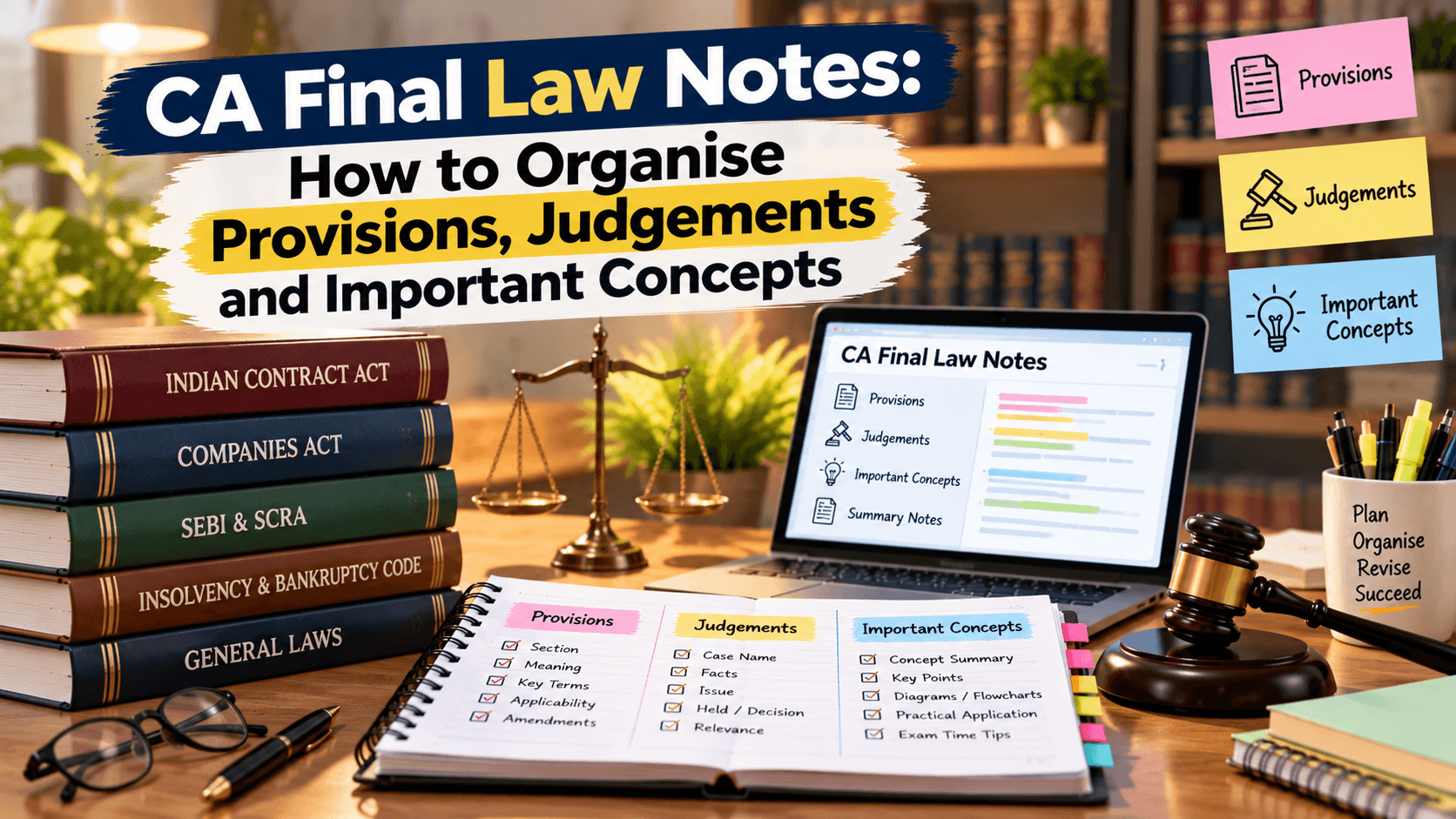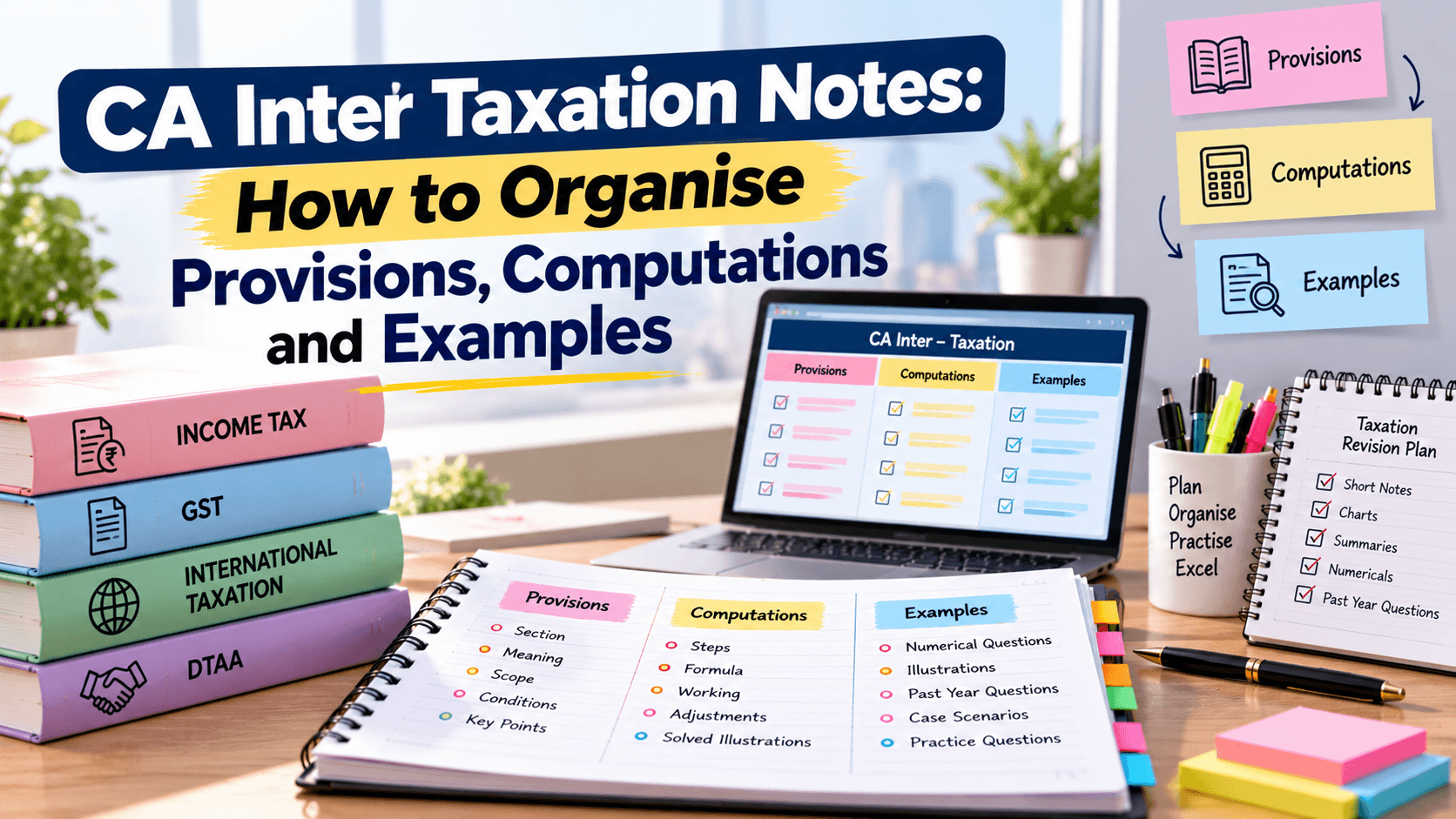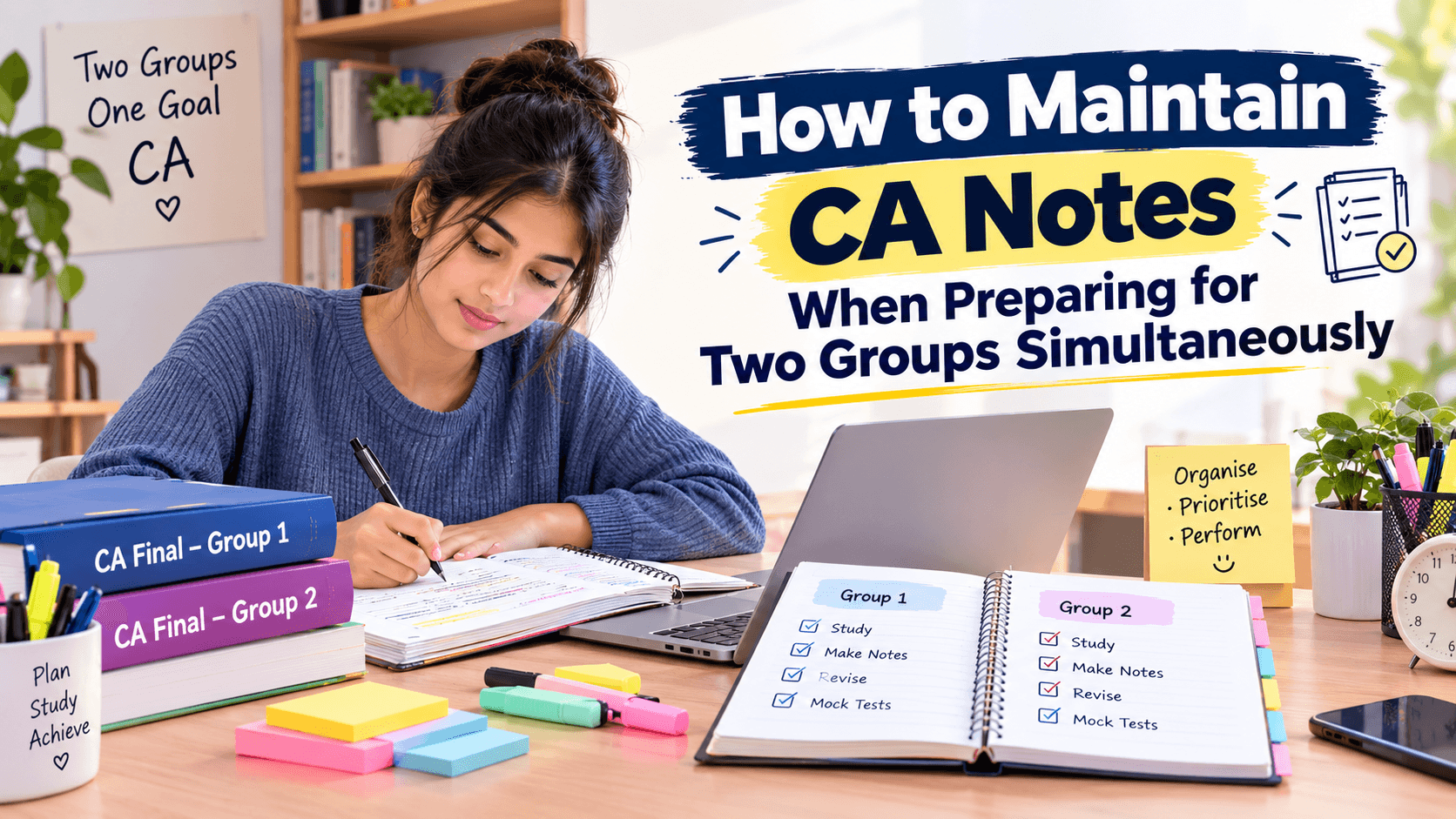
CA Final Notes: Organise Advanced Concepts Across Different Papers
Learn how to organise CA Final Notes across different papers with concept maps, cross-paper links, concise summaries, practice logs, and a structured revision system…

In this article(13 sections)ShowHide
CA Final preparation involves detailed concepts, technical provisions, practical applications, and questions that may require you to connect more than one area of knowledge. If your notes are scattered across multiple notebooks, PDFs, and loose pages, revision can become slower than it needs to be. You may remember studying a concept but struggle to locate the explanation, example, or related point when you need it.
A well-organised set of CA Final Notes should do more than summarise each chapter. It should preserve the structure of every paper while helping you identify useful links between concepts. This guide explains how to organise advanced topics, build cross-paper references where relevant, maintain concise revision material, and use practice results to keep your notes useful. Studycaller is included as a preparation brand within this broader study workflow.
Why Advanced CA Final Concepts Need a Clear Structure
At the CA Final level, a concept may involve a detailed rule, a technical calculation, an exception, or a practical judgement. A short summary can help you revise, but oversimplifying a topic may remove the conditions that make the concept accurate. Your notes need to balance brevity with enough context to support correct application.
Organisation also matters because different papers demand different kinds of preparation. Some areas require detailed technical understanding, some involve calculations and structured workings, and others depend heavily on applying principles to a scenario. A single note format for every topic may hide these differences. Instead, retain a common overall system and adapt the contents to the subject.
Cross-paper connections can be useful when a question or professional scenario requires you to draw on related knowledge. However, not every similar-looking concept is interchangeable. Keep the main explanation under its correct paper and add a cross-reference only when it helps you understand or apply the topic. This preserves clarity without creating a confusing collection of mixed notes.
Build a Paper-Wise Note System First
Start with one main folder or notebook for each paper in the syllabus applicable to your attempt. Within each paper, organise notes by module, chapter, and topic using the same naming pattern. This creates a predictable location for every concept and makes it easier to update a single section without disrupting the rest of your material.
Use a simple hierarchy: paper, chapter, topic, then supporting resources. Keep the main concept summary in one place, worked examples in a clearly labelled section, and quick revision sheets linked to the original notes. If you store everything in a single large file, use a clickable contents page and consistent headings so you can navigate quickly.
| Level | What belongs here | Example naming approach |
|---|---|---|
| Paper | All core notes for one paper | Paper name or number as per current syllabus |
| Chapter | Chapter overview and topic list | Chapter number plus chapter title |
| Concept | Detailed explanation and relevant conditions | Short, specific concept heading |
| Practice | Worked examples, question references, and errors | Question source and attempt date |
| Revision | Condensed points and cross-references | Topic name plus last-reviewed date |
Use the official syllabus and prescribed study resources for your attempt to determine the paper and chapter structure. Do not rely on an old folder system without checking whether paper names, content, or applicable requirements have changed. The organisation system should follow the syllabus rather than force the syllabus into an outdated structure.
Create a Standard Page for Every Advanced Concept
A standard concept page makes detailed material easier to review. It also reduces the temptation to copy entire paragraphs without deciding which information matters. Use the following structure as a starting point, then adapt it for the type of concept you are studying.
1. Core idea and purpose
Begin with a concise explanation of what the concept means and why it matters. Keep technical terminology accurate, but use your own wording to explain the logic. If the full definition must be retained precisely, include it separately and label it clearly.
2. Essential conditions, steps, or components
Break a long explanation into a logical sequence. For a technical rule, record the relevant conditions and exceptions. For a calculation-based method, show the order of steps and the reason for important adjustments. For a judgement-based topic, note the factors that guide the analysis.
3. Application or worked example
Add one representative example that shows how the concept works. Keep the source or question reference so you can return to the full solution. Explain the steps that are easy to forget, rather than reproducing every line without annotation.
4. Limitations and common traps
Record circumstances where the method should not be applied, common exceptions, or distinctions from similar concepts. These notes are particularly useful when two rules appear alike but lead to different outcomes. Verify technical details against the applicable prescribed material before relying on a short summary.
5. Revision prompt
Finish the page with one or two questions that test recall. For example, ask yourself to state the conditions without looking, explain why an adjustment is required, or apply the rule to a changed fact pattern. A revision prompt turns a static note into a tool for active practice.
Connect Related Concepts Across Different Papers
Cross-paper references can help you recognise links between technical areas, but they should be used selectively. Begin by identifying the main concept and the paper in which it is studied. Then ask whether another paper genuinely uses related knowledge or whether the connection is only superficial.
When a useful link exists, add a small “Related concept” box to the main note. Include the name of the other topic, its paper or chapter reference, and one sentence explaining the connection. Keep the detailed explanation in its original location so you do not end up maintaining two different versions of the same material.
| Cross-reference field | What to record |
|---|---|
| Main concept | The topic you are currently revising |
| Related topic | The concept that may be relevant in another area |
| Reason for the link | How the topics connect in a question or professional context |
| Boundary or distinction | Where the rules, methods, or assumptions differ |
| Practice reference | A question that helps you test the connection |
For example, a practical scenario may require you to interpret facts, identify a relevant technical issue, and explain the consequences using knowledge from the appropriate subject. Your notes can remind you of the sequence of analysis without suggesting that separate rules are identical. The precise connection will depend on the papers and syllabus applicable to your attempt.
Do not create cross-links simply to make the notes look advanced. A useful link should improve understanding, help with question analysis, or make revision more efficient. If you cannot explain the relationship in one or two clear sentences, study the concepts separately before linking them.
Organise Advanced Examples and Integrated Questions
Advanced concepts become clearer when you see how they operate in a full question. Keep worked examples in a separate practice section and label each one with the concept tested, the question source, and the main lesson. This makes it possible to find an example quickly without searching through every page of the chapter.
For a longer question, divide the solution into stages: facts or data to identify, relevant concept or rule, method of application, working or reasoning, and final conclusion. Annotate the points where you made a decision or selected a method. This is often more valuable than keeping only a polished final answer.
When a question appears to connect several topics, record the order in which you approached it. Note which information belonged to each topic and how the separate parts contributed to the final answer. Keep the original question reference and avoid rewriting the entire question unless it is necessary for your revision system.
After reviewing the solution, attempt a similar question without looking at your notes. If you cannot reproduce the reasoning, update the concept page or error log with the missing step. Reattempt the question after a gap to check whether you understand the method rather than simply recognising the earlier answer.
Create Concise Revision Sheets Without Losing Important Detail
Quick revision sheets should be created from your fuller notes, not used as the only place where a complicated concept is explained. Their purpose is to help you recall the structure of a topic, important conditions, formulas or steps, and common mistakes in a short period.
For each chapter, limit the sheet to the material that genuinely benefits from quick review. This may include a short concept map, a sequence of steps, a comparison of similar concepts, a formula with its conditions, or a list of personal errors. Include a reference to the full notes whenever a topic requires deeper explanation.
| Topic type | Useful revision format | What to preserve |
|---|---|---|
| Technical rule or provision | Structured summary or decision path | Essential conditions, exceptions, and terminology |
| Calculation-based method | Step sequence and formula sheet | Assumptions, adjustments, and working checks |
| Similar concepts | Comparison table | Differences that change application or outcome |
| Long practical question | Answer framework | Order of analysis and key reasoning steps |
| Repeated personal mistakes | Short error checklist | The reminder needed to prevent the same error |
Avoid compressing a complex topic until its meaning becomes unclear. If a short sheet leaves you unable to explain the conditions or apply the method, it is too brief. Use the full note to rebuild understanding, then refine the quick sheet after you have practised the topic again.
Track Updates and Source References Carefully
CA Final notes should be easy to verify. Add a source reference for technical explanations, examples, and important updates. You do not need to cite every sentence in a personal notebook, but you should be able to locate the relevant prescribed material when a detail needs checking.
Keep a small update log with the topic, what changed or was corrected, the source checked, and the date. If the applicable syllabus or guidance is revised, update the original concept page and any quick-reference sheet that depends on it. Otherwise, two versions of the same concept can remain in circulation and cause confusion during revision.
Mark uncertain points as questions rather than silently treating them as facts. Resolve them using the current prescribed resources or an appropriate academic source, then update the note. This is especially important when a topic includes conditions, exceptions, or technical wording that should not be paraphrased carelessly.
Use an Error Log to Improve Your Notes
Practice results show which parts of your notes need improvement. After a mock test or question practice session, classify mistakes rather than simply recording the score. Common categories include misunderstanding the concept, missing a condition, choosing the wrong method, incomplete reasoning, calculation error, poor presentation, or time pressure.
| Problem noticed | What to add to your notes | Next practice step |
|---|---|---|
| Forgot a key condition | A clear reminder beside the main rule | Recall the conditions without looking |
| Confused similar concepts | A comparison table showing the distinction | Attempt one question on each concept |
| Selected the wrong method | A short note on when each method applies | Identify the method before solving a new question |
| Incomplete answer | An answer structure or missing-step checklist | Rewrite the answer under timed conditions |
| Repeated calculation error | A working check or calculation reminder | Re-solve the question and verify each step |
Review your error log every week and move recurring reminders into the relevant concept page or quick-reference sheet. Keep the detailed history in the log, but place the most useful reminder near the concept where you are likely to need it. This connects your revision material with actual performance.
Choose a Digital or Paper-Based Organisation System
Paper notebooks can be useful if you prefer writing diagrams, workings, or annotations by hand. Digital notes are easier to search, rearrange, link, and update. A hybrid approach can also work, provided you decide which version is the main source and avoid maintaining several conflicting copies.
For paper notes, use clear chapter dividers, page numbers, and an index. Leave space for corrections and cross-references. For digital notes, use consistent file names, clickable headings, and folders arranged by paper and chapter. Keep backups of important files and store question references alongside the relevant notes.
Do not spend hours transferring every existing note into a new app or notebook. Start with the subjects or chapters you are currently revising and apply the system going forward. The best system is the one that makes it faster to find a concept and act on it, not the one with the most elaborate design.
Plan Revision Around Your Notes
Set a regular review cycle that combines recall, question practice, and error correction. After completing a topic, explain the concept without looking at the notes. Then attempt a relevant question and compare your approach with a reliable solution. If you cannot apply the concept, return to the full note and identify the missing step.
Use a tracker to record the last review date, practice result, and next action. Topics that repeatedly cause errors should be reviewed sooner; topics you can apply consistently may need only periodic checks. Avoid marking a chapter complete simply because you have read or rewritten the notes.
| Review stage | Action | Evidence of progress |
|---|---|---|
| Understand | Read the full explanation and annotate key conditions | You can explain the concept in your own words |
| Recall | Recreate the structure without notes | You remember the key steps and limitations |
| Apply | Solve a fresh question | You choose and apply the appropriate method |
| Correct | Update the error log and reattempt weak questions | The same mistake occurs less often |
| Maintain | Use a short revision sheet at planned intervals | You can retrieve the important points quickly |
Keep your schedule realistic. It is better to maintain a small number of reliable revision sheets and revisit them regularly than to create dozens of summaries that never get tested. Leave time for solving questions, because advanced understanding develops through application as well as reading.
Common Mistakes When Organising CA Final Notes
Mixing all papers into one file: This can make it hard to locate the main explanation. Keep paper-wise notes and use cross-references for genuine connections.
Over-summarising technical concepts: Short notes are useful, but removing essential conditions or exceptions can make them misleading. Preserve important details and link to the full explanation.
Copying solutions without understanding them: A copied answer may look complete while leaving you unable to reproduce the reasoning. Annotate the method and practise independently.
Creating too many duplicate notes: Multiple versions can become inconsistent. Keep one main concept page and use concise revision sheets that refer back to it.
Ignoring updates: Check notes against the applicable syllabus and current prescribed resources. Record corrections and update any quick-reference sheets affected by them.
Using organisation as a substitute for practice: Neat folders do not prove readiness. Test recall, solve fresh questions, and use mistakes to decide what to revise next.
How Studycaller Fits Into CA Final Preparation
Studycaller can be part of your broader preparation workflow as you organise notes, revision tasks, and supplementary study resources. Before relying on any additional material, check whether it matches the syllabus and attempt you are preparing for and whether it fills a specific gap in your learning.
Use supplementary resources with a clear purpose: clarifying a difficult concept, practising a question type, or improving your revision routine. Avoid collecting multiple overlapping PDFs simply because they are available. A smaller, well-maintained set of notes supported by regular question practice is easier to update and use.
Your notes should reflect the way you learn from practice. Keep the main explanation accurate, make cross-paper links only when useful, preserve examples that clarify difficult steps, and use an error log to guide your next revision session. This makes organisation a practical part of preparation rather than a separate project.
Conclusion
Organising CA Final Notes across different papers requires a clear paper-wise structure, consistent concept pages, carefully chosen cross-references, and concise revision sheets. Keep detailed explanations in their proper locations, link related concepts only when the connection is meaningful, and use practice results to identify what needs improvement.
Start with one difficult chapter and organise its core idea, conditions, example, common traps, and revision prompt. Then test your notes by solving a fresh question without help. With regular review and accurate source references, your notes can become a reliable tool for revising advanced concepts across the CA Final syllabus.
CA Final notes students love
Free notes from the Studycaller library, picked for this article.
Summary Notes · CA Final Others
Ca Subham singhal spom( Set A )notes
Nikita Agrawal 40 32.4k
Detailed Notes · CA Final Integrated Business Solutions
Shubham Singhal Law Book SPOM
Rahul 32 19.6k
Summary Notes · CA Final Others
SPOM set A Law Notes
A Lal 16 17.2k
MCQs · CA Final Others
MCQ for set c (Arbitration and conciliation act)
Nikita Agrawal 12 23.9k
Frequently asked questions
1. How should I organise CA Final Notes across different papers?
Create a separate main section for each paper, then organise material by chapter and concept. Keep detailed explanations in their original locations and add concise cross-references where related topics genuinely support understanding or question application.
2. Should I combine related concepts from different CA Final papers?
Keep each concept under its main paper and use cross-references to show useful connections. This preserves the correct context and avoids duplicating explanations or confusing rules that may look similar but have different applications.
3. What should a CA Final concept note include?
Include the core idea, important conditions or steps, a representative example, common traps, source references, and a revision prompt. Adapt the format to the topic so that technical rules, calculations, and application-based concepts remain clear.
4. How can I make short notes for advanced CA Final topics?
Create short summaries from your full notes after understanding and practising the concept. Preserve key conditions, exceptions, formulas, and reasoning steps. Link to the detailed explanation whenever a topic cannot be safely reduced to a few lines.
5. How do cross-paper references help during revision?
They help you locate related knowledge when a scenario requires more than one area of understanding. A useful reference names the related topic, explains the connection briefly, and highlights important differences rather than merging separate rules.
6. Should I keep worked examples separately from theory notes?
Keep examples in a clearly labelled practice section linked to the relevant concept. This makes it easier to find solutions, compare methods, and attempt questions independently while keeping the main explanation concise and easy to revise.
7. How can an error log improve CA Final revision?
An error log identifies repeated gaps such as forgotten conditions, incorrect method selection, incomplete reasoning, or calculation mistakes. Use it to update your notes with targeted reminders and schedule fresh attempts rather than simply rereading the solution.
8. Are digital notes better for organising advanced concepts?
Digital notes are easy to search and link, while paper notes can suit handwritten workings and annotations. Either can work well if you use consistent labels, maintain one main version, and can retrieve the right concept quickly.
9. How often should I update CA Final Notes?
Review notes when you encounter a correction, complete practice questions, or verify a relevant update. Check technical content against the prescribed resources applicable to your attempt and update linked revision sheets whenever the main concept changes.
10. Can Studycaller be used alongside my CA Final notes?
Studycaller can be included in your preparation workflow when its resources suit your needs. Use supplementary material to address a specific learning or practice gap while keeping prescribed study resources and the applicable syllabus as your main reference.