






The CA Intermediate Advanced Accounting paper is a crucial subject in the CA Intermediate course. This paper aims to build strong accounting knowledge and practical problem-solving skills. To excel in this subject, understanding the marks weightage of different topics can help students prioritize their preparation.
This guide provides a detailed breakdown of the CA Intermediate Advanced Accounting marks weightage notes for various topics, study tips, and frequently asked questions (FAQs) to help students perform well in the exam.
Marks Weightage for CA Intermediate Advanced Accounting
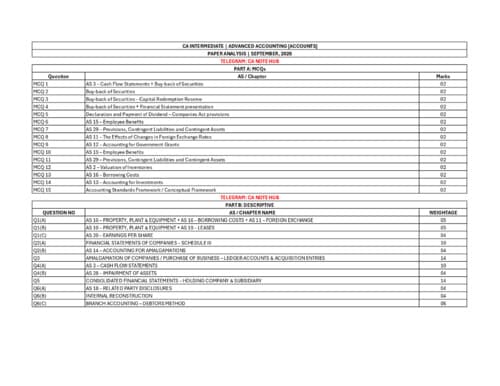
The Institute of Chartered Accountants of India (ICAI) designs the syllabus for Advanced Accounting, ensuring that students gain a deep understanding of financial reporting and accounting standards. Below is a table showing the approximate weightage of different topics based on past trends:
CA Intermediate Advanced Accounting Marks Weightage Table
| Chapter/Topics | Weightage % | Approx Marks |
| Accounting Standards (AS) | 20% - 25% | 16 - 20 marks |
| Partnership Accounts | 15% - 20% | 12 - 16 marks |
| Company Accounts | 25% - 30% | 20 - 24 marks |
| Consolidated Financial Statements | 10% - 15% | 8 - 12 marks |
| Amalgamation & Corporate Restructuring | 15% - 20% | 12 - 16 marks |
| Financial Statement Interpretation | 5% - 10% | 12 - 16 marks |
| Other Miscellaneous Topics | 5% - 10% | 4 - 8 marks |
Detailed Topic-Wise Breakdown
1. Accounting Standards (AS) – 20% to 25% (16-20 Marks)
-
Covers major AS applicable to CA Intermediate.
-
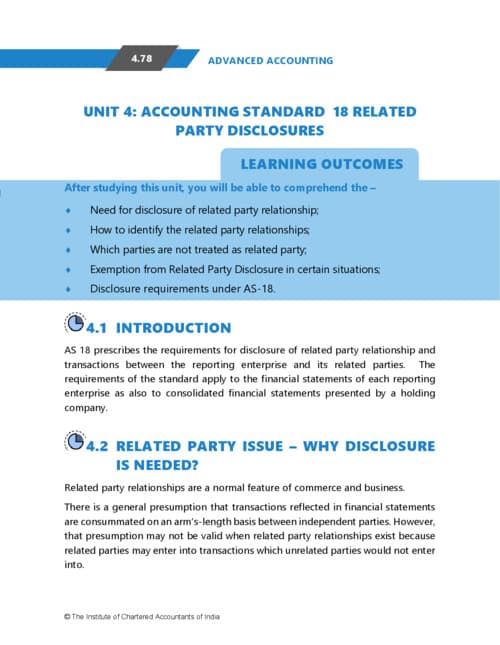
Important standards include AS 4, AS 5, AS 11, AS 12, AS 16, AS 19, AS 26, AS 29.
-
Focus on practical application and case-based questions.
2. Partnership Accounts – 15% to 20% (12-16 Marks)
-
Covers reconstitution, admission, retirement, dissolution, and amalgamation of firms.
-
Questions are often lengthy but scoring.
-
Special attention to piecemeal distribution of cash.
3. Company Accounts – 25% to 30% (20-24 Marks)
-
Includes accounting for shares, debentures, buyback, ESOP, and underwriting of shares.
-
Issue and redemption of shares/debentures are key areas.
-
Prepare journal entries and financial statements thoroughly.
4. Consolidated Financial Statements – 10% to 15% (8-12 Marks)
-
Includes holding and subsidiary company accounts.
-
Focus on Goodwill, Minority Interest, and Consolidation Adjustments.
-
Practice is essential for numerical accuracy.
5. Amalgamation & Corporate Restructuring – 15% to 20% (12-16 Marks)
-
Covers mergers, acquisitions, and internal reconstruction.
-
Purchase method and pooling of interest method are important.
-
Prepare case-based questions for better understanding.
6. Financial Statement Interpretation – 5% to 10% (4-8 Marks)
-
Includes Ratios, Comparative & Common Size Statements, and Cash Flow statements.
-
Questions are application-based and conceptual.
7. Other Miscellaneous Topics: 5% to 10% (4-8 Marks)
-
Covers ESOP, buyback of shares, valuation of goodwill & shares.
-
These topics are minor but can fetch easy marks.
Study Tips for CA Intermediate Advanced Accounting
-
Focus on Accounting Standards: AS holds significant weightage and is scoring if concepts are clear.
-
Solve Past Papers: Practicing RTPs, MTPs, and past ICAI papers improves problem-solving speed.
-
Understand Concepts Deeply: Instead of memorizing, focus on why an entry is made.
-
Time Management: Allocate time wisely during the exam—don't spend too much time on a single question.
-
Use ICAI Study Material: ICAI’s modules and practice manuals are crucial for exam preparation.
Conclusion
Intermediate Advanced Accounting is a high-scoring subject if prepared strategically. Understanding the marks weightage of each topic helps prioritize preparation and maximize scores. By focusing on accounting standards, company accounts, and consolidation, along with regular practice and conceptual clarity, students can improve their chances of success.
Stay consistent, practice daily, and make use of ICAI resources for a well-rounded preparation.