PDF · Detailed Notes
Quantitative Aptitude Formulas and Shortcuts: All Formula Sheet for CA Foundation Maths
- Shared by
- Deepak
- Course
- CA Foundation
- Subject
- Quantitative Aptitude
- Added
- 21 Apr 2024
Continue reading in the Studycaller app
The full PDF — free to read, save and share in the app.
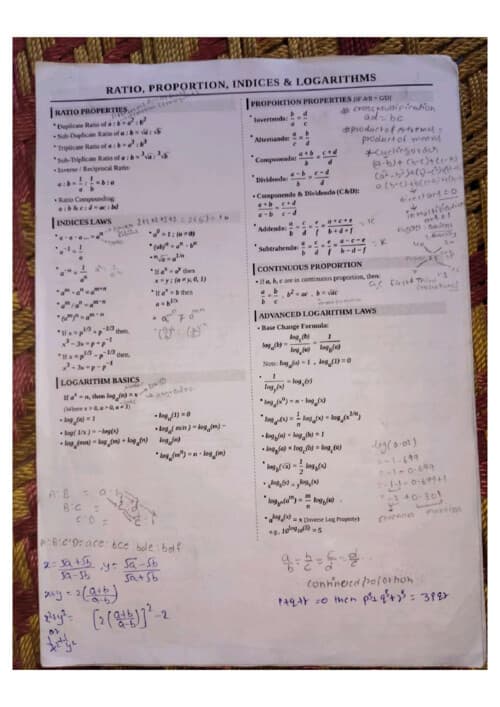
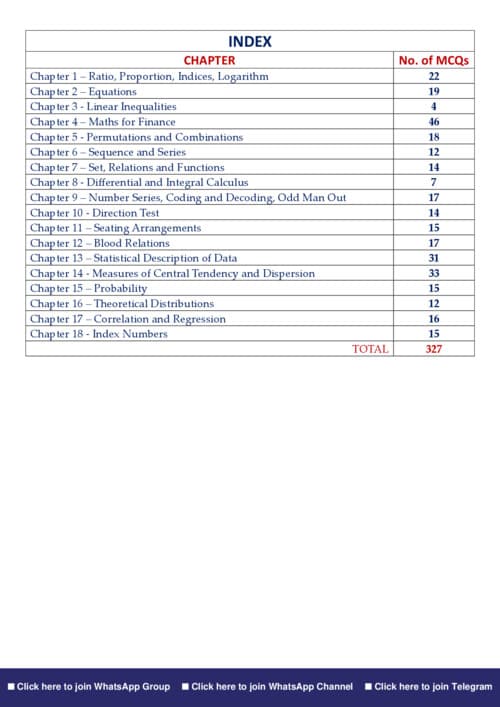
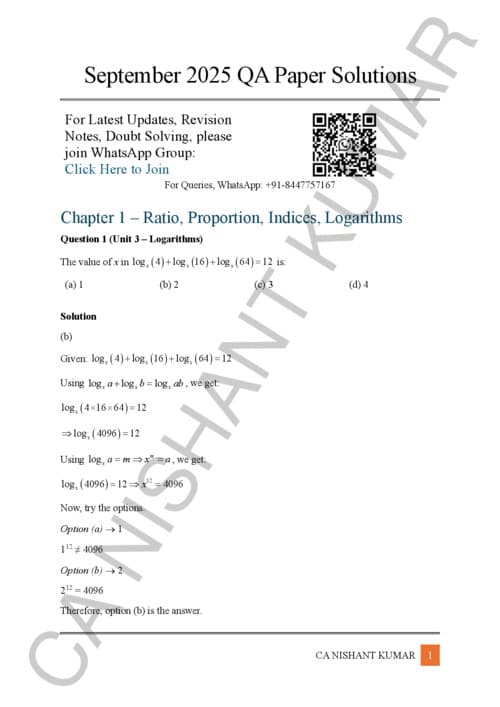
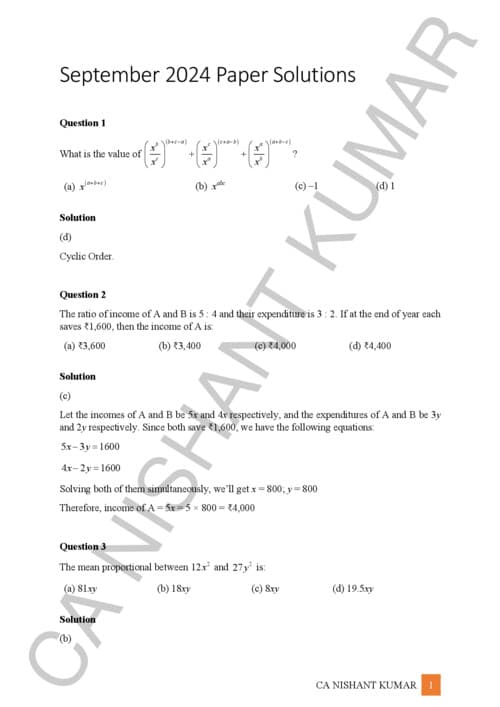
This handwritten sheet collects quantitative aptitude formulas for CA Foundation maths, with key results highlighted for fast reading. The pages shown begin with Chapter 1 on ratio, proportion, logarithms and indices. They list fourth, third and mean proportion, the properties from invertendo to subtrahendo, laws of indices and over fifteen log rules. A page of calculator tricks follows, showing how to find logs and cube-root type answers using repeated keys. Chapter 7 then covers sets, relations and functions, along with basic algebraic identities and sums of natural numbers. Chapter 14 starts with measures of central tendency, including the direct, short-cut and step deviation methods for the arithmetic mean. It suits CA Foundation students who want aptitude formulas on a few pages for last-week revision. It is also useful for practising MCQs, where speed with formulas and the calculator matters.
Quantitative Aptitude Formulas Covered in This Sheet
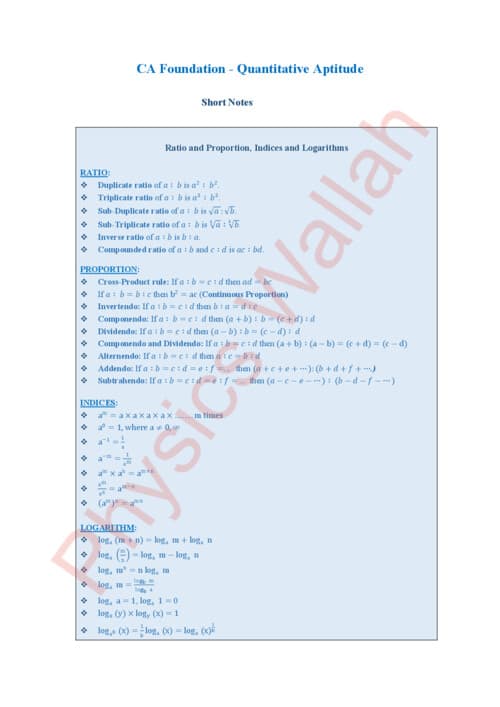
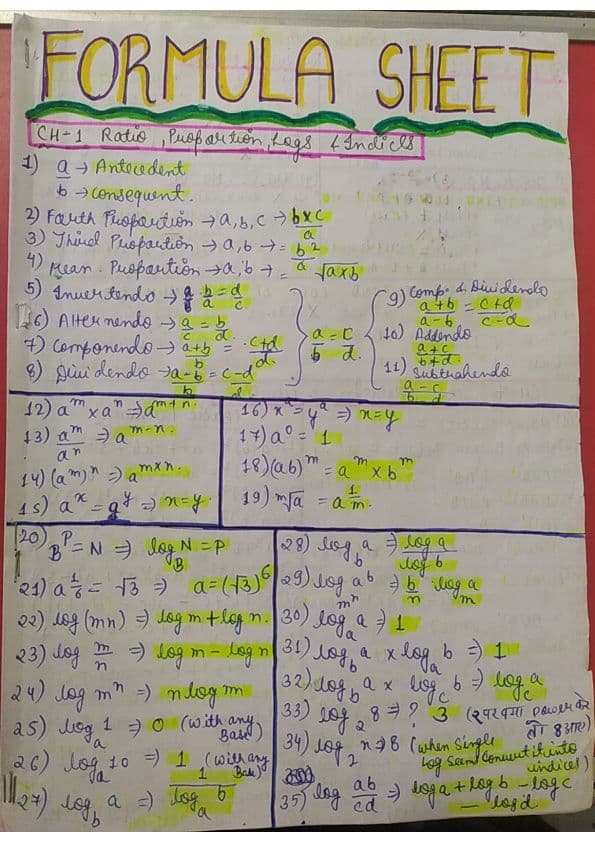
The first page deals with ratio, proportion, logs and indices. It defines antecedent and consequent. It gives the fourth proportional (b×c/a), the third proportional (b²/a) and the mean proportional (√ab). For a/b = c/d it lists invertendo, alternendo, componendo, dividendo, componendo-dividendo, addendo and subtrahendo. The laws of indices run from a^m × a^n = a^(m+n) to the m-th root as a^(1/m). The log section moves from B^P = N meaning log base B of N = P to the product, quotient and power rules and the change of base. It also covers log_b a × log_a b = 1 and the chain rule log_b a × log_c b = log_c a. The sets page covers the number of subsets (2^n) and proper subsets (2^n − 1), De Morgan's laws, and n(A∪B) for two and three sets. It also lists the power set, the Cartesian product, symmetric difference and the types of relations. Standard identities such as (a+b)³ and a³+b³+c³−3abc appear, along with the sum of n natural numbers, their squares and their cubes. The chapter numbers shown are Ch-1, Ch-7 and Ch-14, so the sheet seems to be arranged by chapter. Only the first 3 of 16 pages are previewed here.
Key Points to Remember for the Exam
Several notes on the sheet flag common MCQ traps. Every equal set is an equivalent set, but an equivalent set need not be equal. Every set is a subset of itself, and the empty set is a subset of every set. Every universal relation is reflexive. An identity relation is reflexive, but the converse is not true. A relation is an equivalence relation only when it is reflexive, symmetric and transitive. The sheet gives 'is equal to' and 'is parallel to' as examples. In logs, remember that log of 1 is 0 in any base and log_a a is 1. Also, log(ab/cd) splits into log a + log b − log c − log d. The sheet suggests converting a single log into index form when it looks difficult, as with log_2 8 = 3. For the mean, keep the three methods separate. The direct method uses Σfx/Σf. The short-cut method adds Σfu/Σf to the assumed mean A. The step deviation method multiplies by the class width h. The calculator tricks, such as the log 512 to base 2√2 and log 100 to base 0.1 examples, are worth practising until they become quick.
How to Revise with These Formula Notes
First, study each chapter from the ICAI study material so that you understand where each formula comes from. Then use this sheet as a one-glance recall tool. Cover the highlighted answers and try to write each result from memory, for example the proportion properties or n(A∪B∪C). Next, solve RTP and MTP questions on ratio, logs, sets and central tendency with the sheet beside you. Mark any formula you had to look up. Try the calculator tricks on past paper MCQs to check that they give the right answer in your own calculator. Where a trick fails, the sheet notes that a second division-based method can be used. In the final week, read the whole sheet once a day and attempt a timed set of past questions. This builds the speed that the objective paper needs.
Who Should Use This Aptitude Formulas Sheet
The sheet is written for CA Foundation students taking the Quantitative Aptitude paper. It is especially useful for those who find it hard to keep track of the many small results in ratio, logarithms, indices and sets. It suits students who have already studied the chapters once and now need a compact revision aid before the exam. It also helps those who want to learn calculator shortcuts for log and root questions. Commerce students preparing for other aptitude tests that include ratio, logs, sets or averages may find the algebra and log sections helpful. However, the sheet does not cover logical reasoning topics in the preview pages. No attempt or syllabus year is mentioned, so check the topics against your current ICAI syllabus. The full 16-page note can be opened in the Studycaller app.
Key topics in these notes
- Ratio and proportion properties
- Fourth third and mean proportion
- Invertendo alternendo componendo and dividendo
- Laws of indices
- Logarithm rules and change of base
- Calculator tricks for logs
- Sets subsets and power set
- De Morgan's laws and n(A∪B∪C)
- Types of relations and composite function
- Algebraic identities and sum of natural numbers
- Arithmetic mean: direct short-cut and step deviation methods
Explore more Quantitative Aptitude notes
- quantitative aptitude
- ca foundation
- formula sheet
- logarithms
- ratio and proportion
- sets and relations
- central tendency
- calculator tricks
Related notes
- Ca foundation QUANTITATIVE APTITUDE september 2025 formula sheet ⚡✨
- Quantitative aptitude All chapter formula Sheet
- Quantitative Aptitude Short note with all formulas, theory cover and calculator tricks by PW Anurag sir
- Formula sheet - quantitative aptitude
- Quantitative aptitude All chapter formula sheet by shivani mam✨
- RATIO , PROPORTION , INDICES AND LOGARITHM IMPORTANT QUESTIONS PRACTICE BY ANURAG CHAUHAN SIR!!
- Ratio , proportion, indices, logarithm handwritten notes
- Quantitative Aptitude All formulas chart
Comments from students
Harini Balasubramanian · 3 Apr 2025
Accountancy question bank
Frequently asked questions
What does this quantitative aptitude formula sheet cover?
The preview pages cover ratio, proportion, logs and indices, calculator tricks, sets, relations and functions, basic algebraic identities, and the start of measures of central tendency.
Is this formula sheet meant for CA Foundation?
Yes. It is listed under CA Foundation Quantitative Aptitude, and its chapters follow the topics of that paper.
Does it include calculator shortcuts for logarithms?
Yes. One page shows calculator tricks, including log 512 to base 2√2, log 343 to base 7, log 100 to base 0.1, and a key sequence to find the log of any number.
Which formulas for the arithmetic mean are given?
The sheet gives the simple mean, the direct method Σfx/Σf, the short-cut method using an assumed mean, and the step deviation method using class width h.
Does it include reasoning formulas?
The first three pages shown cover maths topics only, not logical reasoning. The remaining pages of the 16-page note are not previewed here.
What set theory formulas are included?
The sheet lists 2^n subsets and 2^n − 1 proper subsets, De Morgan's laws, n(A∪B) and n(A∪B∪C), n(A−B), symmetric difference, the power set and the Cartesian product.
How can I get the full quantitative aptitude formulas PDF?
Open it free in the Studycaller app to read all 16 pages.