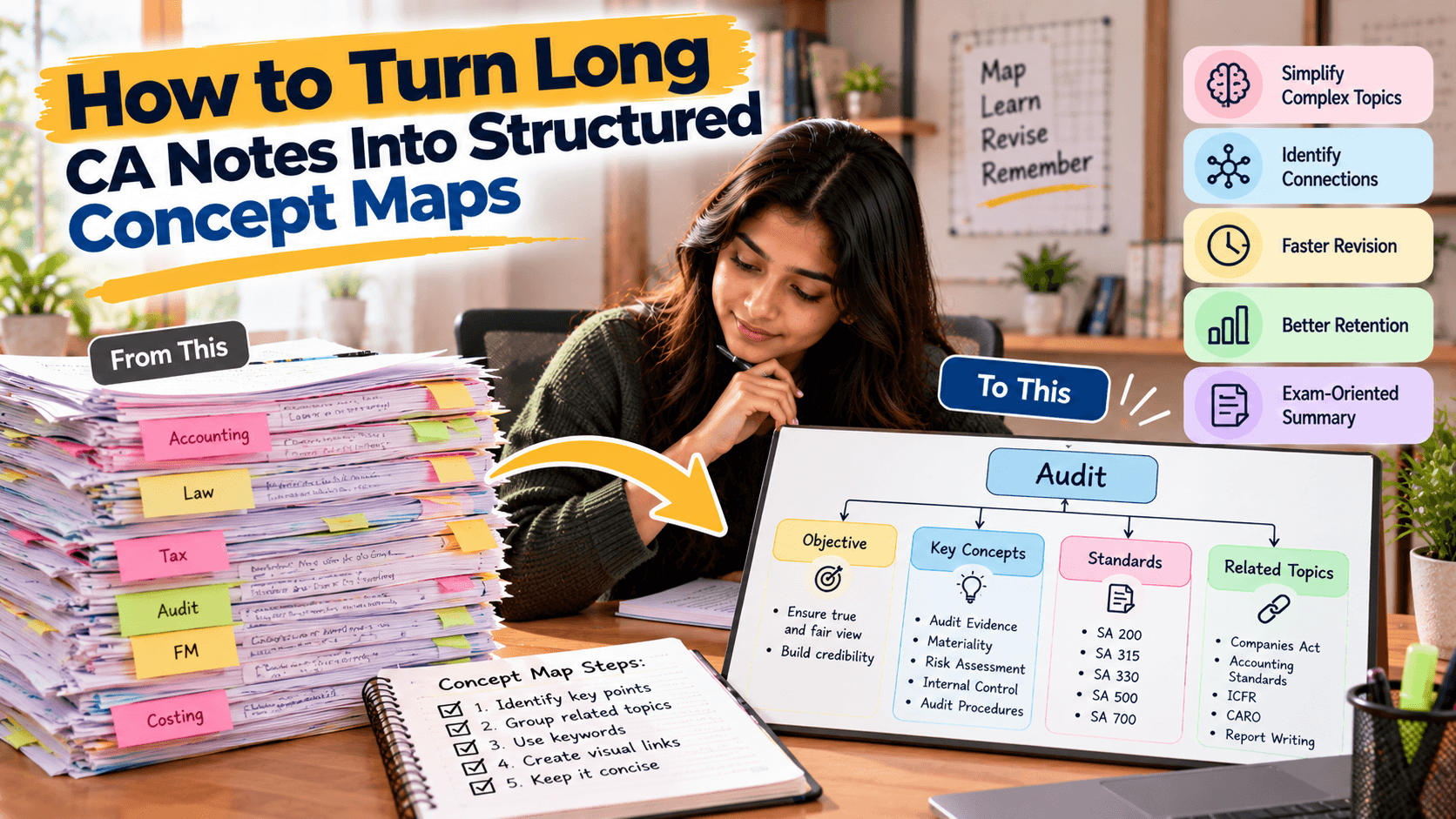
How to Turn Long CA Notes Into Structured Concept Maps
Learn how to convert long CA notes into structured concept maps, identify key ideas, show topic relationships, and revise complex chapters more effectively with…
In this article(15 sections)ShowHide
Good CA notes should make difficult topics easier to understand and revise, not create more work every time you study. how to Turn Long CA Notes Into Structured Concept Maps is a practical part of building a dependable study system, especially when classes, self-study, and exam practice all generate material that needs to stay organised.
This guide explains a clear approach that students can adapt to their subject, CA level, and preparation stage. Studycaller is included as part of an exam-focused routine, while syllabus-specific requirements and amendments should always be checked against the relevant official material.
Why concept maps can make long notes manageable
Long CA notes can be useful for detailed learning, but they are not always the easiest material to revise quickly. Several pages may explain one central idea through definitions, conditions, exceptions, examples, and applications. A concept map gives those details a visible structure by showing the main idea and how the supporting ideas relate to it.
A concept map is not simply a colourful summary. Its value comes from the relationships between concepts. It can show which idea is a prerequisite, which condition changes an outcome, how a process moves from one step to another, or where two topics should be compared. Use it alongside detailed notes, not as a replacement for the full explanation when that detail is needed.
Read the chapter before drawing
Start with one chapter or a manageable section. Read the material once to understand its overall purpose, then identify the headings, definitions, rules, steps, exceptions, and examples. Avoid drawing the map while you are still trying to understand every sentence. Otherwise, the page can become a collection of disconnected keywords that looks organised but does not reflect the subject accurately.
After the first read, write a one-sentence answer to the question: “What is this chapter mainly explaining?” That sentence can become the central concept or the main branch. Then list the few supporting ideas needed to explain it. If you cannot describe the chapter in simple language, revisit the source before compressing it. Mapping works best after basic understanding has begun.
A simple structure for a concept map
| Map element | What it contains | Example prompt |
|---|---|---|
| Central concept | Main topic | What is this chapter about? |
| Main branch | Major idea or category | What are the key components? |
| Link phrase | Relationship between concepts | Depends on / qualifies / leads to |
| Source pointer | Location of full details | Which page explains the exception? |
Choose the central concept and main branches
Place the central concept at the top or centre of the page. Add main branches for the major components of the topic, such as meaning, conditions, procedure, exceptions, and application. The exact structure depends on the chapter. A process-heavy topic may work better as a flow, while a topic with related categories may be clearer as a branching map.
Keep the number of main branches manageable. If every detail becomes a main branch, the hierarchy disappears. Group related ideas under a shared heading and use sub-branches for supporting points. You should be able to scan the map and understand the chapter’s structure without reading every label. If the page becomes crowded, split it into two connected maps rather than shrinking the text.
Write linking words, not only keywords
Keywords are useful memory triggers, but they do not always show how concepts relate. Add linking phrases such as “requires,” “depends on,” “is an exception to,” “leads to,” or “is compared with.” These words turn a set of labels into meaningful statements. A line between two boxes should communicate a relationship that you can explain in a question or discussion.
Check each connection by reading it aloud as a sentence. If the relationship sounds unclear or incorrect, revise the labels or the arrow. This is especially important for rules with conditions and exceptions. A map should not simplify the material so much that it changes the meaning. Keep a reference to the detailed notes whenever the full wording is important.
Separate rules, steps, exceptions, and examples
Different types of information need different positions in the map. A definition may sit near the central concept, a sequence of steps can run in order, and an exception can branch from the rule it qualifies. Examples should support a concept rather than overwhelm the map. Use one short example or a question reference if it illustrates the relationship particularly well.
Do not try to fit a complete worked solution into a concept map. Detailed calculations, long legal wording, and extensive explanations belong in the main notes or practice file. The map should help you decide where to look and recall the structure of the method. If a short note is insufficient to prevent a common mistake, include a clear pointer to the full explanation.
Use a consistent visual hierarchy
Choose a simple visual system that you can repeat across chapters. For example, main concepts may use larger boxes, supporting details smaller boxes, and exceptions a distinct outline. Arrows should indicate direction or relationship consistently. Use colour only when it carries meaning, such as separating definitions from procedures. Too many colours, icons, and decorative shapes can make the map harder to read.
Make sure the map remains understandable in black and white or when printed. Keep labels short but specific, leave enough space between branches, and avoid crossing lines wherever possible. If you create maps digitally, use a readable font and a format that can be opened on your usual devices. A plain, clear map that you revisit is more valuable than an elaborate map that takes too long to maintain.
Turn paragraphs into questions and prompts
One effective way to reduce long notes is to convert paragraph headings into questions. A branch might ask “When does this rule apply?” with smaller branches for conditions and exceptions. Another might ask “What steps are used to solve this question?” followed by the sequence. Questions make the map useful for active recall because you can cover the labels and try to answer from memory.
After drawing the map, test it without looking at the original chapter. Explain each branch aloud or reconstruct the main structure on a blank page. Then compare your answer with the detailed notes and correct omissions. If you can only understand the map while reading the original material, it is not yet a strong revision aid. Improve the labels until they trigger the idea without hiding important detail.
Keep the map accurate and connected to source notes
Every map should point back to the detailed notes it summarises. Add chapter, section, or page references for definitions, lengthy examples, and complicated exceptions. This prevents you from relying on an abbreviated label when you need the full rule. It also makes it easy to verify the map after a correction or syllabus-related update.
Do not treat the map as an independent authority. If the source notes change, review the map and update any affected branches. Mark uncertain points as questions until they are verified. For CA preparation, accuracy matters more than visual simplicity. A concept map is successful when it preserves the important relationships while making the chapter easier to navigate and recall.
Build maps from mistakes and difficult topics
Not every chapter needs a concept map. Use them where the material is dense, where several rules interact, or where you repeatedly forget the structure. A mock-test mistake can tell you what kind of map would help. If you confuse conditions, map the decision points. If you forget a process, map the sequence. If you mix up similar concepts, create a comparison map.
Make the map respond to a specific learning problem. After a test, identify the point at which your reasoning went wrong and add a branch that clarifies it. Then practise a similar question to see whether the map helps. This keeps the activity practical and prevents concept mapping from becoming a time-consuming substitute for question practice.
Use concept maps for spaced revision
Revisit the map after the initial study session, then again after a few days and during later revision cycles. Each time, try to recreate the structure before looking at the original. The exact intervals can fit your timetable; the important part is returning to the concepts instead of viewing the map once and assuming the information will remain available.
Use the map as a starting point for mixed practice. Select a branch, explain the rule, and attempt a question that applies it. If you cannot recall the supporting detail, return to the source notes. This combination of retrieval and application helps you judge whether the map is doing its job. Update only the parts that remain unclear or inaccurate.
How Studycaller can fit into concept-map revision
Practice tests can show which chapters are difficult to recall and which relationships break down when questions combine multiple concepts. Use the result to decide whether a map, comparison chart, or process flow would address the problem. After creating the map, test it with another set of questions rather than judging it only by appearance.
Studycaller can be part of a preparation cycle that includes focused practice, review of errors, and targeted revision. Keep the concept map connected to the detailed notes and applicable study material. The goal is to make complex topics easier to understand and retrieve while preserving the detail needed for accurate answers.
Keep the map practical rather than decorative
Once the map is drafted, remove anything that does not help explain a concept or its relationship to another idea. Decorative icons, repeated labels, and long copied sentences can make the page crowded. Check whether a student who understands the chapter could use the map to reconstruct its structure. If not, improve the hierarchy and linking phrases rather than adding more colour or shapes.
Use the map as a companion to practice, not as a replacement for it. Choose a branch, explain the relationship, and answer a relevant question without looking at the source. If the map does not help, identify whether the problem is a missing concept, an unclear connection, or insufficient understanding of the underlying rule. Revise only the part that addresses that problem and then test it again.
Check the map against a question, not just the chapter
A map can look accurate while still leaving out the decision that matters in an exam question. To check it, choose a question that uses the topic and trace the reasoning through the map. Can you identify the relevant condition, select the correct rule, follow the necessary steps, and locate any exception? If a decision point is missing, add it in a concise form and refer to the detailed notes.
Repeat this check with a different question if the chapter has several applications. The goal is not to place every possible question on the map, but to ensure that its structure supports the kind of reasoning the topic requires. When the map helps you explain why a method applies, rather than merely name the method, it is doing useful revision work.
Conclusion
Concept maps can make long CA notes easier to navigate when they show the relationships between ideas rather than merely shortening paragraphs. Keep maps accurate, connect them to detailed source notes, and use them for active recall followed by question practice.
Notes students love
Free notes from the Studycaller library, picked for this article.
Amendment Notes · CA Foundation Business Economics
Full economics handwritten notes by CA Parag Gupta sir
Heet Hingrajiya 209 68.6k
Detailed Notes · CA Foundation Business Economics
"Hi guys! Maine kuch naya try kiya Economics me — ek alag andaaz, ek alag soch... Chapter 1: Nature & Scope of Business Economics – Unit 1 I
مُحَمَّد 126 14.7k
Chart Book · CA Foundation Business Laws
Chpter 3 the sale of goods act Unit. 1 only. Full of story line Concept clarity and funny stories punch lines
مُحَمَّد 118 14.2k
Amendment Notes · CA Foundation Business Laws
Nia 1881 story line pdf Coverage total 11 Concept
مُحَمَّد 117 12.5k
Frequently asked questions
What is a concept map for CA studies?
A concept map is a visual arrangement of a main idea and its supporting concepts, with labelled links showing how the ideas relate to each other.
Should concept maps replace detailed CA notes?
No. Use maps for structure and recall, while keeping detailed explanations, full rules, and worked calculations in the original notes.
How do I start a concept map?
Read a manageable section, identify its central idea, list the major branches, and add supporting concepts only after you understand the chapter’s overall structure.
How many branches should a map have?
There is no fixed number. Keep the main branches limited enough to show a clear hierarchy, and split a crowded map into connected parts.
Why should I use linking words?
Linking words explain whether one concept depends on, qualifies, leads to, or differs from another. They make the map more meaningful than a collection of keywords.
Can I make concept maps by hand?
Yes. Paper and pen are sufficient. Use a consistent visual hierarchy, readable labels, clear arrows, and enough space to follow each relationship.
How can concept maps help with revision?
Cover the map and reconstruct its main branches from memory, explain the links aloud, and then solve questions that apply the concepts.
When should I create a concept map?
Use maps for dense chapters, connected rules, multi-step processes, or topics where you repeatedly forget the structure. Not every chapter needs one.
How should I update a concept map?
Check it against the detailed source whenever a rule or explanation changes. Update affected branches and retain references to the full notes.
How can Studycaller support concept-map practice?
Use test results to find difficult topics, map the relationships causing confusion, and then attempt similar questions to check whether the map improves recall.