How to Organise Important Legal Provisions in CA Notes for Faster Retrieval
Organise legal provisions in CA notes with topic headings, rule-condition-exception layouts, comparison tables and recall prompts for faster, clearer revision.
In this article(11 sections)ShowHide
Legal subjects can feel difficult to revise when provisions, conditions, exceptions and consequences are scattered across pages of notes. Re-reading the same chapter may take time without making it easier to retrieve the correct rule during a question.
A clear organisation system helps you find and understand provisions faster. Instead of collecting section numbers alone, arrange each provision around its meaning, conditions, exceptions and application. Keep technical wording accurate while making the structure easy to scan.
Why Legal Notes Need a Retrieval System
Legal revision requires more than remembering a section number. You may need to state the rule, identify conditions, explain an exception or apply the provision to facts. If these elements are separated in your notes, it becomes harder to produce a complete answer under time pressure.
Organised notes reduce the effort required to find related information. They also make gaps visible: if you have recorded a rule but not its conditions or exceptions, you can see what needs checking. The objective is not to shorten every provision but to make its structure easy to understand and recall.
Arrange Notes by Act, Chapter and Topic
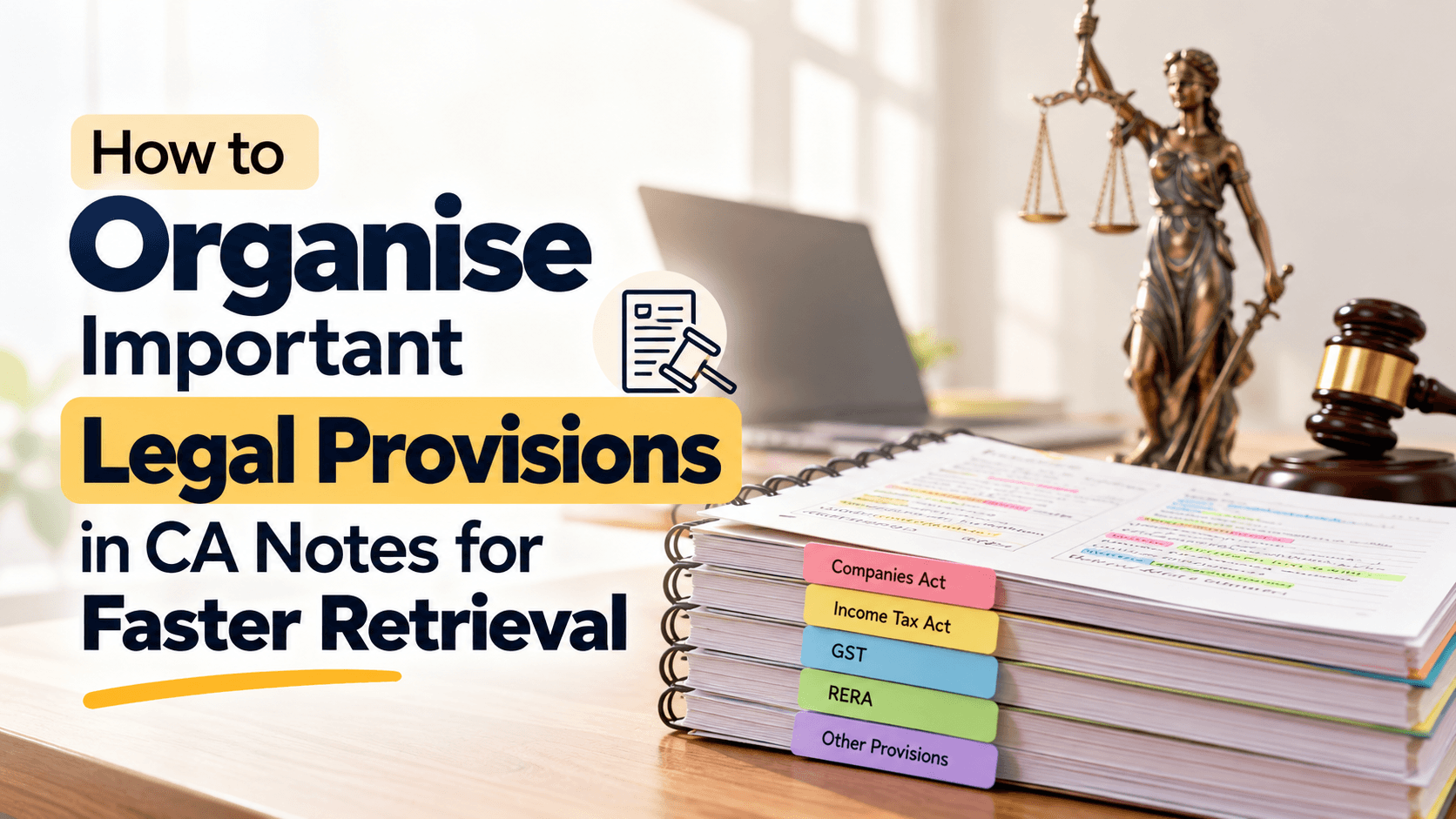
Start with the structure used in your syllabus and study material. Group provisions by Act, chapter and topic, then use consistent headings. Keep related provisions close together where their relationship matters, such as a main rule and a provision explaining an exception or procedure.
Use the section or rule number as a reference label, not as the only information on the page. Add a short topic name that tells you what the provision covers. This makes the notes easier to scan and helps retrieve the concept even if you cannot immediately recall the exact number.
Use a Rule-Condition-Exception-Effect Layout
For each important provision, create a repeatable structure: rule, conditions, exception or limitation, consequence, and relevant procedure or time period. Not every provision needs every field, but the same layout makes comparison easier and reduces the chance of overlooking a key element.
Preserve exact statutory language where technical wording is important. Add a plain-language explanation underneath it, clearly distinguished from the original wording. This helps you understand the provision without accidentally treating a simplified paraphrase as formal legal text.
Separate Main Rules From Exceptions
Exceptions are easy to overlook when they appear in a dense paragraph. Mark them clearly and place them close to the main rule. Explain when the exception applies and whether it changes the rule completely or only in a particular circumstance, using authorised study material as the reference.
Create a comparison prompt when two provisions appear similar. Ask what fact or condition makes one apply instead of the other. This is more useful than memorising two isolated paragraphs because questions may test whether you can distinguish related rules.
Build Comparison Tables for Similar Provisions
A comparison table can show differences in scope, conditions, authority, time limits, procedure and consequences. Keep each cell short and use precise wording. If a distinction is too complex for a table, write a short explanation below it and refer to the detailed notes.
Do not force every legal topic into a table. Tables work best when comparing a small number of clearly defined points. For provisions that depend on a sequence of steps, a numbered process or flow-style outline may be easier to revise.
Use Case-Based Examples to Understand Application
Where your course material provides illustrations or case-based questions, connect them to the relevant provision. Note the facts that trigger the rule, the legal point involved and the conclusion. This helps you understand how the provision operates instead of remembering it as an isolated statement.
Keep examples short and accurate. Clearly label them as illustrations, not statutory wording. During revision, cover the conclusion and ask which rule applies and why. If you cannot explain the link between facts and provision, revisit the reasoning.
Create Recall Prompts for Fast Revision
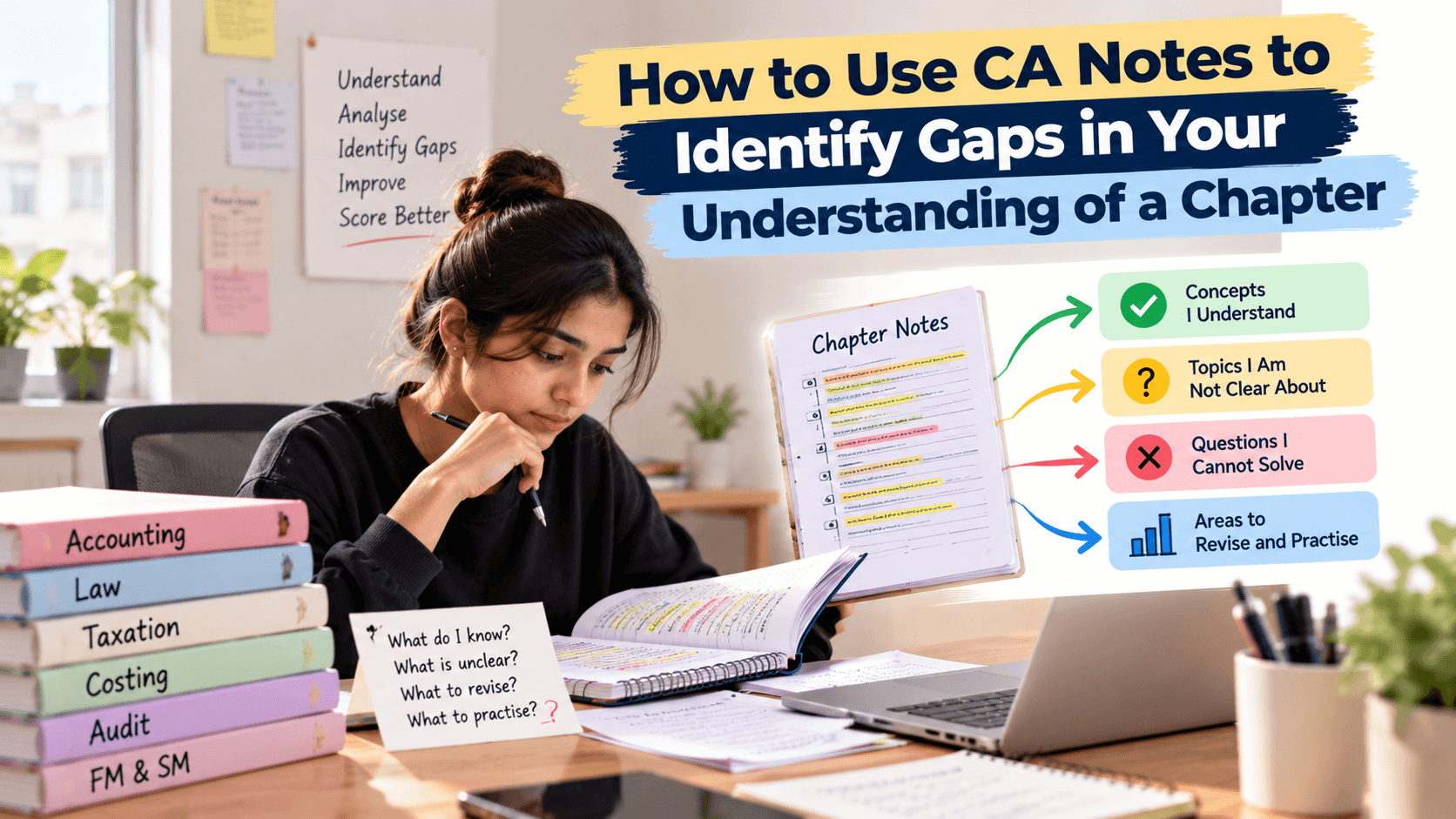
Turn each topic heading into questions such as: What is the main rule? What conditions must be met? Is there an exception? What is the consequence of non-compliance? What facts would make this provision relevant? These prompts test whether you can retrieve the structure without reading the page.
Use short-answer prompts for definitions and longer prompts for application. Review them with notes closed, then check exact wording and missed conditions. For important provisions, practise writing a structured answer rather than only saying the section number.
Keep Amendments and Time-Sensitive Details Clear
Legal study material can be updated, and the applicable law may depend on the syllabus and examination attempt. Mark the version or attempt for which your notes are prepared and verify amendments through official study material or authoritative updates relevant to your course.
Do not mix old and new wording without a clear note. If you update a provision, revise related summaries, comparison tables and recall questions as well. A concise amendment log can help identify what changed and which pages need checking before the exam.
Make Notes Easy to Scan; Studycaller Support
Use consistent headings, spacing, page references and limited visual markers. A small set of labels—rule, condition, exception and example—may be enough. Too many colours, abbreviations and symbols can slow you down if their meaning is not obvious.
Studycaller can be included in a wider CA law revision routine alongside organised notes, recall prompts and timed question practice. Use practice results to identify provisions you confuse or conditions you forget, then update the relevant note and test yourself again.
Quick Reference Table
| Element | What to record | Revision benefit |
|---|---|---|
| Rule | Main legal principle or requirement | Clarifies the central idea |
| Conditions | When the rule applies | Prevents incomplete recall |
| Exception | Limits or alternative treatment | Helps distinguish provisions |
| Effect | Result of applying or breaching the rule | Supports complete answers |
| Example or prompt | Short illustration or recall question | Tests application |
How Studycaller Can Support Your CA Preparation
Studycaller can be part of a structured CA preparation routine alongside your notes, revision schedule and timed practice. Use the method in this article to identify what you know, locate gaps and choose focused practice tasks. Review your mistakes regularly and rely on official ICAI resources for current syllabus, examination and administrative requirements.
Notes students love
Free notes from the Studycaller library, picked for this article.
Amendment Notes · CA Foundation Business Economics
Full economics handwritten notes by CA Parag Gupta sir
Heet Hingrajiya 209 68.6k
Detailed Notes · CA Foundation Business Economics
"Hi guys! Maine kuch naya try kiya Economics me — ek alag andaaz, ek alag soch... Chapter 1: Nature & Scope of Business Economics – Unit 1 I
مُحَمَّد 126 14.7k
Chart Book · CA Foundation Business Laws
Chpter 3 the sale of goods act Unit. 1 only. Full of story line Concept clarity and funny stories punch lines
مُحَمَّد 118 14.2k
Amendment Notes · CA Foundation Business Laws
Nia 1881 story line pdf Coverage total 11 Concept
مُحَمَّد 117 12.5k
Frequently asked questions
How should I organise legal provisions in CA notes?
Arrange them by Act, chapter and topic, then use a consistent layout for the rule, conditions, exceptions, consequences and procedure where relevant. Add clear headings and preserve technical wording from authorised material.
Should I memorise section numbers first?
Understand the provision before prioritising its number. Section references can be useful where required, but a number without the rule, conditions and application does not show complete understanding.
How can I remember exceptions in law subjects?
Place each exception beside the main rule, label when it applies and compare it with similar provisions. Create a recall question that asks for the rule and its exceptions together.
Are comparison tables useful for CA law notes?
Yes, when provisions have clear differences such as scope, conditions, procedure or consequences. Keep entries concise and accurate. For complex processes, a numbered outline may be clearer.
Should I write provisions in my own words?
A plain-language explanation can help you understand the provision, but keep formal statutory wording accurate where it matters. Clearly distinguish your summary from the original text.
How do I revise legal provisions quickly?
Use topic headings as prompts, cover the notes and recall the rule, conditions, exceptions and consequences. Check omissions, revisit difficult provisions and practise applying them to short scenarios.
How can I keep law notes updated?
Mark the syllabus or study-material version and verify amendments through official course material and authoritative updates. When a provision changes, update its summary, comparisons and recall prompts.
Should every provision have an example?
No. Add examples where they clarify application or distinguish similar rules. Keep them short and label them as illustrations. Use detailed notes for complex situations.
How do I know if my legal notes are too detailed?
If you cannot locate the rule or its conditions quickly, improve the layout. Keep a concise summary for retrieval and retain detailed explanations for difficult topics.
How can Studycaller support CA law revision?
Use Studycaller alongside organised provisions, recall questions and timed practice. Review which rules or conditions you miss, update the relevant notes and retest them.