
How to Create Cross-References Between Related Topics in CA Notes
Learn how to create useful cross-references in CA notes, connect related concepts across chapters, improve revision, and avoid repeating explanations with Studycaller.
In this article(15 sections)ShowHide
Good CA notes should make difficult topics easier to understand and revise, not create more work every time you study. how to Create Cross-References Between Related Topics in CA Notes is a practical part of building a dependable study system, especially when classes, self-study, and exam practice all generate material that needs to stay organised.
This guide explains a clear approach that students can adapt to their subject, CA level, and preparation stage. Studycaller is included as part of an exam-focused routine, while syllabus-specific requirements and amendments should always be checked against the relevant official material.
Why connected notes are easier to revise
CA subjects often contain ideas that support or qualify other ideas. A definition introduced in one chapter may appear in a later application, and a method learned in one area may help you understand a related question elsewhere. If every chapter is treated as a completely separate unit, you may remember individual pages but miss the relationships that make concepts easier to apply.
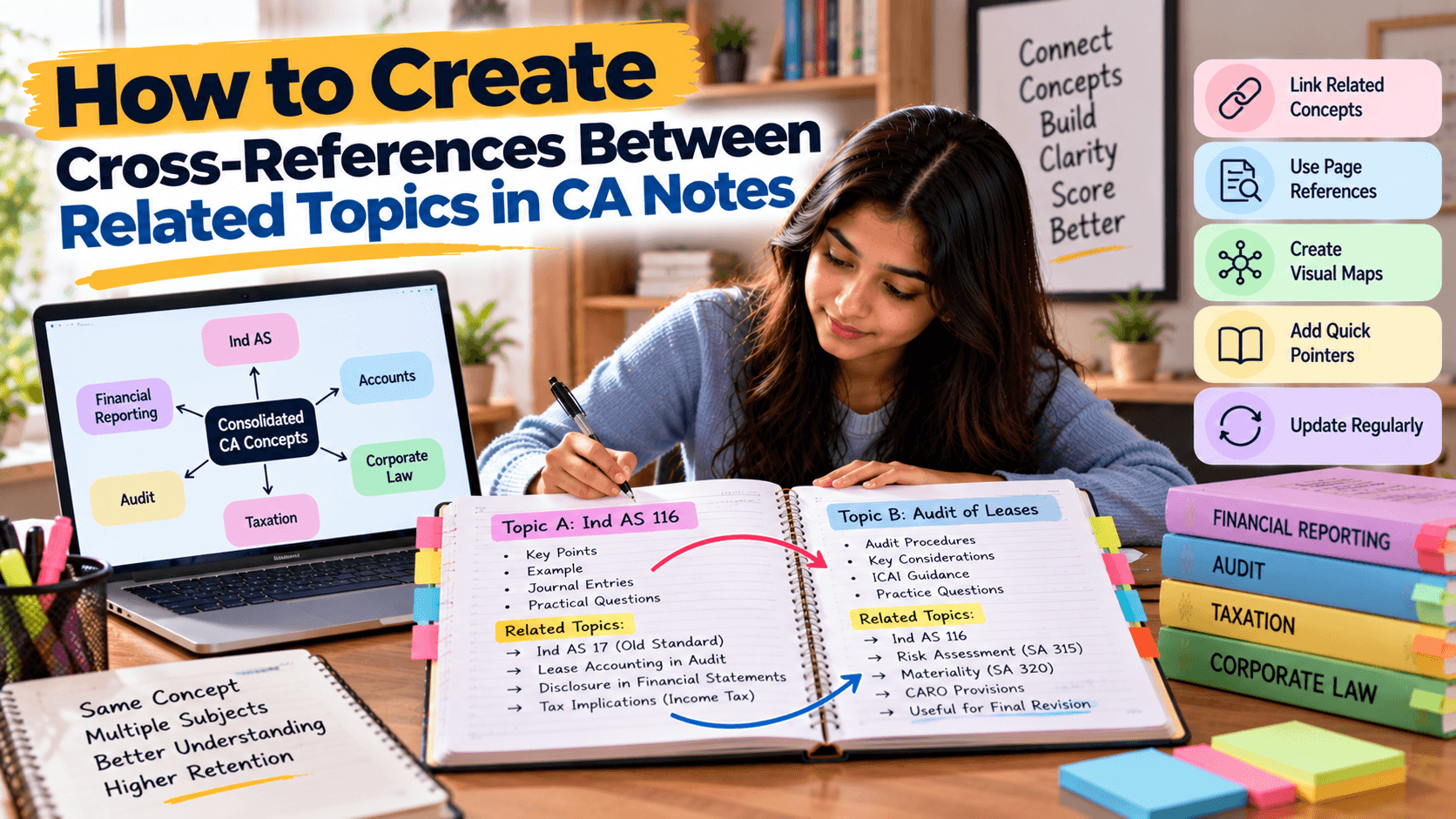
Cross-references create a path between related notes without copying the same explanation into several places. They help you find the full rule, compare similar concepts, and revise connected topics together. A good reference is precise and purposeful. It should save time, clarify a relationship, or prevent repeated content—not send you on a search through the entire notebook.
Identify relationships before adding links
Begin by reviewing chapter headings and subheadings. Look for repeated terms, concepts that rely on earlier definitions, exceptions that affect another topic, and methods that share a calculation or presentation step. Make a rough list of the connections you notice before adding references. This prevents random links that do not help you answer questions.
Connections can be direct or comparative. A direct reference points to a prerequisite or fuller explanation. A comparative reference helps you distinguish two concepts that are easy to confuse. A procedural reference connects a rule to the steps used in a question. Label the purpose clearly so you know why the link exists when you return during revision.
Examples of useful cross-references
| Current note | Reference text | Purpose |
|---|---|---|
| A rule | See Section 2.3 for the full condition | Find prerequisite |
| Similar concepts | Compare with Chapter 6, Section 1 | Avoid confusion |
| Worked question | Review Example 4 in the practice file | Reconnect rule and method |
| Updated topic | Check the chapter index for the latest location | Maintain accuracy |
Give every topic a stable identifier
Cross-references work best when chapter and section names remain consistent. Assign a chapter number and use clear headings, such as “Chapter 5 — Recognition” or “Section 5.2 — Conditions.” In digital notes, headings can become clickable links. In paper notes, use page numbers and section codes that can be updated when the notebook changes.
Avoid referencing a temporary page position if you regularly rearrange material. If the notes are printed or handwritten, leave space for page updates or use a small index. For digital documents, check links after renaming files or moving folders. A reference that points to an old location can be more frustrating than having no reference at all.
Write references that explain the connection
A useful cross-reference does more than say “see Chapter 3.” Add a few words explaining why the topic matters: “See Chapter 3 for the definition used in this adjustment” or “Compare with Section 6.1 to distinguish the two treatments.” The reader should understand the purpose before leaving the current page.
Keep the wording short. A long explanation inside the reference can recreate the duplication you are trying to avoid. If the relationship itself is important, record one sentence in the current note and direct the reader to the full treatment elsewhere. This gives enough context to make the link meaningful while keeping the main explanation in one place.
Build a topic map before making too many links
For a subject with many related chapters, create a simple topic map or index. Put the main concept in the centre and list prerequisite ideas, connected chapters, common comparisons, and practice areas around it. The map helps you see which links are important and which are incidental. It can also reveal topics that need a clearer explanation.
Do not attempt to link every term to every other term. Too many connections make notes difficult to navigate. Start with relationships that repeatedly appear in your study material or that you personally struggle to remember. Add new links when a lecture, question, or test demonstrates a useful connection. The map should grow from learning needs, not from a desire to make the notes look complex.
Use cross-references to compare similar concepts
Students sometimes confuse rules that sound similar but have different conditions, exceptions, or applications. Create a comparison note that lists the key difference and points to the detailed explanation of each concept. This helps you avoid copying both full explanations into every chapter where they appear.
Comparison references are particularly useful during revision because they encourage discrimination: you must decide which rule applies and why. Keep the distinction grounded in your approved study material and confirm it with a teacher if you are unsure. A short comparison cue is not a replacement for understanding the complete rule; it is a reminder to retrieve the right explanation.
Connect theory with practical questions
Cross-references should link concepts to application. When a question tests a rule from one chapter alongside a method from another, record the relevant chapter and the step where the connection matters. You might note that a calculation depends on a definition discussed earlier or that a presentation choice follows from a condition covered elsewhere.
After solving a question, ask whether a cross-reference would have helped you recognise the connection sooner. If yes, add one at the relevant note. Include the question number or source only when you can locate it reliably. Over time, these links can turn isolated worked examples into a connected learning system and help you recognise patterns in unfamiliar questions.
Keep references accurate as notes change
Cross-references can break when you renumber chapters, merge files, or rewrite a section. Check them whenever you make a major update. If a reference points to a page that no longer exists, update it immediately rather than trusting your memory to find the topic later. For digital notes, use links to headings or bookmarks where possible instead of hard-coded page numbers.
Maintain a short index of important relationships for each subject. During a weekly review, test a few references at random and confirm that they open the right section. If several links point to the same source, update them together when that source changes. This small maintenance habit keeps your notes dependable and prevents navigation problems from accumulating.
Use references during revision sessions
Instead of reading every chapter in sequence each time, choose a central topic and follow its most useful connections. Review the main concept, revisit the prerequisite, compare the related rule, and attempt a question that combines them. This method can help you practise retrieving knowledge across chapters rather than only within the order in which you learned it.
Keep the session focused. Follow a reference only when it answers a question or strengthens a connection you need. If you discover a new relationship, add it to the notes after the session rather than interrupting every few minutes to edit. This balance lets you learn actively while keeping the note system organised.
Review links using mock-test mistakes
Mock tests can reveal where your knowledge is disconnected. You may know a definition but fail to apply it in a later chapter, or you may use a familiar method without noticing a condition that changes the answer. When analysing mistakes, identify whether the problem was missing knowledge, weak recall, or failure to connect two ideas.
If a missing connection caused the error, add a cross-reference and write a brief explanation of the relationship. If the issue was that you did not know the rule at all, revise the full source instead of adding a link that cannot solve the gap. This distinction makes cross-references practical and prevents them from becoming a substitute for learning.
How Studycaller can support connected revision
Exam-focused practice helps students see how concepts work under timed conditions. After reviewing a question, note which chapters contributed to the answer and whether a cross-reference could help you revise that relationship. Keep the link concise and revisit it during a later mixed-topic session.
Studycaller can fit into a preparation routine that combines practice, error analysis, and targeted revision. Use test feedback to identify recurring gaps, then improve the relevant notes. The aim is not to build the largest network of links; it is to make important concepts easier to find, compare, and apply when solving CA questions.
Make the link useful during a real study session
Try each new cross-reference while studying, rather than assuming it will be useful later. Start from the current topic and follow the link to its destination. Confirm that the referenced section answers the question raised by the original note. If you have to search again or cannot tell why the two topics are connected, rewrite the reference to include a clearer destination and purpose.
During revision, use a small number of links to build a focused chain: prerequisite concept, main rule, relevant exception, and application in a question. Stop when the connection is understood. This keeps the process purposeful and prevents a single topic from sending you through every chapter. Over time, the best links will be the ones that help you retrieve information or make a more accurate decision.
Avoid building links that do not answer a question
Before adding a reference, ask what problem it solves. Does it point to a prerequisite, explain an exception, help distinguish similar rules, or connect theory with a practical method? If the answer is unclear, the link may not be necessary. A short note with three useful connections is often easier to revise than a page filled with dozens of broad references.
Review the references that you actually use while solving questions. Keep the ones that help you locate information or make a distinction, and rewrite the ones that send you to an unrelated or overly broad section. This keeps the network of notes purposeful. The aim is to make the next step in your reasoning easier to find, not to create a complete map of every possible relationship.
Conclusion
Cross-references help turn separate chapters into a connected set of notes. Link only meaningful relationships, make each reference precise, and review links when material changes. Use question practice to discover which connections matter most for understanding and application.
Notes students love
Free notes from the Studycaller library, picked for this article.
Amendment Notes · CA Foundation Business Economics
Full economics handwritten notes by CA Parag Gupta sir
Heet Hingrajiya 209 68.6k
Detailed Notes · CA Foundation Business Economics
"Hi guys! Maine kuch naya try kiya Economics me — ek alag andaaz, ek alag soch... Chapter 1: Nature & Scope of Business Economics – Unit 1 I
مُحَمَّد 126 14.7k
Chart Book · CA Foundation Business Laws
Chpter 3 the sale of goods act Unit. 1 only. Full of story line Concept clarity and funny stories punch lines
مُحَمَّد 118 14.2k
Amendment Notes · CA Foundation Business Laws
Nia 1881 story line pdf Coverage total 11 Concept
مُحَمَّد 117 12.5k
Frequently asked questions
What is a cross-reference in CA notes?
A cross-reference points from one note to a related explanation elsewhere. It helps connect concepts without copying the same full explanation into several chapters.
Why are cross-references useful?
They make related topics easier to find, compare, and revise. They also reduce duplicate content and help you understand how concepts work together in questions.
What should a good cross-reference say?
Include a precise chapter or section and a short reason for the link, such as “compare the conditions” or “see the full definition.”
Should I cross-reference every related term?
No. Prioritise connections that clarify prerequisites, exceptions, comparisons, or applications. Too many links can make notes difficult to navigate.
How do I create cross-references in handwritten notes?
Use stable chapter and section labels, then write the page number and purpose of the reference. Check the page number whenever you reorganise the notebook.
How do I create digital cross-references?
Use links to headings, bookmarks, or named sections where your application supports them. Test the links after renaming or moving files.
Can cross-references help with practical questions?
Yes. They can connect a rule to a calculation, condition, or presentation step used elsewhere. Add a link when question analysis shows that the connection matters.
How do I maintain references after updating notes?
Review links after renumbering, merging, or rewriting chapters. Check that each reference still points to the intended explanation.
What is the difference between a cross-reference and a summary?
A summary condenses information in one place. A cross-reference directs you to another location where the full explanation or related concept is available.
How can Studycaller support connected revision?
Use practice questions and error analysis to identify missing connections, then add precise references and revisit those links during mixed-topic revision.