Biggest Misconceptions About the CA Course Explained
Learn the biggest misconceptions about the CA course related to difficulty, career opportunities, salary, student life, intelligence, and professional growth in chartered accountancy.
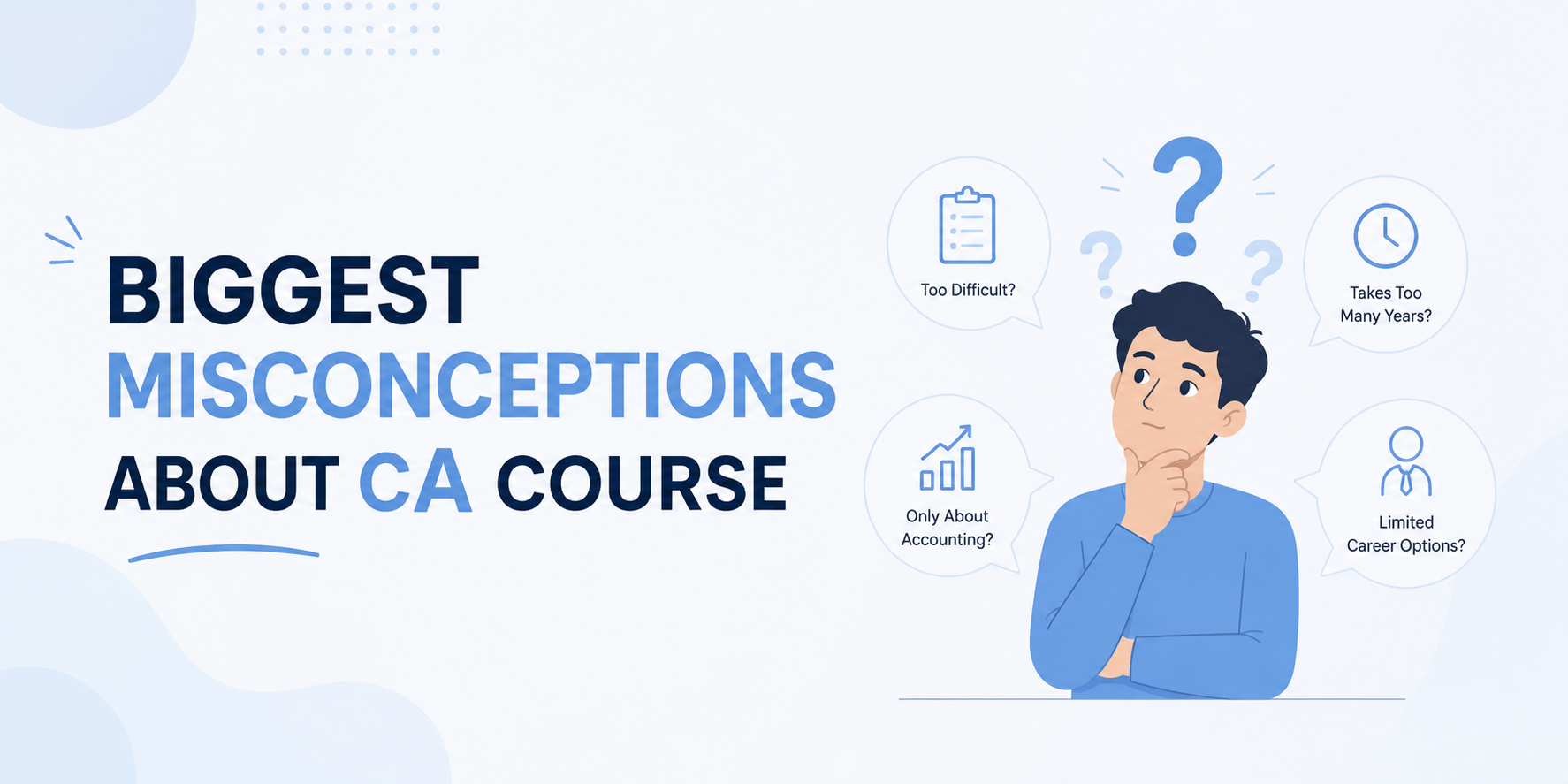
Table of Content
- Misconception That Only Toppers Can Become CAs
- Misconception That the CA Course Has No Student Life
- Misconception That Failing Once Means You Cannot Clear CA
- Misconception That CA Is Only About Accounting
- Misconception That CA Students Must Study 15–16 Hours Daily
- Misconception That CA Guarantees Instant High Salary
- Misconception That Articleship Is Only Cheap Labor
- Misconception That CA Students Cannot Pursue Other Skills
- Misconception That English Fluency Decides Success
- Misconception That CA Is Only for Commerce Students
- Misconception That Technology Will End CA Careers
- Misconception That Success Depends Only on Coaching
- Why Misconceptions Create Unnecessary Pressure
- Conclusion
The Chartered Accountancy course is considered one of the most respected professional courses in India. However, along with its popularity, many misconceptions have also developed around the CA journey. Students often hear exaggerated stories about difficulty level, student life, salaries, intelligence requirements, and career pressure before even understanding the actual reality of the course.
These misconceptions sometimes create unnecessary fear and confusion among students preparing for CA. Some students become overconfident because of unrealistic expectations, while others lose confidence because of negative assumptions about the profession.
Understanding the real picture of the CA course is extremely important because the journey depends more on consistency, discipline, adaptability, and smart preparation than popular myths circulating among students and society.
Misconception That Only Toppers Can Become CAs
One of the most common myths is that only school toppers or exceptionally intelligent students can clear CA exams. In reality, many successful chartered accountants were average students during school or college. The CA course mainly requires:
- Consistency
- Conceptual understanding
- Revision discipline
- Time management
- Patience during preparation
A strong academic background can help, but long-term discipline and regular practice usually matter more than school marks alone.
Many hardworking students clear CA exams successfully through steady preparation and persistence.
Misconception That the CA Course Has No Student Life
Many people believe CA students spend their entire lives only studying without enjoying anything. While CA preparation definitely requires discipline and sacrifices, students can still maintain balanced routines with:
- Family time
- Friendships
- Hobbies
- Small breaks and relaxation
The problem usually arises when students completely ignore balance and create unhealthy study routines. Successful preparation does not always mean studying every hour continuously without mental rest. Balanced students often perform better in the long run.
Misconception That Failing Once Means You Cannot Clear CA
The CA course is competitive and challenging, so failures can happen during preparation. However, many students wrongly assume that one failure means they are not capable of becoming chartered accountants. In reality:
- Multiple attempts are common
- Many successful CAs faced failures
- Improvement happens gradually
Failure often becomes part of the learning process in professional courses. Students who learn from mistakes and continue improving usually perform much better over time.
Misconception That CA Is Only About Accounting
Many students think chartered accountancy only involves accounting entries and calculations. In reality, the CA profession includes several areas, such as:
- Taxation
- Auditing
- Financial management
- Business consulting
- Compliance
- Strategic advisory
Modern chartered accountants often work in technology, finance consulting, investment analysis, startups, and multinational corporations. The profession is much broader than traditional accounting work.
Misconception That CA Students Must Study 15–16 Hours Daily
Social media and competitive environments often create unrealistic pressure regarding study hours. Many students believe they must study for extremely long hours every day to clear CA exams. In reality, the quality of the study usually matters more than the extreme study duration.
Effective preparation depends on:
- Focused learning
- Proper revision
- Mock test practice
- Concept clarity
- Consistency
Unhealthy study schedules may increase stress and reduce productivity instead of improving performance.
Misconception That CA Guarantees Instant High Salary
Many students enter the CA course expecting an immediate high salary and luxurious career growth after qualification. Although chartered accountancy offers strong career opportunities, professional growth still depends on:
- Skills
- Experience
- Communication ability
- Industry exposure
- Continuous learning
Career growth usually happens gradually through professional development and practical experience. Realistic expectations help students stay mentally balanced during the journey.
Misconception That Articleship Is Only Cheap Labor
Some students think articleship has no learning value and only involves excessive workload. While articleship experiences may differ across firms, practical training often helps students learn:
- Real business processes
- Taxation work
- Audit procedures
- Client communication
- Professional discipline
Articleship provides practical exposure that classroom learning alone cannot fully offer.
Students who use articleship smartly often gain valuable professional confidence.
Misconception That CA Students Cannot Pursue Other Skills
Another common myth is that CA students should focus only on studies and avoid learning anything else. However, modern businesses value professionals who also understand:
- Technology
- Communication
- Data analysis
- Leadership
- Financial strategy
Students who improve additional skills often adapt better to changing industries and corporate environments. The finance profession today is becoming increasingly multidimensional.
Misconception That English Fluency Decides Success
Many students from Hindi-medium or regional-language backgrounds fear the CA course because they think strong English fluency is mandatory for success. In reality, conceptual understanding matters much more than accent or advanced vocabulary. Students can gradually improve communication skills over time through:
- Reading practice
- Writing answers regularly
- Professional interactions
Many successful CAs improved communication gradually during articleship and professional exposure.
Misconception That CA Is Only for Commerce Students
Although a commerce background helps in understanding accounting and finance concepts faster, students from other backgrounds can also pursue CA after fulfilling the eligibility criteria.
Several students from science and other educational streams have completed the CA course through dedicated preparation and conceptual learning. Consistent effort often matters more than background alone.
Misconception That Technology Will End CA Careers
With AI and automation growing rapidly, some students believe the CA profession may disappear completely. Technology is definitely changing accounting work, but businesses still need professionals for:
- Strategic decisions
- Financial advisory
- Compliance interpretation
- Ethical judgment
- Risk management
Modern CAs may work differently in the future, but professional finance expertise is still highly valuable. Technology is transforming the profession rather than eliminating it.
Misconception That Success Depends Only on Coaching
Many students believe expensive coaching alone guarantees success in CA exams. Coaching can support preparation, but success mainly depends on:
- Self-study
- Revision consistency
- Writing practice
- Concept understanding
- Discipline
Several students clear CA exams through self-study or limited resources with strong consistency and proper planning. Personal effort remains the most important factor.
Why Misconceptions Create Unnecessary Pressure
Misconceptions often create:
- Fear before starting preparation
- Unrealistic expectations
- Low confidence
- Unhealthy comparison with others
Students who understand the practical reality of the CA journey usually remain more emotionally balanced and focused during preparation. Realistic understanding improves both confidence and preparation quality.
Conclusion
Many misconceptions about the CA course create unnecessary fear, confusion, and unrealistic expectations among students. In reality, success in chartered accountancy depends more on consistency, discipline, adaptability, and practical learning than popular myths about intelligence, study hours, or background. Students who focus on steady improvement and maintain balanced expectations often handle the CA journey more confidently and successfully.

FAQs
What are the biggest misconceptions about the CA course?
Common misconceptions include beliefs that only toppers can clear CA, students must study extremely long hours daily, failures mean permanent weakness, and the profession only involves accounting work.
Is the CA course only for highly intelligent students?
No, the CA course mainly requires consistency, conceptual understanding, revision discipline, and patience. Many average students have successfully become chartered accountants through dedicated preparation and regular practice.
Do CA students need to study 15 hours daily?
No, quality study matters more than extreme study hours. Focused preparation, proper revision, conceptual clarity, and consistency are usually more important than unrealistic daily study schedules.
Is articleship only about workload and pressure?
Articleship may involve workload, but it also provides practical exposure in taxation, auditing, client handling, compliance work, and professional communication that helps students build industry understanding and confidence.
Does one failure mean a student cannot clear CA exams?
No, many successful chartered accountants faced failures during preparation. Improvement, consistency, and learning from mistakes often matter more than attempt count in professional courses.
Is chartered accountancy only about accounting?
No, the CA profession also includes taxation, auditing, financial management, consulting, compliance, strategic advisory, and business analysis roles across multiple industries and organizations.
Can students from non-commerce backgrounds pursue CA?
Yes, students from other educational backgrounds can pursue CA after meeting eligibility requirements. Consistent effort and conceptual understanding are more important than academic background alone.
Will AI and automation end CA careers in the future?
AI may automate repetitive accounting work, but chartered accountants are still needed for strategic planning, advisory services, compliance interpretation, and professional decision-making responsibilities.
Is strong English fluency necessary to become a CA?
No, conceptual clarity matters more than advanced English fluency. Communication skills can improve gradually through practice, reading, writing, and professional exposure during articleship and career growth.
Does coaching guarantee success in CA exams?
No, coaching can support preparation, but success mainly depends on self-study, revision consistency, answer-writing practice, discipline, and conceptual understanding developed through regular effort.