
CS Executive doubt
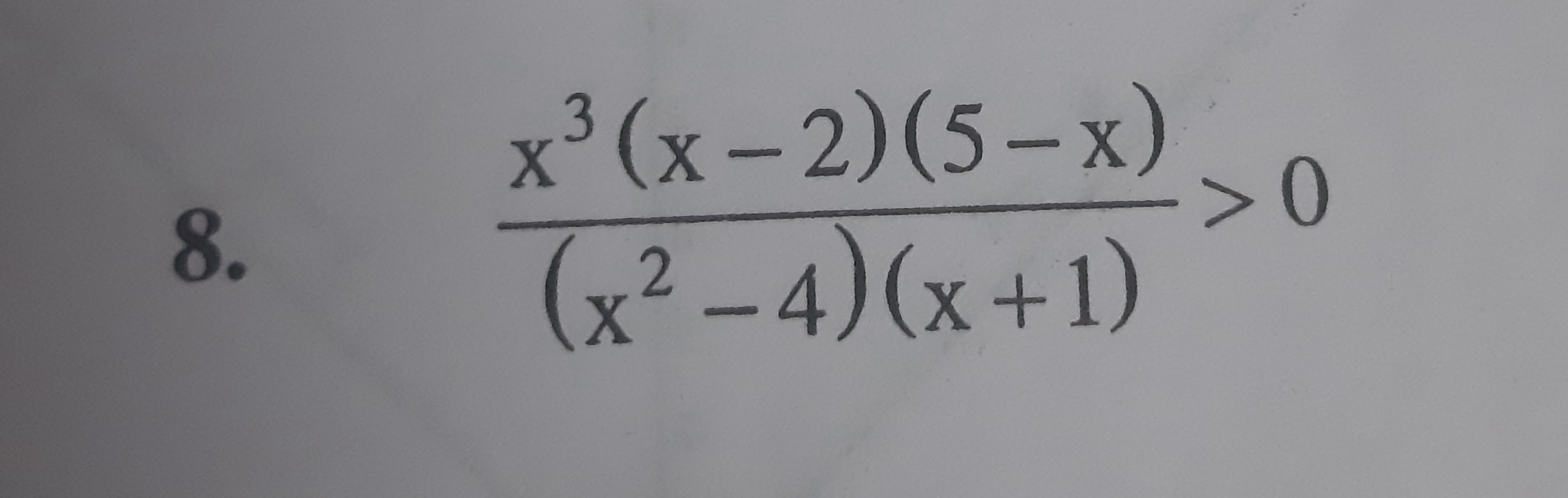
Pls solve the inequalities using wavy curve method
Asked by Ishu27 May 20241398 views
CS Executive doubt
Asked by Ishu27 May 20241398 views
Ishu · 27 May 2024
Don't like your answer
Anmol · 27 May 2024
Solution:[ x \in (-2, -1) \cup (0, 2) \cup (2, 5) ]So, the solution to the inequality is: [ (-2, -1) \cup (0, 2) \cup (2, 5) ]
Anmol · 27 May 2024
To solve the inequality using the wavy curve method, we follow these steps:Factor the expression completely.Find the critical points by setting each factor to zero.Determine the sign of each factor in the intervals formed by the critical points.Combine the signs to find where the entire expression is positive.Let's go through these steps for the given inequality:[ \frac{x^3 (x - 2)(5 - x)}{(x^2 - 4)(x + 1)} > 0 ]Step 1: Factor the ExpressionThe expression is already factored, but let's simplify the denominator: [ x^2 - 4 = (x - 2)(x + 2) ]So the inequality becomes: [ \frac{x^3 (x - 2)(5 - x)}{(x - 2)(x + 2)(x + 1)} > 0 ]Step 2: Find the Critical PointsThe critical points are the values of (x) where any factor equals zero: [ x^3 = 0 \implies x = 0 ] [ x - 2 = 0 \implies x = 2 ] [ 5 - x = 0 \implies x = 5 ] [ x + 2 = 0 \implies x = -2 ] [ x + 1 = 0 \implies x = -1 ]So the critical points are ( x = -2, -1, 0, 2, 5 ).Step 3: Determine the Sign in Each IntervalWe need to test the sign of the expression in the intervals formed by these critical points: ((-∞, -2), (-2, -1), (-1, 0), (0, 2), (2, 5), (5, ∞)).Consider the expression: [ \frac{x^3 (x - 2)(5 - x)}{(x - 2)(x + 2)(x + 1)} ]We can cancel the common factor ( (x - 2) ) from the numerator and the denominator, as long as we note that ( x eq 2 ): [ \frac{x^3 (5 - x)}{(x + 2)(x + 1)} ]Now, we test the sign in each interval:For ( x < -2 ): Choose ( x = -3 ) [ \frac{(-3)^3 (5 + 3)}{(-3 + 2)(-3 + 1)} = \frac{-27 \cdot 8}{-1 \cdot -2} = \frac{-216}{2} < 0 ]For ( -2 < x < -1 ): Choose ( x = -1.5 ) [ \frac{(-1.5)^3 (5 + 1.5)}{(-1.5 + 2)(-1.5 + 1)} = \frac{-(3.375) \cdot 6.5}{0.5 \cdot -0.5} = \frac{-21.9375}{-0.25} > 0 ]For ( -1 < x < 0 ): Choose ( x = -0.5 ) [ \frac{(-0.5)^3 (5 + 0.5)}{(-0.5 + 2)(-0.5 + 1)} = \frac{-0.125 \cdot 5.5}{1.5 \cdot 0.5} = \frac{-0.6875}{0.75} < 0 ]For ( 0 < x < 2 ): Choose ( x = 1 ) [ \frac{1^3 (5 - 1)}{(1 + 2)(1 + 1)} = \frac{1 \cdot 4}{3 \cdot 2} = \frac{4}{6} > 0 ]For ( 2 < x < 5 ): Choose ( x = 3 ) [ \frac{3^3 (5 - 3)}{(3 + 2)(3 + 1)} = \frac{27 \cdot 2}{5 \cdot 4} = \frac{54}{20} > 0 ]For ( x > 5 ): Choose ( x = 6 ) [ \frac{6^3 (5 - 6)}{(6 + 2)(6 + 1)} = \frac{216 \cdot (-1)}{8 \cdot 7} = \frac{-216}{56} < 0 ]Step 4: Combine the SignsBased on the test points, we summarize the signs in each interval:((-∞, -2)): Negative((-2, -1)): Positive((-1, 0)): Negative((0, 2)): Positive((2, 5)): Positive((5, ∞)): NegativeStep 5: Include/Exclude Critical PointsThe inequality ( \frac{x^3 (x - 2)(5 - x)}{(x + 2)(x + 1)} > 0 ) is strictly greater than 0, so we exclude the points where the expression is zero or undefined (i.e., (x = -2, -1, 0, 2, 5)).Solution:[ x \in (-2, -1) \cup (0, 2) \cup (2, 5) ]So, the solution to the inequality is: [ (-2, -1) \cup (0, 2) \cup (2, 5) ]
Free app · 5 lakh+ learners
Read full notes, ask doubts, follow toppers and track your study hours — free on Android and iPhone.